
The Structural Problem at the Growth Stage
A profitable, growing business has just signed a letter of intent to acquire a bolt-on target. The combined enterprise has a defensible EBITDA base, a clear strategic rationale, and a management team capable of executing the integration. The problem is the gap between what senior lenders will provide and what the total transaction requires.
Senior secured lenders — banks and direct lenders operating at the top of the capital stack — will typically advance 3.0x to 4.0x trailing EBITDA against a cash-flowing acquisition target. If the target is being acquired at a 7.0x or 8.0x EBITDA multiple, which is common in the current private market, the arithmetic leaves a meaningful hole. Equity can fill that hole, but at a cost: dilution, loss of control, and the compression of returns on the existing equity base.
This is the structural problem that mezzanine financing was designed to solve. It is not a fallback. It is a deliberate tool — one that belongs in every growth-stage operator’s capital structure literacy. Understanding when to use it, how to price it, and how to negotiate its terms is the difference between a deal that closes on acceptable terms and one that either fails or over-dilutes the existing ownership.
The Capital Stack in a Growth-Stage Acquisition: Layer by Layer
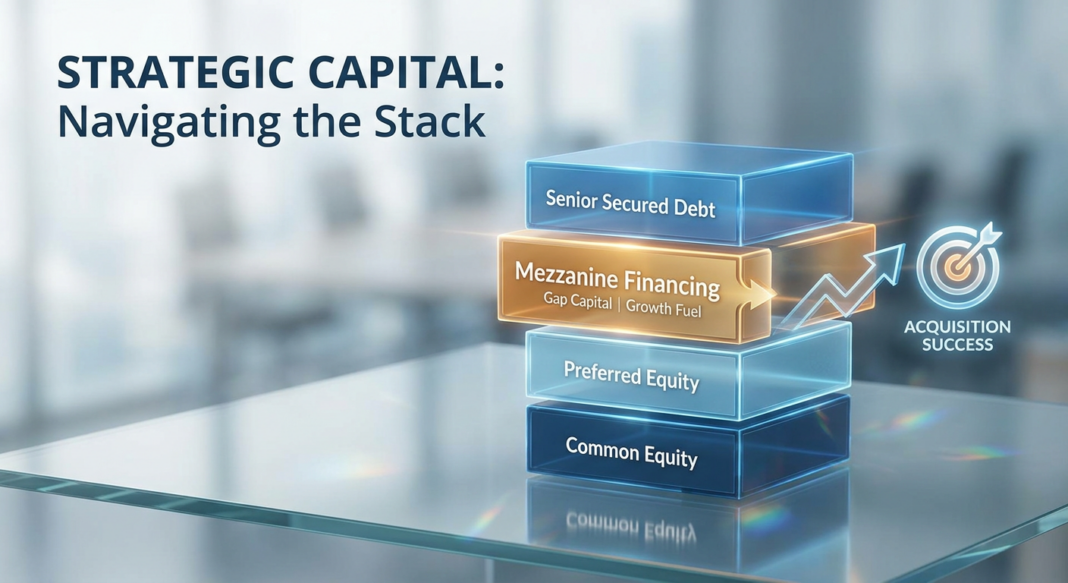
Before mapping the mezzanine layer specifically, it is worth anchoring the full stack. A growth-stage acquisition typically comprises three to four distinct capital layers, each carrying a different cost, a different set of structural expectations, and a different risk tolerance. From most senior to most junior:
- Senior secured debt sits at the top of the priority waterfall. It carries the lowest cost — typically SOFR plus 300–500 basis points in the current market for middle-market credits — and is sized against hard asset coverage or a conservative multiple of EBITDA. It amortizes, it has maintenance covenants, and it matures in five to seven years. It is the cheapest capital available and should be fully deployed before any junior layer is considered.
- Mezzanine or subordinated debt is the gap capital layer. As documented in Bond Capital’s acquisition financing framework, all-in pricing for this layer typically ranges from 13% to 18%, structured as a blended cash-pay coupon plus a PIK (payment-in-kind) component, plus warrant coverage of 1% to 5% of fully diluted equity. It is subordinated to all senior lenders but senior to every equity instrument. Covenant packages are negotiated — some mezzanine providers accept incurrence-only covenants; others require maintenance tests with defined EBITDA thresholds.
- Preferred equity or seller notes can sit between the mezzanine and common equity layers. Seller notes in particular are a flexible tool: they defer cash outflow, signal seller confidence in the business, and reduce the total third-party financing required at close. Preferred equity carries no scheduled amortization but typically includes a dividend rate and liquidation preference that must be cleared before common equity participates.
- Common equity is the most expensive layer in dilution terms. It is sized as the residual once debt capacity and any seller participation have been fully deployed. Minimizing equity contribution — without over-levering the business — is the central structuring objective in any acquisition financing. This is where the mezzanine layer creates its core value: it allows sponsors and operators to substitute structured debt for equity, preserving ownership while still closing the gap.
A Worked Example: The $15M Mezzanine Tranche
Consider a growth-stage acquisition with the following parameters. The target is acquired for $15M — roughly a 7.5x multiple on $2M of EBITDA. Senior lenders are willing to advance $7M, or 3.5x EBITDA. The acquiring company’s management team has $3M in equity to contribute. That leaves a $5M gap that neither the senior facility nor management equity can close.
A mezzanine provider steps in with a $5M subordinated note structured as follows: a 10% cash-pay coupon, a 4% PIK component activatable at the borrower’s election in years one and two, and warrant coverage of 3% of fully diluted equity. The all-in cost, assuming the PIK toggle is exercised in year one and the warrants are priced at close, is approximately 16% — well within the 13% to 18% market range cited by Bond Capital’s acquisition financing framework. The note matures in six years, with no scheduled principal amortization until year four. Covenants are incurrence-based, with a single maintenance test: a minimum liquidity threshold of $500K in unrestricted cash.
The result: the deal closes. Management retains a majority equity position. The senior lender is protected by its priority claim. The mezzanine provider earns a structured return with an equity participation kicker. Each layer is compensated in proportion to its risk.
Running the Gap Capital Process: Four Execution Steps
Understanding the structure is necessary but not sufficient. Execution requires a disciplined process. Bond Capital’s gap capital playbook, as applied to mezzanine financing in acquisition contexts, organizes the process into four sequential steps.
Step 1: Quantify the gap precisely. Before approaching any capital provider, build a sources-and-uses schedule that maps every dollar from origination to closing. Senior facility proceeds, management equity, seller notes, and any working capital adjustments must all be modeled explicitly. The residual is the mezzanine need. Providers will not quote against a narrative — they require a schedule.
Step 2: Prepare three documents. A use-of-proceeds memo mapping each capital source to its specific application in the transaction. A three-year integrated financial model showing revenue, EBITDA, debt service, and free cash flow with sensitivity tables on two variables: revenue growth and EBITDA margin compression. And a management presentation covering strategic rationale, competitive position, customer concentration, and exit pathway. Mezzanine providers underwrite for five to seven year hold periods and need to underwrite the eventual refinancing or sale, not just the entry.
Step 3: Run a structured process. Approach four to six mezzanine providers simultaneously with a defined response window — typically ten to fifteen business days. Require each provider to specify pricing (cash coupon and PIK split), warrant coverage percentage, covenant structure (maintenance vs. incurrence), amortization schedule, and any change-of-control or prepayment provisions.
Step 4: Evaluate on total cost of constraint, not coupon. A 14% all-in mezzanine facility with 3% warrant coverage and quarterly maintenance covenants can be structurally more constraining than a 16% preferred equity instrument with no covenants and no amortization. The correct comparison metric is total cost of constraint — cash coupon, PIK accrual, dilution from warrants, and operational restrictions imposed by covenant packages — evaluated together, not in isolation.
Five Negotiation Points That Move the Most Value
Once terms are received, negotiation is not about price alone. The following five structural points typically generate more value than coupon reduction.
- PIK toggle flexibility. Negotiate the right — not the obligation — to PIK interest in years one through two. This preserves integration-period cash without triggering a default event. A mandatory cash-pay coupon on a freshly acquired, integrating business is a liquidity risk that skilled operators eliminate at the term sheet stage.
- Warrant coverage cap and exercise price. Warrant coverage is a cost that compounds over time if the business performs. Negotiate a hard cap on the warrant percentage and push for an exercise price tied to the entry valuation, not a discount to it. Resist any ratchet mechanism that increases coverage if financial performance falls below projections.
- Incurrence vs. maintenance covenants. Incurrence covenants only test when the borrower takes a specific action — issuing new debt, making an acquisition, paying a dividend. Maintenance covenants test on a rolling basis regardless of borrower action. The former provides significantly more operational flexibility. Most mezzanine providers will accept incurrence-based packages for credits with strong cash generation and manageable leverage.
- Prepayment windows. Negotiate a defined prepayment right beginning in year two or three, ideally with a declining premium structure. This preserves the option to refinance the mezzanine tranche into cheaper senior debt as the business deleverages and credit metrics improve.
- Change-of-control provisions. Mezzanine documents frequently include put rights triggered by ownership changes. In a growth-stage business where future equity events — secondary sales, co-investment rounds — are likely, negotiate narrow and precisely defined change-of-control triggers that do not inadvertently accelerate the mezzanine obligation on a partial ownership transfer.
Key Takeaways
- Mezzanine financing exists to close the gap between senior debt capacity and total acquisition cost — it is a structural tool, not a financing option of last resort.
- All-in mezzanine pricing in the current middle market ranges from 13% to 18%, structured as a blend of cash coupon, PIK, and warrant coverage of 1% to 5% of fully diluted equity.
- Evaluate competing mezzanine proposals on total cost of constraint — coupon, PIK accrual, warrant dilution, and covenant restrictions — not on headline rate alone.
- Running a structured, simultaneous process across four to six providers with a defined response window generates competitive tension and better structural outcomes than bilateral negotiation.
- The five highest-value negotiation points are PIK toggle flexibility, warrant coverage cap, incurrence vs. maintenance covenant structure, prepayment windows, and change-of-control trigger definition.


