
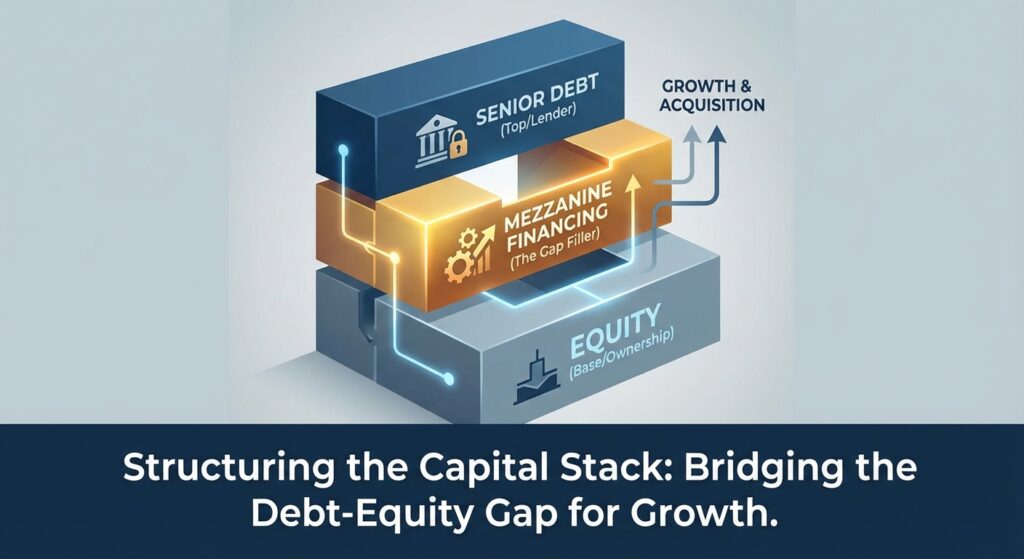
The Acquisition Gap: Why Growth-Stage Companies Run Out of Stack Before They Run Out of Deal
A founder-led software company with $18M in ARR wants to acquire a complementary business at a $35M purchase price. Its senior lender will advance 3.0x EBITDA — roughly $9M. The sponsor or owner doesn’t want to issue equity at a depressed implied valuation. That leaves a $26M hole between senior debt capacity and the deal price. This is the classic gap capital problem, and it defines the central financing challenge for growth-stage companies pursuing acquisitions, recapitalizations, or accelerated expansion.
The capital stack, as defined by repayment priority, runs from senior secured debt at the top (lowest cost, first lien, tightest covenants) down through subordinated debt, preferred equity, and common equity at the bottom (highest cost, no guaranteed return, maximum upside). Mezzanine debt occupies the critical middle layer — subordinated in repayment priority to senior debt but senior to equity — and it is precisely this layer that fills acquisition gaps when senior capacity is exhausted and equity dilution is unacceptable.
Understanding how to architect, price, and negotiate this layer is one of the most consequential skills in private company finance. As corporatefinanceinstitute.com notes, subordinated debt carries higher risk than senior positions and therefore demands higher returns to compensate — making structure design and cost management central to the borrower’s job.
The Capital Stack in Context: Mapping the Cost Spectrum
Before structuring the gap, operators must understand the full cost-of-capital spectrum they are navigating:
- Senior Bank Debt (3.0x–4.5x EBITDA): Lowest all-in cost (typically SOFR + 200–350 bps for investment-grade proximate credits). Maintenance covenants, borrowing base limits, and cross-default provisions. First lien on all assets.
- Unitranche / Private Credit (4.0x–6.0x EBITDA): Single-tranche blended rate, currently pricing at SOFR + 500–650 bps in the middle market. Covenant-lite or single maintenance covenant. Faster execution than syndicated structures.
- Mezzanine Debt (subordinated, 6.0x–7.5x EBITDA total leverage): All-in returns targeted at 13%–18% IRR, delivered through a combination of cash-pay coupon (typically 8%–11%), PIK interest (2%–4%), and an equity kicker (warrants or co-invest rights covering 1%–5% of equity value).
- Preferred Equity: No stated maturity, dividend accrual (cumulative or non-cumulative), conversion or redemption rights. Higher cost than mezz in most structures; used when debt service capacity is constrained.
- Common Equity / Sponsor Co-Invest: Highest cost of capital. No guaranteed return. Full dilution to existing holders.
As capitalxo.com observes, each layer of the stack exists because it serves a distinct risk-return appetite — and a well-architected stack matches each layer to the appropriate use-of-proceeds and cash flow profile of the business.
Mezzanine Structure Breakdown: The Mechanics
For the acquisition scenario above — $35M deal, $9M senior debt, $26M gap — a realistic mezzanine structure might look like this:
Illustrative Term Sheet Elements: $35M Software Acquisition
| Element | Senior Tranche | Mezzanine Tranche |
|---|---|---|
| Amount | $9M | $16M |
| Equity (Owner Rollover) | — | $10M |
| Cash-Pay Coupon | SOFR + 300 bps | 9.5% per annum |
| PIK Toggle | None | 3.0% (Year 1–2 option) |
| Equity Kicker | None | Warrants: 3% of fully diluted equity |
| Maturity | 5 years | 6 years (1-year tail) |
| Call Protection | 6-month soft call | NC2 / 103 / 101 |
| Covenants | Total Leverage ≤ 4.5x; DSCR ≥ 1.20x | Incurrence-based; springing cash sweep |
The PIK toggle is the critical liquidity feature: in Years 1–2, when integration costs suppress free cash flow, the borrower may elect to accrue the mezzanine coupon rather than pay it in cash, preserving working capital. The accrued amount compounds and is repaid at maturity or upon a liquidity event. Warrant coverage gives the mezz lender equity participation if the combined business performs, bringing their blended IRR toward the 15%–17% range even if the cash coupon alone doesn’t get there.
Mezzanine vs. Alternatives: When Each Structure Wins
Mezzanine vs. Unitranche: A unitranche collapses the senior and subordinated layers into a single instrument, simplifying intercreditor dynamics. For deals at 5.0x–6.0x total leverage, unitranche is often faster and only marginally more expensive than a bifurcated structure. However, unitranche lenders typically cap total leverage at 6.0x; mezzanine behind a senior facility can push total leverage to 7.0x–7.5x in sponsor-backed deals, which is why it remains essential for higher-leverage acquisitions.
Mezzanine vs. Preferred Equity: Preferred equity has no scheduled amortization and doesn’t trigger default if unpaid — a feature that matters when cash flow visibility is uncertain. The trade-off is cost: preferred equity typically demands 15%–20%+ returns versus 13%–18% for mezz, and it may carry more governance rights (board seats, protective provisions). If EBITDA conversion is high and the business can service cash-pay debt, mezzanine is generally cheaper and preserves more control.
Mezzanine vs. Equity Issuance: Issuing equity avoids all debt service but dilutes existing holders and resets ownership economics permanently. If the business is on a trajectory toward a liquidity event in 3–5 years at a premium to current implied valuation, debt financing preserves the upside for existing equity. The cost-of-dilution calculation — not just the coupon — is what drives the mezzanine vs. equity decision.
The Gap Capital Playbook: Quantify, Prepare, Run, Negotiate
Step 1: Quantify the Gap Precisely
Build a sources-and-uses table. Senior debt capacity is typically a function of the lender’s leverage multiple applied to pro forma EBITDA (post-synergies, with appropriate haircut). The gap is total purchase price plus transaction costs minus senior debt minus available equity. That number — not a rough estimate — is what you take to market.
Step 2: Prepare the Mezz Package
Mezzanine lenders underwrite on a fundamentally different basis than senior lenders. They are underwriting enterprise value and equity cushion, not just asset coverage. Your materials must include: (a) a detailed 5-year integrated financial model with downside sensitivities; (b) a clear articulation of the equity cushion below the mezz position; (c) management’s track record operating through cycles; and (d) a defined exit or refinancing path within the instrument’s maturity window. As swingbridgellc.com notes, subordinated capital providers face a wider range of outcomes than senior lenders and must be convinced the upside scenario is credible and the downside scenario is survivable.
Step 3: Run a Targeted Process
The mezzanine market is relationship-driven and relatively concentrated. For middle-market deals ($10M–$50M mezz tranche), target 8–12 dedicated mezz funds and private credit platforms with demonstrated appetite in your sector. Provide a teaser, then a full CIM. Parallel-path senior and mezz discussions — don’t close senior terms before you understand mezz pricing, because senior covenants directly affect what mezz providers will accept.
Step 4: Negotiate the Structure
The highest-leverage negotiation points for borrowers are: (1) PIK optionality — push for a full toggle rather than mandatory PIK, preserving flexibility; (2) warrant coverage — negotiate the strike price, exercise window, and put/call mechanics carefully, as warrant dilution compounds at exit; (3) call protection — a standard NC2 / 103 / 101 schedule is market, but if you anticipate a refinancing in Year 2–3, negotiate a make-whole cap rather than an open-ended make-whole; and (4) covenant headroom — incurrence-based covenants on the mezzanine tranche are strongly preferable to maintenance-based, as they only trigger on affirmative actions (additional debt, restricted payments) rather than quarterly financial tests.
Key Takeaways
- 🏗️ The capital stack is architectural: Each layer — senior, mezz, preferred, equity — exists to match a specific risk-return appetite and cash flow profile. Mismatching layers to uses-of-proceeds creates fragility.
- 📊 Mezzanine fills the acquisition gap: When senior leverage capacity is exhausted and equity dilution is unacceptable, subordinated debt with PIK optionality and equity kickers is the purpose-built solution — but it demands a credible equity cushion and exit path.
- 🔄 PIK toggles are cash flow insurance, not a free lunch: Electing PIK accrual preserves near-term liquidity but increases the terminal repayment obligation. Model the compounding impact across multiple PIK election periods before signing.
- ⚖️ The real equity dilution question is cost-of-dilution, not coupon: Paying 13%–15% all-in for mezzanine is cheaper than issuing equity at a low implied valuation if the business exits at a significant premium in 4–5 years. Run the waterfall both ways.
- 📋 Incurrence covenants are non-negotiable on the mezz tranche: Maintenance covenants on subordinated debt create a hair-trigger default risk during integration. Push hard for incurrence-only packages with generous restricted payment baskets.


