
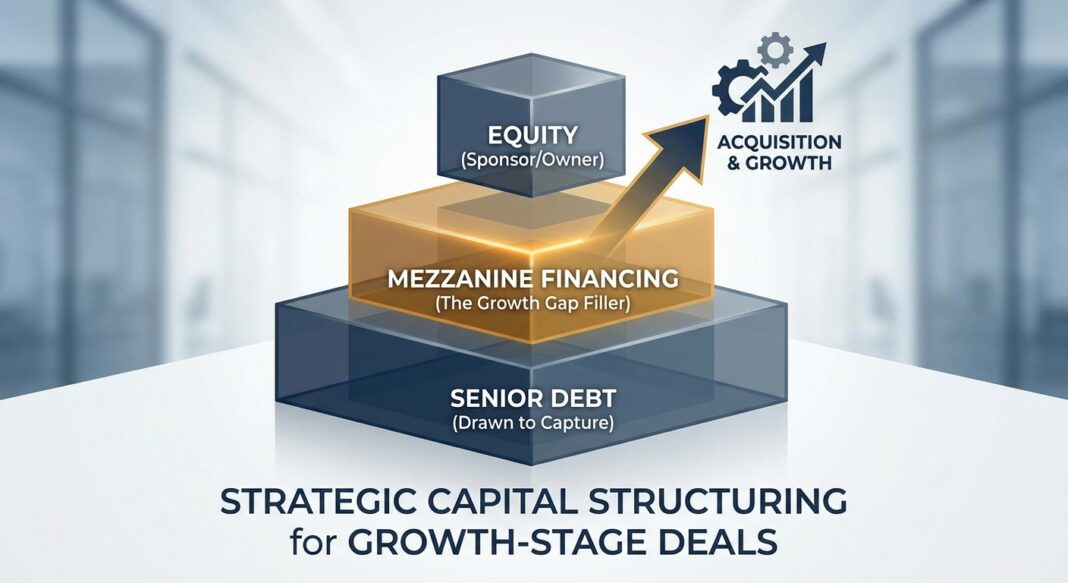
The Gap That Mezz Was Built to Fill
A growth-stage company — say, a $40M revenue business services platform with $8M in EBITDA — has identified an add-on acquisition priced at $30M. The company’s senior lender, a regional bank, will stretch to 3.0x EBITDA in a term loan, delivering roughly $24M of debt capacity. The equity sponsor or founding owner isn’t willing to write a check for the remaining $6M to $10M gap, particularly when doing so would either dilute the cap table materially or drain the business of working capital reserves.
This is precisely the scenario mezzanine financing was engineered to solve. Sitting between senior secured debt and common equity on the capital stack, mezzanine — or “mezz” — carries more risk than senior debt but less dilution than a new equity raise. It comes at a cost that reflects that middle position: higher yields, subordinated claims, and structural features like PIK interest and equity kickers. Understanding how to deploy it correctly, and when alternatives are superior, is a core competency for any operator or investor navigating a growth-stage transaction.
Structure Breakdown: How Mezzanine Financing Works
Mezzanine debt occupies the junior layer of the debt capital stack, subordinated to senior secured lenders but senior to preferred and common equity. It is unsecured or secured by a second lien, and repayment — both principal and interest — is contractually subordinated through an intercreditor agreement with the senior lender.
The core components of a mezzanine facility typically include:
- Cash Pay Interest: A fixed or floating coupon paid in cash, typically ranging from 8% to 13% per annum in the current private credit environment as of early 2026.
- PIK (Payment-in-Kind) Interest: An additional interest component that accrues to principal rather than being paid currently. PIK preserves the borrower’s near-term cash flow and is common in leveraged buyout (LBO) and acquisition structures. A typical PIK component ranges from 2% to 5%, creating an effective all-in yield of 10% to 18%.
- Equity Kicker / Warrant Coverage: Mezzanine lenders frequently require warrants or an equity co-investment right representing 1% to 5% of the borrower’s fully diluted equity. This aligns the lender’s upside with the company’s growth trajectory and is a primary differentiator from senior debt.
- Maturity: Typically five to seven years, with a bullet or limited amortization structure, creating a back-loaded repayment profile that suits acquisition cash flow ramps.
Illustrative Term Sheet Example
Consider a $50M enterprise value business services platform completing a $30M bolt-on acquisition:
- Senior Term Loan (First Lien): $24M at SOFR + 350 bps (approximately 8.8% all-in as of Q1 2026), 5-year maturity, 1% annual amortization, maintenance covenants at 4.5x Net Leverage and 1.15x Fixed Charge Coverage Ratio (FCCR).
- Mezzanine Tranche: $8M at 12% cash pay + 3% PIK, 6-year maturity, bullet repayment, subordinated via intercreditor agreement, warrant coverage of 3% of fully diluted equity at a nominal exercise price.
- Equity Contribution: $8M from sponsor or owner rollover, representing approximately 27% of the total acquisition capital.
- Effective All-In Cost of Mezz: Approximately 15% cash/PIK yield plus warrant economics — underwriting to an IRR of 18% to 22% for the mezzanine provider.
The intercreditor agreement governs standstill periods (typically 90 to 180 days during which the mezz lender cannot enforce remedies), payment blockage rights for the senior lender, and waterfall provisions on asset sale proceeds.
Mezz vs. the Alternatives: Where It Wins and Where It Doesn’t
Mezzanine is not the default answer — it should be selected only when the cost-benefit tradeoff is clear versus competing structures.
Mezzanine vs. Unitranche
Unitranche debt — a single blended facility from a direct lender that replaces the senior/mezz split — has captured significant market share from traditional two-tranche structures over the past decade. For deals between $25M and $200M in enterprise value, unitranche often delivers a cleaner execution: one lender, one intercreditor agreement, faster closing. However, unitranche pricing (typically SOFR + 500 to 650 bps, or approximately 10.5% to 12.5% all-in as of early 2026 per S&P LCD data) is not always cheaper than a senior/mezz split when the equity kicker is excluded from the cost calculation. For borrowers who can negotiate a tight equity warrant package, a bifurcated senior/mezz structure may preserve more equity value at exit.
Mezzanine vs. Preferred Equity
Preferred equity sits above common equity but below all debt, carries no interest deduction for the borrower (dividends vs. interest), and typically requires a higher return hurdle of 15% to 25%+ IRR. It is most appropriate when a company cannot support additional debt service, or when a lender seeks governance rights (board seats, protective provisions) that a debt instrument cannot provide. Mezzanine preserves more of the capital structure’s debt character and offers interest deductibility — a meaningful advantage in a 21% corporate tax environment.
When Mezz Is the Right Tool
Mezzanine is optimal when: (1) the company has predictable, recurring cash flow sufficient to service cash-pay interest; (2) the equity sponsor or owner has a clear exit thesis within the mezz maturity window; (3) senior debt capacity has been fully utilized; and (4) the equity kicker economics are manageable relative to projected enterprise value at exit.
Current Market Terms: What the Data Shows in Early 2026
The mezzanine market in early 2026 reflects a rate environment that has moderated from 2023 peaks but remains structurally elevated relative to pre-2022 norms. Key market reference points include:
- All-in Mezz Yields: S&P LCD data and Pitchbook’s Q4 2025 private credit survey indicate that middle-market mezzanine facilities are pricing between 13% and 17% total yield (cash + PIK), down from a peak of 16% to 20% in late 2023 as base rates rose.
- Warrant Coverage: Equity kickers of 2% to 5% on fully diluted equity remain standard for true mezzanine (subordinated, unsecured) instruments, per Debtwire’s 2025 Private Credit Report. Second-lien instruments, which carry stronger collateral positions, typically carry no warrant or a reduced kicker of under 1%.
- Leverage Multiples: Total leverage for middle-market acquisition financing (senior + mezz) is ranging between 4.5x and 5.5x EBITDA as of Q1 2026, per S&P LCD’s U.S. Leveraged Lending Review. Senior-only leverage averages 3.0x to 3.5x, leaving a 1.0x to 2.0x mezz layer as the typical gap.
- OID and Fees: Mezzanine facilities commonly carry an original issue discount (OID) of 1% to 2% and an arrangement or commitment fee of 1.0% to 1.5%, adding 50 to 100 bps to the effective yield on a fully drawn basis.
- Covenant Packages: Unlike incurrence-only covenants on broadly syndicated loans, mezzanine facilities typically carry a single maintenance covenant (often a leverage test) that mirrors or is set slightly wider than the senior lender’s package, plus standard incurrence covenants governing additional debt, dividends, and asset sales.
The Gap Capital Playbook: How to Run a Mezzanine Process
Step 1 — Quantify the Gap
Start with the total uses of capital (acquisition price, fees, transaction costs, integration reserves) and subtract available sources (senior debt capacity at the bank’s maximum leverage multiple, equity contributions the owner or sponsor will commit). The residual is the “gap” — this is your mezzanine quantum. Model both cash-pay and PIK scenarios to confirm debt service coverage under stress cases, targeting a minimum FCCR of 1.10x including full cash-pay mezz interest.
Step 2 — Prepare the Package
Mezzanine providers underwrite to enterprise value and equity cushion, not just asset coverage. Your information memorandum should lead with a clear equity cushion analysis (typically required at 30% to 40% of enterprise value below the mezz tranche), a three-year EBITDA bridge, and a specific exit thesis (strategic sale, refinancing, or recapitalization) within the proposed mezz maturity window. Include audited or quality-of-earnings-reviewed financials and a detailed integration plan for the acquisition target.
Step 3 — Run a Targeted Process
Mezzanine is not broadly syndicated — it is placed with three to eight targeted providers simultaneously. Relevant lender types include BDCs (Business Development Companies), family offices with credit mandates, insurance company private placement desks, and dedicated mezzanine funds. Pitchbook’s lender database and Debtwire’s deal tracker are standard tools for identifying active participants in your size range. Process timelines run four to eight weeks from term sheet to close for a well-prepared deal.
Step 4 — Negotiate the Structure
The highest-leverage negotiation points for borrowers are: (1) the cash/PIK split — pushing PIK higher preserves near-term cash flow but compounds the balance; (2) warrant coverage percentage and the valuation methodology used to set the exercise price at signing; (3) call protection — mezzanine lenders typically require 12 to 24 months of no-call period or a make-whole premium; and (4) the definition of “EBITDA” in any maintenance covenant, which should include standardized add-backs for non-recurring costs consistent with the senior lender’s definition. Negotiate for a 30-day equity cure right on any maintenance covenant breach, which provides a safety valve if performance temporarily underperforms the case.
Key Takeaways
- Mezz fills a specific gap: It is the tool of choice when senior debt capacity is exhausted and the equity cost of dilution exceeds the blended yield cost of a subordinated tranche — typically at 1.0x to 2.0x EBITDA of incremental leverage.
- The warrant is the real negotiation: Cash and PIK yields are relatively standardized by market. The equity kicker — its percentage, valuation basis, and anti-dilution provisions — is where borrowers should spend the most negotiating capital.
- Model stress scenarios before committing: The PIK component compounds. A $8M mezz facility at 3% PIK over six years grows the outstanding balance to approximately $9.6M before cash-pay interest. Exit proceeds must clear the full accreted balance, intercreditor obligations, and senior debt before equity sees any recovery.
- Unitranche is not always cheaper: On a blended all-in cost basis, a bifurcated senior/mezz structure with a modest warrant can be more economical than a unitranche facility — particularly for borrowers with strong bank relationships who can anchor a tight senior piece.
- Process preparation determines pricing: Mezzanine lenders price risk based on equity cushion, exit visibility, and management credibility. A deal that arrives with audited financials, a quality-of-earnings report, and a clear exit thesis will price 100 to 200 bps tighter than a deal that requires the lender to do the underwriting work for the borrower.


