
The Funding Gap That Kills Deals — And How Mezzanine Solves It
Picture a founder-owned services company generating $8 million in EBITDA. The business has identified a bolt-on acquisition at a $40 million enterprise value — a strategic move that accelerates market share and diversifies revenue. The company’s bank will stretch to 3.5x EBITDA in senior debt, delivering $28 million. Equity from the operating partner covers $6 million. That leaves a $6 million gap sitting directly between the bank’s ceiling and the deal’s required funding.
This scenario plays out thousands of times each year across the lower and core middle market. Senior lenders, particularly commercial banks, are constrained by leverage limits, cash flow coverage requirements, and regulatory capital rules. Equity is expensive and dilutive, especially when founders are reluctant to sell meaningful ownership ahead of a value-creating transaction. The instrument purpose-built for this gap is mezzanine debt — a subordinated, hybrid layer of the capital stack that combines contractual debt obligations with equity participation features to compensate lenders for accepting junior risk.
Understanding how to structure, price, and negotiate a mezzanine facility is not optional for growth-stage operators or their advisors. It is the difference between a deal that closes and a deal that dies on the capital structure slide.
Mezzanine Structure: Component-by-Component Breakdown
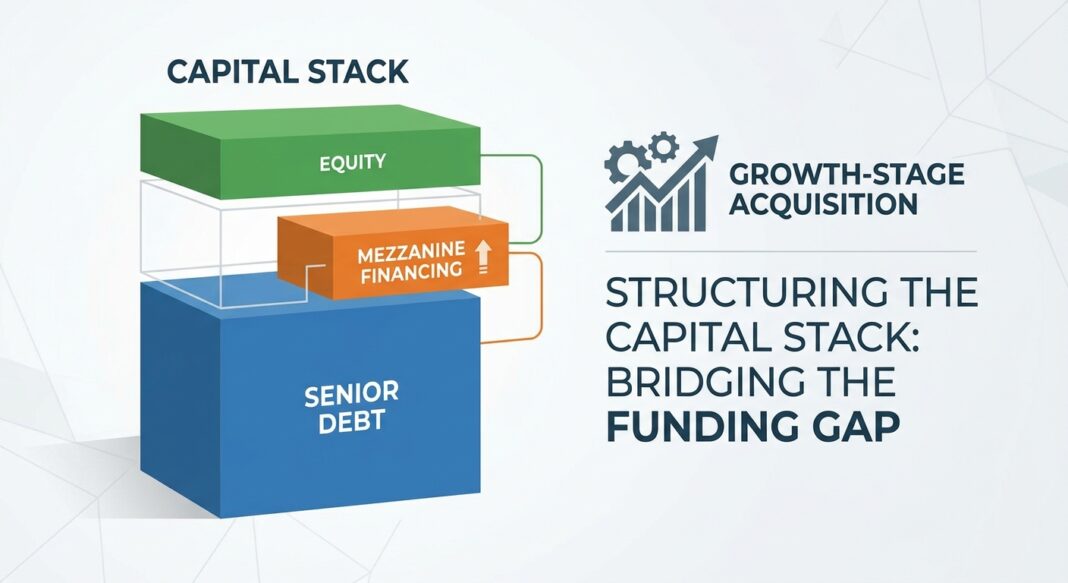
Position in the Stack. Mezzanine debt is subordinated, meaning it ranks junior to all senior secured obligations in both payment priority and collateral recovery. As one practitioner framework describes it, mezzanine sits below all senior creditors in the payment waterfall and is typically unsecured or secured by a second lien on assets. This subordinated position means lenders bear meaningfully more risk than a bank — and they price accordingly.
The Three-Part Economic Structure. A mezzanine facility combines three distinct return components that must be understood in totality to assess true cost of capital:
- Cash Interest Coupon: A base interest rate paid monthly or quarterly in cash. In 2026, cash coupons on lower middle market mezzanine facilities run approximately 11% to 14% annually for healthy companies with $5M–$15M in EBITDA, with smaller or more cyclical borrowers paying 14% to 16% cash.
- PIK (Payment-in-Kind) Interest: A deferred interest component where instead of cash, the interest accrues onto the outstanding principal balance. PIK compounds over the life of the facility, increasing the effective cost of borrowing over time. Typical PIK spreads in 2026 run 1% to 4% on top of cash coupons.
- Equity Kicker (Warrants): Options or rights granting the mezzanine lender a small equity stake — typically 1% to 5% of fully diluted equity — exercisable at a nominal or pre-agreed strike price. This component allows the lender to participate in enterprise value appreciation at exit and is what elevates mezzanine total returns into the 15%–20% IRR range that funds target.
Illustrative Deal Example — $40M Acquisition of a Services Business.
Scenario: Acquisition of a $40M EV business; Target generates $8M EBITDA; Buyer has limited equity capacity.
| Layer | Amount | Leverage | Pricing | Structure |
|---|---|---|---|---|
| Senior Bank Debt | $28M | 3.5x EBITDA | ~7.0% | Amortizing term loan + revolver |
| Mezzanine Debt | $6M | +0.75x EBITDA | 12% cash + 2% PIK + 3% warrants | 5-year bullet, interest-only |
| Equity | $6M | — | Residual return | Common equity / operator rollover |
| Total | $40M | 5.0x EBITDA | — | — |
The mezzanine provider earns 12% cash interest annually ($720K per year), accrues 2% PIK onto principal, and holds warrants representing 3% of the fully diluted equity — capturing upside if the business is sold at a higher multiple than entry.
Typical Tranche Size and Providers. Institutional mezzanine checks generally range from $5M to $75M, with SBIC-licensed funds handling smaller checks down to $2M. Active providers include dedicated mezzanine funds, Business Development Companies (BDCs), and family office capital pools.
Mezzanine vs. Alternatives: When Each Structure Wins
Mezzanine does not exist in isolation — it competes with several adjacent structures in the capital stack. Understanding the trade-offs is essential for selecting the right instrument.
Mezzanine vs. Unitranche. A unitranche facility combines senior and subordinated debt into a single instrument with one lender, one interest rate, and one set of covenants. Current middle-market unitranche spreads run approximately SOFR+4.75% to SOFR+5.50% for deals in the $40M–$100M EBITDA range. Unitranche wins on execution speed — a unitranche can close in 45 to 90 days versus 90+ days for a traditional senior-plus-mezzanine split — and on structural simplicity: the borrower sees one clean credit agreement and avoids intercreditor negotiation. However, unitranche typically maxes out at 5.0x–5.5x total leverage, while a senior-plus-mezzanine stack can sometimes push total leverage to 5.5x–6.0x by treating the mezzanine as structurally subordinated outside the senior credit agreement.
Mezzanine vs. Preferred Equity. Preferred equity sits below mezzanine debt in the capital stack but carries a critical structural distinction: it is legally equity, not debt. This means senior lenders treat it as equity for leverage covenant calculations — it does not consume senior debt capacity. Missed preferred dividends also do not trigger a payment default the way missed mezzanine interest payments do. The trade-off is cost: preferred equity is typically more expensive than mezzanine on an all-in basis, and the absence of tax-deductible interest eliminates a meaningful cost advantage that mezzanine debt preserves.
Mezzanine vs. Second Lien. Second lien debt occupies a middle ground — it has second-priority security on assets and cash flows, sitting between first-lien senior and true mezzanine. Second lien typically carries cash-only interest (no PIK) and no equity warrants, making it cheaper on a blended basis but with less structural flexibility. It prices approximately 150–300 basis points inside mezzanine but offers subordinated lenders weaker total return upside.
The Right Use Case for Mezzanine. Mezzanine is optimal when the use of proceeds is a growth-accretive event — an acquisition, platform build-out, or meaningful expansion capex — and the business has a credible path to deleveraging through EBITDA growth over 4–7 years. It is structurally mismatched for businesses with declining margins, heavy customer concentration, or cyclical cash flows where PIK compounding creates a growing refinancing burden at maturity.
Current Market Terms: 2026 Mezzanine Benchmarks
The mezzanine market in mid-2026 reflects a period of moderate spread compression from 2024 peaks as senior credit markets tightened and BDC competition for deal flow intensified. Key market data points:
- Cash Coupon Range (LMM, 2026): 11%–14% for healthy $5M–$15M EBITDA borrowers. Smaller or more cyclical credits pay 14%–16% cash, per market pricing data compiled by CT Acquisitions from active deal flow.
- PIK Component: Typically 1%–4% on top of cash interest, bringing total interest cost to 13%–17% annually. Blended cost of capital including warrant dilution runs 15%–18%.
- Warrant Coverage: Generally 1%–5% of fully diluted equity, with exact sizing negotiated based on deal leverage and lender IRR targets. Mezzanine funds underwrite to a blended 15%–20% IRR, with the equity kicker being the component that closes the gap between cash coupons and target returns.
- Leverage Stacking: Typical lower middle market acquisition structures in 2026 run senior bank debt at 3.0x–4.0x EBITDA plus mezzanine of 1.0x–2.0x, producing total leverage of 4.0x–6.0x depending on business quality and lender appetite.
- Covenant Architecture: The distinction between mezzanine and broadly syndicated structures is stark on covenants. In the lower middle market, the vast majority of loans retain full financial maintenance covenant packages — tested quarterly regardless of borrower action — compared to the broadly syndicated market where incurrence-only, covenant-lite structures dominate. For borrowers, maintenance covenants require ongoing compliance with leverage, coverage, and fixed-charge ratios, providing lenders early-warning visibility into credit deterioration. Incurrence covenants, by contrast, are only triggered when a borrower takes a specific action such as incurring new debt, making an acquisition, or paying a dividend — a distinction that meaningfully impacts operating flexibility.
The Gap Capital Playbook: From Quantifying the Need to Closing the Structure
Executing a mezzanine raise requires operators to move through four distinct phases. Shortcuts at any stage increase execution risk or result in a suboptimal structure.
Phase 1: Quantify the Gap
Before approaching any capital provider, operators must construct a rigorous uses-and-sources table. Start with total capital required for the transaction (purchase price + transaction fees + integration costs + working capital reserve). Subtract realistic senior debt capacity — tested against both bank leverage limits and DSCR minimums — and available equity. The residual is the mezzanine requirement. Importantly, the mezzanine layer must be sized to a level where total debt service (cash interest on both senior and mezzanine) does not exceed sustainable free cash flow. A common stress test is to ensure total cash debt service remains below 60%–70% of EBITDA post-close.
Phase 2: Prepare Materials
Mezzanine providers underwrite to IRR, not just coverage ratios. A compelling mezzanine package includes: (a) a 5-year financial model with monthly cash flows in years 1–2 and quarterly thereafter, demonstrating leverage reduction and debt service capacity; (b) a clearly articulated growth thesis connecting the use of proceeds to EBITDA expansion — this is what justifies the mezzanine premium over senior debt; (c) a management quality narrative, since lenders at the mezzanine level have limited collateral and rely disproportionately on operator execution; and (d) a proposed exit or refinancing timeline, since mezzanine funds underwrite to a liquidity horizon and need to see a credible path to principal repayment.
Phase 3: Run the Process
Mezzanine closings typically take 30–90 days from term sheet to funding. The intercreditor agreement negotiation between the senior lender and the mezzanine provider is typically the longest step in the process. Starting both the senior and mezzanine processes simultaneously — rather than sequentially — is the single most impactful timeline optimization available to borrowers. Running a competitive process with 3–5 mezzanine providers simultaneously creates pricing tension and improves covenant outcomes.
Phase 4: Negotiate the Structure
The most consequential negotiation points in a mezzanine transaction are:
- Cash vs. PIK Split: Operators should push to maximize the PIK component in years 1–3 when integration capital needs are highest, accepting a higher total rate in exchange for cash flow preservation. All-PIK structures, where no cash interest is paid in early years, exist for situations requiring maximum cash flexibility — but the compound effect of 12%–15% PIK over five years creates a materially larger refinancing burden at maturity.
- Warrant Coverage and Strike Price: Warrants representing 1%–5% of fully diluted equity are standard, but strike price mechanics matter significantly. A nominal or $0.01 strike warrant converts to pure upside value at any positive exit — a cost operators frequently underestimate. Borrowers should negotiate warrant coverage down in exchange for a modestly higher cash coupon when the growth thesis is high-confidence.
- Prepayment Terms: Standard mezzanine facilities include call protection — typically a no-call period for the first two years, followed by a declining prepayment premium of 2%–1%–par in years 3–5. Borrowers targeting a refinancing or sale within three years should prioritize negotiating a shorter call protection window, even if it marginally raises the coupon.
- Covenant Headroom: Maintenance covenants are the rule in private mezzanine, not the exception. Borrowers should negotiate initial covenant levels with 20%–25% headroom to projected EBITDA — wide enough to absorb a single integration quarter without triggering a technical default — and push for an equity cure right, which allows equity contributions to remedy a covenant breach without requiring lender consent or amendment.
Key Takeaways
- Mezzanine fills the funding gap between senior debt capacity and total capital required — it is the instrument that makes growth-stage acquisitions viable when banks hit their leverage ceiling and equity dilution is strategically unacceptable.
- True all-in cost of mezzanine is 15%–18% when cash coupon (11%–14%), PIK accrual (1%–4%), and equity warrant dilution (1%–5% of fully diluted equity) are modeled together — operators who evaluate only the cash coupon systematically underestimate the cost of capital.
- PIK interest compounds leverage — every quarter of PIK accrual increases the outstanding balance and the refinancing burden at maturity; sizing and scheduling PIK should be tied directly to projected free cash flow generation and the anticipated exit or refinancing timeline.
- The intercreditor agreement is the execution bottleneck — starting senior and mezzanine processes simultaneously and selecting lender pairs with prior intercreditor experience is the most effective way to protect deal timing.
- Maintenance covenants are standard in private mezzanine — unlike broadly syndicated loan markets where incurrence-only, covenant-lite structures dominate, lower middle market private mezzanine facilities retain quarterly-tested financial maintenance covenants; borrowers must negotiate adequate headroom and equity cure rights from the outset, not after the first test date.


