
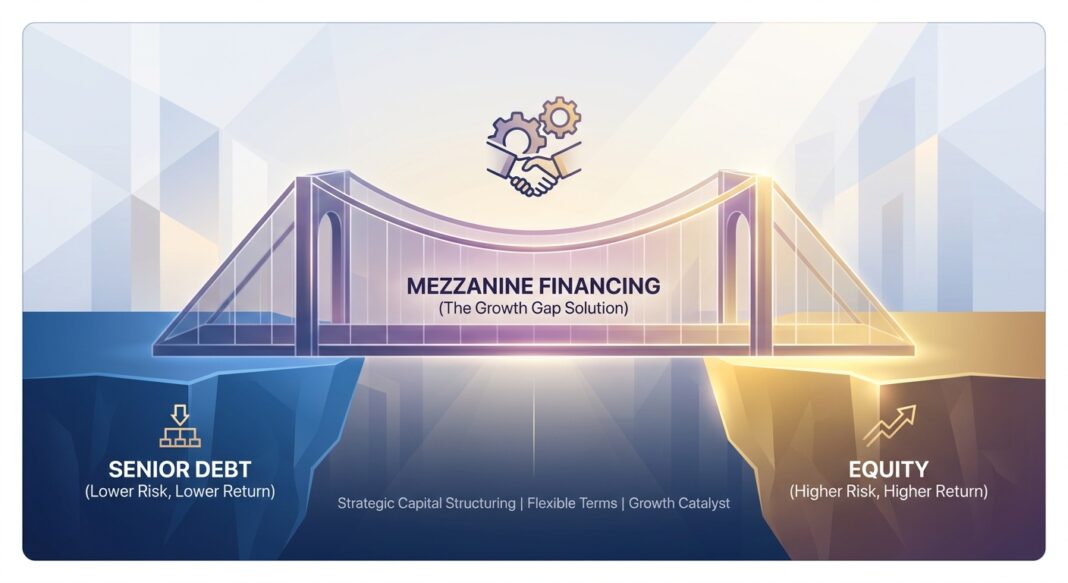
The Growth-Stage Financing Gap: When Senior Debt Stops and Equity Dilution Starts
Every growth-stage operator running an acquisition eventually hits the same structural wall. The senior lender — whether a bank or a direct lender — reaches its maximum leverage appetite at roughly 2.5x–3.5x EBITDA. The purchase price, however, implies a total leverage need of 4.0x–5.5x EBITDA. The difference between those two numbers is not an abstraction. It is a real capital gap measured in millions of dollars that must be filled by something. The question is: what, at what cost, and on what terms?
Raising a priced equity round solves the gap but imposes permanent dilution at a valuation the operator may believe is materially too low. Doing nothing means losing the deal. A third path exists in the middle layer of the capital stack — mezzanine financing — and understanding how to navigate it is one of the highest-leverage structural skills an acquirer can develop.
This article is a practitioner’s guide to that navigation: how the capital stack layers connect, how use-of-proceeds determines structure, what the gap capital market looks like in mid-2026, and how to run the process from term sheet to close.
The Capital Stack, Layer by Layer: Cost, Priority, and Role
Before structuring mezzanine, operators must internalize how each layer of the capital stack functions — and why its cost reflects its risk position.
Layer 1 — Senior Secured Debt (Banks & Direct Lenders)
The cheapest layer in cash-pay terms. Senior secured debt is typically priced at SOFR plus a credit spread, with a first lien on operating assets, and sized to 2.0x–3.5x EBITDA depending on lender appetite and the company’s revenue quality. In the upper middle market, unitranche facilities from direct lenders — which consolidate senior and subordinated debt into a single facility — typically price at SOFR + 425–475 basis points, with core middle market credits commanding 50–100 basis points higher, according to Capstone Partners’ Winter 2025 Leveraged Finance Report. Senior lenders set the floor and ceiling for everything below them.
Layer 2 — Mezzanine / Subordinated Debt (The Gap Capital Layer)
Mezzanine debt has three defining structural features that distinguish it from senior debt: its subordinated and unsecured position, its option for Payment-in-Kind (PIK) interest, and its equity kicker — almost always in the form of stock warrants.
On pricing: the cost structure for mezzanine in current market conditions is 8–12% cash interest plus 2–4% PIK (which accrues to principal) plus warrants or equity co-investment of 1–5% of equity, creating a 16–22% all-in IRR for the provider. On tenure: the maturity of mezzanine loans is usually longer than that of senior debt, often around 5 to 7 years, to give the borrower time to grow and increase cash flows.
The PIK mechanism deserves specific attention. PIK stands for payment-in-kind. PIK interest accrues on the principal balance instead of being paid in cash, compounding over the life of the facility and increasing the effective cost of borrowing over time. For an acquirer with tight post-close cash flow, PIK preserves liquidity — but it is not free: when borrowers elect PIK interest, the outstanding balance compounds, increasing the total debt burden. If the anticipated liquidity event is delayed, the growing PIK balance creates a larger refinancing burden at bullet maturity — a risk that can become severe in deteriorating markets.
On warrants: in mezzanine financing, warrants act as an equity kicker, letting lenders share in the company’s upside value if it grows. Every warrant granted to a mezzanine lender dilutes existing common equity. In a successful exit, the mezzanine lender’s equity kicker reduces the return available to the PE sponsor and management team — a cost that must be weighed against the benefit of reduced upfront equity contribution.
Layer 3 — Preferred Equity
Preferred stock is equity with debt-like protections — a liquidation preference that pays holders before common shareholders on an exit, and sometimes a dividend. It is the standard instrument in priced venture and growth rounds. Preferred equity carries no mandatory cash interest, making it more forgiving on cash flow — but it is the most dilutive option on an ownership basis.
Layer 4 — Common Equity
The residual claim. The most expensive capital in the stack when measured by required return, and the layer that bears all losses first. Sponsors use mezzanine to reduce equity contribution because even at 15–20% yields, mezzanine is cheaper than the 20%+ returns expected on equity.
A Worked Example: The $50M Gap in a $120M Software Acquisition
Consider a growth-stage software company — $8M EBITDA, 25% organic growth, high net revenue retention — executing a bolt-on acquisition at a $120M enterprise value (15.0x EBITDA). The capital stack need breaks down as follows:
| Capital Layer | Amount | Leverage Multiple | Pricing | Key Terms |
|---|---|---|---|---|
| Senior Secured (Unitranche) | $28M | 3.5x EBITDA | SOFR + 475 bps (~9.8% all-in) | 1st lien, maintenance covenant at 5.5x leverage, 1% annual amortization |
| Mezzanine (Gap Capital) | $22M | +2.75x EBITDA | 10% cash + 3% PIK + 3% warrants (~18–20% all-in IRR) | Subordinated, 6-year bullet, incurrence covenants, warrant strike at current valuation |
| Common Equity (Management + Sponsor) | $70M | N/A | Residual upside | Diluted by warrant coverage; protected by waterfall priority |
Total leverage at close: 6.25x EBITDA — aggressive but executable for a high-retention SaaS business. The $22M mezzanine tranche is the gap capital: it cannot be covered by the senior lender without breaching leverage limits, and it cannot be covered by equity without unacceptable dilution at this valuation. An equity kicker is the ownership participation component of a mezzanine structure, typically warrants or conversion rights that allow the lender to participate in the company’s upside — which is what makes mezzanine dilutive despite being structured as debt.
The operator’s analysis must go beyond the stated interest rate: mezzanine debt all-in cost is materially higher than senior bank debt but lower than equity. Total cost includes cash interest, PIK interest, warrants or equity co-investment, fees, and prepayment penalties.
Mezzanine vs. Alternatives: When Each Structure Wins
Mezzanine vs. Unitranche
The middle market lending landscape has experienced a decisive shift toward simplified debt structures, with unitranche facilities increasingly becoming the financing solution of choice for transactions ranging from $10 million to $500 million in enterprise value. This consolidation of senior and subordinated debt into a single facility has materially impacted deal execution timelines and documentation complexity. Unitranche is the right answer when execution speed and simplicity dominate — but it has leverage limits. When leverage requirements exceed what a unitranche provider will deploy, mezzanine fills the structural gap between senior debt and equity.
Speed matters: if unitranche financing can close 30 to 45 days faster than a syndicated alternative, sponsors often justify 50 to 100 basis points of extra spread by avoiding financing gaps, broken syndications, or delayed closings that jeopardize purchase agreements.
Mezzanine vs. Preferred Equity
Mezzanine carries mandatory cash interest; preferred equity often accrues dividends without cash payment. For companies with constrained near-term cash flow, preferred equity reduces fixed charge burden — but it sits higher in the equity waterfall and is more dilutive on a common ownership basis. The right choice depends on whether the company can reliably service debt from cash flow: if it can, debt is usually cheaper and preserves ownership; if it cannot, equity is often the only realistic option.
Traditional Mezzanine’s Continued Relevance
Despite the unitranche’s rise, traditional mezzanine debt has not disappeared. It remains relevant in several contexts: very large transactions where unitranche lenders cannot provide the full quantum of debt needed, situations where the borrower wants to minimize total cost by maximizing cheap senior debt separately, deals where the sponsor or management team wants equity kickers to align lender incentives, and portfolio company add-on financings where existing credit agreements restrict additional senior debt.
Current Market Terms: What the Data Shows in Mid-2026
The mezzanine and private credit markets have evolved materially over the past 18 months. Operators preparing to run a process should benchmark against the following current market standards:
- Mezzanine All-In Cost: In 2026, the all-in mezzanine cost runs 10–14%, composed of a cash coupon of 8–11% plus PIK of 2–4% plus warrant coverage. Including the equity component, total provider IRR runs 16–22%.
- Unitranche Pricing (Upper Middle Market): KBRA’s direct lending data put the average private unitranche coupon at roughly 9.00% at the end of 2025, running about 160 basis points above comparable broadly syndicated loans.
- Cov-Lite Penetration in Syndicated Markets: Covenant-lite institutional leveraged loans represented 91.7% of large corporate new-issue institutional loans in the United States in 2024, per PitchBook LCD. However, for the sub-$100M transaction market where growth-stage acquirers operate, maintenance covenants remain the norm.
- Covenant Architecture in Private Credit: The share of private credit lenders that will not do deals without financial maintenance covenants grew to 46% — climbing 11 percentage points from 2025 — pointing to increased lender demand for credit deterioration protection.
- Market Scale: Global private credit assets under management reached approximately $2.1 trillion in 2025, up from $1.5 trillion a year earlier.
- Recent Deal Size: In March 2026, PitchBook reported that the Thoma Bravo-backed WWEX and Auctane merger secured a $4.815 billion unitranche loan plus a $275 million revolver, priced at 575 basis points over the benchmark rate, with Ares Capital serving as administrative agent for a 33-lender club that included Blackstone, Blue Owl, Apollo, and Oaktree.
Covenant Design: Maintenance vs. Incurrence
Operators must understand the covenant architecture before accepting any term sheet. Maintenance covenants require borrowers to pass financial tests every quarter regardless of any action taken, while incurrence covenants only apply when the borrower takes a specific action like incurring new debt or paying a dividend.
In private credit, covenants serve as functional tools for risk management: maintenance covenants provide early warning signals, and incurrence covenants prevent actions that increase lender risk. Covenant use shifts with borrower size — maintenance covenants are more prevalent with smaller borrowers, while incurrence covenants are the primary guardrails as companies grow. From the borrower’s perspective, incurrence-only covenants provide maximum operational flexibility; from the lender’s perspective, restructurings initiated at the covenant-breach stage, before a payment default, produce materially higher recoveries than those triggered by missed payments.
The financial covenant in a typical private credit facility is a single net first-lien or total net leverage covenant with an initial cushion of 25 to 35 percent over the base case plan, stepping down as cash flow grows. Negotiating that initial cushion — and the step-down schedule — is one of the most consequential structural decisions a borrower makes.
The Gap Capital Playbook: Quantify, Prepare, Process, Negotiate
Step 1 — Quantify the Gap Precisely
Before approaching any provider, build a sources-and-uses table at multiple purchase price assumptions. The gap is the residual: total enterprise value minus senior debt capacity minus available equity. That gap quantum cannot be covered by the senior lender without breaching leverage limits, and it cannot be covered by equity without unacceptable dilution. It requires a structured solution — mezzanine debt, preferred equity, or a blend of both.
Run scenario analysis before committing to a structure. For each scenario, stress-test your post-close Fixed Charge Coverage Ratio (FCCR), total leverage multiple, and pro-forma equity dilution. The target zone is an FCCR above 1.20x, total leverage below 5.0x EBITDA, and equity dilution below 15% of common. The scenario that meets all three thresholds in the base case — and survives in the downside case — is the optimal structure.
Step 2 — Prepare Provider-Ready Materials
Gap capital providers — mezzanine funds, BDCs, family offices, and credit opportunity funds — underwrite to a fundamentally different thesis than senior lenders. Senior lenders underwrite to downside asset coverage. Mezzanine providers underwrite to enterprise value creation and equity coverage. Your materials must therefore lead with enterprise value durability, not asset liquidation value. Package a business overview, three-year financial model with EBITDA bridge, management presentations, and a clear articulation of why enterprise value exceeds debt at exit.
Step 3 — Run the Process Competitively
Do not take the first term sheet. The mezzanine market has deepened considerably: top mezzanine providers include BDCs such as Ares Capital, Blue Owl, Main Street, and FS KKR; specialty mezzanine funds including Audax Mezzanine, Madison Capital, Twin Brook, Babson, and Maranon; and family offices and high-net-worth pooled mezzanine vehicles. Running three to five competitive term sheets is standard and will compress pricing by 100–200 basis points and reduce warrant coverage by 1–2 percentage points in a competitive process.
Step 4 — Evaluate Total Cost of Constraint, Not Just Coupon
Covenant packages are negotiated — some mezzanine providers accept incurrence-only covenants; others require maintenance tests. The correct comparison metric when selecting between providers is total cost of constraint, not just total cost of coupon. The analysis must be holistic: cash-pay burden, PIK accrual, covenant headroom, and warrant dilution, evaluated simultaneously against the business’s projected cash flow profile.
Negotiation Guidance: The Five Structural Points That Move Value
1. PIK Toggle vs. Mandatory PIK
Push for a toggle — the right to elect PIK at the borrower’s discretion rather than a mandatory PIK structure. Toggle gives the operator cash flow flexibility without locking in compounding debt from day one. Mezzanine structures often feature deferred or payment-in-kind (PIK) options, with interest paid throughout the loan term and principal repaid at maturity. Mandatory PIK removes operator choice; toggle preserves it.
2. Warrant Coverage and Strike Price
The true complexity of mezzanine comes from the warrants. These equity kickers can complicate the capital structure, add layers to future financing rounds, and create challenging negotiations in a potential exit scenario. Negotiate the strike price at current enterprise value — not a discounted strike. Also negotiate a warrant cap as a percentage of fully diluted shares, and include a buyout mechanism allowing the company to repurchase warrants at a fixed multiple of initial cost after Year 3.
3. Covenant Headroom and EBITDA Definition
The initial leverage covenant cushion should be at least 30% above the base case. Equally important is negotiating the EBITDA definition to include addbacks for acquisition costs, restructuring charges, and run-rate synergies. A tight EBITDA definition with a thin covenant cushion is a structural trap — it constrains management through normal operating variance rather than genuine credit deterioration.
4. Prepayment Flexibility
Mezzanine providers typically embed call protection of 2–3 years (e.g., 103/102/101 premium in Years 1/2/3, then par). Negotiate for a make-whole provision rather than a fixed premium in Year 1, and push for a clean par call after Year 3. Refinancing flexibility is critical if rates compress or if the business scales enough to access cheaper capital within the loan term.
5. Incremental Debt Basket
Incremental debt permissions are typically sized by the larger of a fixed amount and a grower basket, with most-favored-nation protection capping new-money margin increases at 50 basis points for 6 to 12 months. For an acquirer with an active M&A pipeline, negotiating a meaningful incremental basket at the outset — rather than seeking amendments mid-strategy — preserves deal momentum and avoids the leverage lenders hold at amendment time.
Key Takeaways
- 🔑 Mezzanine is a structural solution to a quantifiable gap — the distance between senior debt capacity and total capital need. Size the gap precisely before approaching any provider.
- 🔑 The all-in cost is the only cost that matters — not the headline coupon. In 2026, full-stack mezzanine IRR including cash interest, PIK accrual, and warrant economics runs 16–22%. Model all three components before comparing structures.
- 🔑 Covenant architecture is a negotiation, not a standard — push for incurrence-only covenants if cash flow growth is credible. If maintenance covenants are unavoidable, negotiate a 30%+ cushion over the base case and a borrower-friendly EBITDA definition that captures run-rate synergies.
- 🔑 Warrant terms deserve as much attention as rate — a $0.01 strike warrant on 5% of a high-growth company can represent more economic cost at exit than 200 basis points of additional coupon. Negotiate a buyout mechanism and a capped ownership percentage.
- 🔑 Process competition compresses terms — running three to five competitive mezzanine term sheets is standard and will drive meaningful pricing and structural improvements. The mezzanine market in 2026 is deep, liquid, and competitive for quality credits.


