
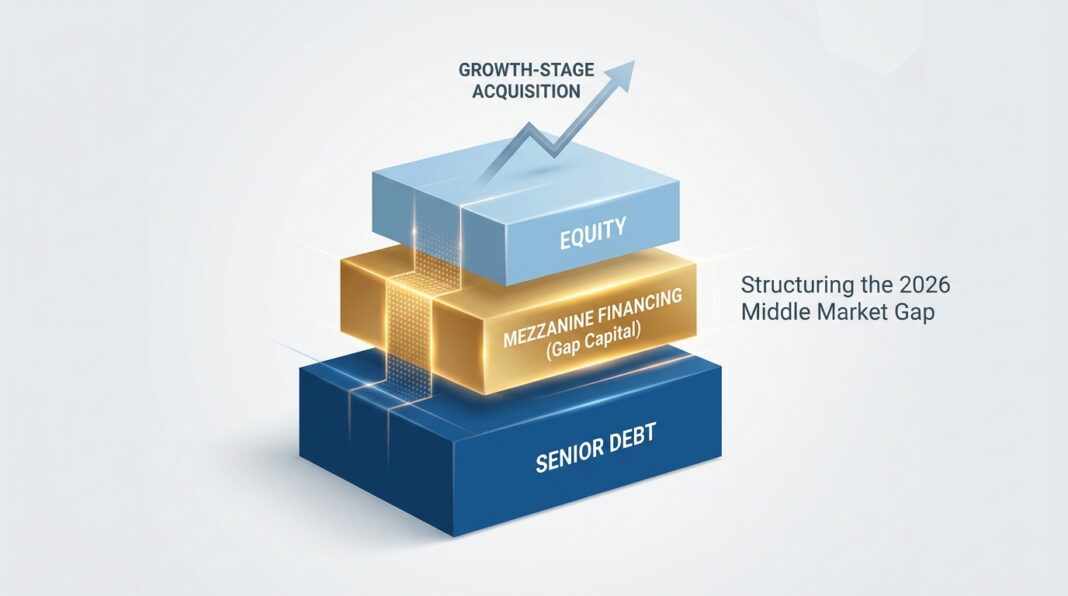
The Problem That Lives Between the Senior Line and the Equity Check
Picture a founder-led distribution business generating $8 million in EBITDA. A bolt-on acquisition has surfaced at a $60 million enterprise value — a platform-defining move that would add two new geographies and 40% incremental revenue. The bank will go to 3.0x EBITDA, writing a $24 million senior term loan. The founder is willing to contribute $15 million in equity. That leaves a $21 million gap sitting in the middle of the capital stack with nowhere to go.
This is the classic growth-stage acquisition problem. The business is too mature for venture capital, too small for the broadly syndicated loan market, and too capital-hungry to rely on organic cash generation alone. Bringing in a growth equity partner to fill the gap is technically possible — but it means surrendering 25–35% of the company at precisely the moment the operator believes value is about to compound most aggressively.
Mezzanine financing exists to solve this exact problem. It is the subordinated debt layer purpose-built for the gap between maximum senior leverage and minimum equity contribution — and in 2026’s middle market, it is one of the most actively deployed instruments in the private credit toolkit. Understanding how to structure it, price it, and negotiate it is the difference between closing the deal and watching it collapse at the capital table.
Structure Breakdown: What Mezzanine Actually Is and How It Is Built
Position in the Capital Stack
Mezzanine debt sits below all senior creditors in the payment waterfall and above common equity. In a liquidation or restructuring, senior lenders get paid first, equity holders absorb losses last, and mezzanine occupies the high-risk middle. That subordinated position is why mezzanine lenders demand — and receive — significantly higher returns than senior lenders.
The Three Economic Features
Every mezzanine instrument is defined by three structural features working in combination:
- Cash-Pay Coupon: The current interest component, paid periodically in cash. In 2026, the cash-pay portion of a middle-market mezzanine coupon typically runs 8–11%, reflecting the elevated rate environment since the 2022–2024 Fed cycle.
- Payment-in-Kind (PIK) Interest: Rather than paying this portion in cash, the borrower issues additional debt notes, compounding the outstanding principal each period. The lender receives cash only at bullet maturity or exit. In today’s market, the PIK component typically runs 2–4 percentage points on top of the cash coupon, bringing the all-in cost to 10–14% before the equity kicker.
- Equity Kicker (Warrants): Lenders receive warrants granting the right to purchase equity at a predetermined strike price, providing upside beyond the debt return. This is the feature that most complicates cap table management, but it is precisely what allows mezzanine to deliver lender IRRs of 15–25% all-in while keeping the borrower’s cash interest burden below that of a full equity raise.
Worked Example: The $60M Acquisition Capital Stack
Using the distribution business scenario from above, here is how the full capital stack assembles in 2026:
| Layer | Amount | % of EV | Pricing | Provider Type |
|---|---|---|---|---|
| Senior Term Loan (3.0x EBITDA) | $24M | 40% | SOFR + 275–325 bps | Regional Bank / SBA 7(a) |
| Mezzanine Debt (2.0x EBITDA) | $16M | 27% | 10–12% Cash + 2–3% PIK + Warrants (3–8% of equity) | Specialist Mezz Fund / BDC |
| Seller Rollover / Note | $5M | 8% | 5–7% Seller Note | Selling Owner |
| Sponsor / Operator Equity | $15M | 25% | Residual Upside | Founder / Family Office |
The mezzanine layer bridges the 27% gap in the stack, allowing the operator to execute the $60M acquisition with only 25% equity contribution — a meaningful leverage on their capital. The all-in blended cost of the debt capital (senior + mezz) lands approximately 200–300 basis points above a unitranche equivalent, but the equity dilution is zero beyond the warrant strip.
Mezzanine vs. The Alternatives: When Each Structure Wins
Mezzanine vs. Unitranche
The unitranche — a single-facility loan that blends senior and subordinated debt into one instrument from one lender — has become the dominant structure for middle-market acquisitions in 2026, with pricing running SOFR + 500–700 basis points and all-in blended costs of 9.5–11% for a typical 5x leverage deal. The appeal is structural simplicity: one credit agreement, one lender relationship, one covenant package, and faster execution — often closing 30–45 days ahead of a syndicated or bifurcated alternative.
But unitranche has hard limits. Most direct lenders deploying unitranche capital operate within leverage parameters of 4–6x EBITDA. For deals requiring leverage above that ceiling — or where the sponsor’s equity capacity constrains the equity cheque — mezzanine re-enters as the marginal layer. The traditional senior-plus-mezzanine structure also wins when the borrower can maximize cheap senior debt separately from a relationship bank, then layer in subordinated capital at a known fixed cost, rather than pay blended unitranche pricing across the full quantum of debt.
Mezzanine vs. Growth Equity
Growth equity minority checks typically price at 4.0–8.0x forward EBITDA valuation for a 20–40% stake held over five to seven years. For an operator with conviction in their near-term growth trajectory, this is the most expensive form of gap-filling capital on a risk-adjusted basis. Mezzanine is tax-deductible, non-dilutive to equity ownership (beyond the warrant strip), and exits the capital structure at a known maturity — typically five to seven years — whereas equity is permanent capital until a full exit event occurs. The calculus shifts toward growth equity only when the business cannot service the cash-pay component of a mezzanine coupon without constraining reinvestment.
Decision Matrix
- Use mezzanine when: EBITDA is stable, deal leverage exceeds senior capacity, equity dilution is unacceptable, and the operator has a defined exit or refinancing horizon within five to seven years.
- Use unitranche when: Speed, simplicity, and single-lender management outweigh cost, and leverage requirements fit within 4–6x EBITDA.
- Use growth equity when: Cash flow cannot support a PIK-accruing debt balance, the company needs operational partnership alongside capital, or the operator is open to a partial liquidity event.
Current Market Terms: What the 2026 Mezzanine Market Is Pricing
The rate environment of 2022–2024 materially reset mezzanine pricing from the low-rate era, and that repricing has largely held. Here is what practitioners are seeing in live deal flow as of mid-2026:
- All-In Cost: Middle-market mezzanine for performing companies prices at 10–14% all-in (cash coupon 8–11% plus PIK 2–4%), with all-in lender IRRs targeting 15–25% when the equity kicker is included. This compares to a 9–12% pre-hike range just three years ago.
- Covenant Structure: Mezzanine facilities typically carry a maintenance covenant tested quarterly — most commonly a maximum leverage ratio and a minimum fixed charge coverage ratio. This contrasts sharply with the broadly syndicated loan market, where over 85% of institutional leveraged loans now lack any meaningful maintenance covenant. In private credit, maintenance covenants function as early-warning mechanisms, giving lenders structured intervention rights before a credit deteriorates to payment default.
- Leverage Thresholds: In the lower middle market, the senior-plus-mezzanine structure typically extends combined leverage to 5.0–6.0x EBITDA: approximately 3.0–3.5x senior and 1.5–2.5x mezzanine. Unitranche lenders in the same segment may accept financial maintenance covenants at lower thresholds — often Fixed Charge Coverage Ratios of 1.10x — versus a regional bank’s standard 1.25–1.35x FCCR.
- OID and Fees: Original issue discount (OID) on private credit deals has run at approximately 2–3% of funded principal at closing, with upfront fees adding an additional layer of all-in cost that borrowers frequently underweight in total cost-of-capital calculations.
- Market Context: The private credit market reached approximately $2.1 trillion in assets under management in 2025, a figure that has grown dramatically from $1.5 trillion a year earlier, reflecting sustained institutional capital allocation into the asset class. Specialist mezzanine funds — including names such as Audax Mezzanine, NewSpring Mezzanine, Peninsula Capital, and Monroe Capital — have seen renewed allocations as investors seek strategies that combine current cash yield with equity upside in a higher-rate environment.
The Gap Capital Playbook: How to Run the Mezzanine Process
Step 1 — Quantify the Gap Before You Approach Any Lender
Build a three-statement operating model with base, downside, and upside scenarios. Calculate the maximum senior debt capacity at your bank’s FCCR threshold (typically 1.25–1.35x on trailing adjusted EBITDA). Subtract that from total acquisition cost. The residual — after your equity contribution — is your mezzanine sizing target. This number must be stress-tested at downside EBITDA before any lender conversation begins. If the business cannot service the PIK-accruing balance at 80% of base-case EBITDA, the mezzanine quantum is too large.
Step 2 — Prepare the Materials
A mezzanine process requires a Confidential Information Memorandum (CIM) with particular emphasis on EBITDA quality, cash conversion, and debt-service capacity. Mezzanine lenders underwrite to the downside first. Expect deep scrutiny of customer concentration, owner add-backs, and capital expenditure requirements. A Quality of Earnings (QoE) report — even a limited-scope version — substantially accelerates diligence and signals process credibility.
Step 3 — Run Debt and Equity Tracks in Parallel
The single most expensive process mistake operators make is sequencing rather than parallelizing. Running senior debt first, then returning to mezzanine, gives individual lenders informational advantages and eliminates competitive tension at the moment of term sheet negotiation. A well-run parallel process — engaging both the senior lender and two to three mezzanine providers simultaneously — typically produces competing term sheets by week 10 of a 16–24 week process. Compressed or poorly sequenced processes routinely sacrifice 50–150 basis points of pricing and material covenant headroom.
Step 4 — Negotiate the Structure, Not Just the Rate
Borrowers over-index on the coupon and under-negotiate the structure. The most consequential term sheet items in a mezzanine deal are frequently not the headline rate — they are the warrant coverage percentage, the strike price mechanics, the covenant headroom built in above the maintenance test, the PIK toggle provisions (which allow the borrower to elect PIK in stress periods without triggering default), and the prepayment premium schedule. A lower headline rate with tight covenants and aggressive warrant coverage can be materially more expensive than a slightly higher coupon with structural flexibility.
Structuring Guidance: What Operators and Investors Should Watch
For Operators: Five Negotiation Priorities
- Covenant Headroom: Negotiate maintenance covenant levels with at least 20–25% headroom to your base-case projections. A leverage covenant set at 5.5x when your pro-forma leverage is 5.2x is a trip wire, not a protection.
- PIK Toggle: Push for an optional PIK toggle that allows cash interest to convert to PIK during defined stress periods without constituting a default event. This is the single most valuable liquidity protection in a high-rate environment.
- Warrant Strike and Coverage: Challenge warrant coverage percentages (the percentage of fully diluted equity the warrants can capture) and insist on fixed-price strike mechanics rather than formula-based pricing that can shift unfavorably at exit.
- Prepayment Premium Structure: Standard mezz prepayment premiums run 2–5% in the first two years, stepping down to par by year four or five. If your refinancing timeline is within three years — whether via cash flow deleveraging or a sale process — negotiate an accelerated step-down schedule at execution.
- Equity Cure Rights: Ensure the credit agreement permits equity cures for covenant breaches. This allows a sponsor or equity holder to inject capital to fix a covenant trip rather than triggering an immediate lender intervention event.
For Credit Investors: What the Structure Signals About Risk
From a lender’s perspective, the structural design of a mezzanine facility reveals the deal team’s conviction in the downside case. A borrower willing to accept a tight maintenance covenant — say, maximum leverage of 5.0x tested quarterly with no equity cure — is either highly confident in EBITDA stability or has not modeled a credible stress scenario. Investors evaluating mezzanine positions should pay particular attention to the PIK compounding trajectory: when the borrower elects PIK interest, the outstanding balance compounds, increasing the total debt burden over time, and if the anticipated exit or refinancing is delayed, the growing PIK balance can create a materially larger refinancing burden at bullet maturity.
Key Takeaways
- Mezzanine is the precision instrument of gap capital. It fills the structural space between maximum senior leverage and minimum equity contribution — typically 1.5–2.5x EBITDA — without permanently diluting ownership beyond the warrant strip.
- The 2026 pricing reality is higher and stickier than borrowers expect. All-in mezzanine cost runs 10–14% (cash coupon plus PIK), with total lender IRRs targeting 15–25% inclusive of warrants — materially above the pre-2022 era and unlikely to compress unless base rates fall sharply.
- Unitranche has absorbed significant mezzanine market share, but cannot replace it at the margin. For deals requiring leverage above 5–6x EBITDA, senior-plus-mezzanine structures remain the most capital-efficient path to closing at competitive equity-contribution levels.
- Covenant design is a control rights question, not just a compliance question. Maintenance covenants tested quarterly give lenders early intervention rights that incurrence-only covenants do not — borrowers must negotiate headroom, cure provisions, and toggle rights before signing, not after breaching.
- Process discipline is the most undervalued value driver. Parallelizing senior and subordinated debt tracks, running competing term sheets, and stress-testing the PIK compounding trajectory before close are the structural decisions that protect equity value — and they cost nothing beyond preparation time and a credible advisor mandate.


