
The Growth-Stage Capital Challenge: When Senior Debt Runs Out and Equity Costs Too Much
You have built a platform company with $5 million in EBITDA. The add-on acquisition sitting in front of you is priced at $30 million — roughly 6x EBITDA — and it is exactly the right asset to double your market share. Your regional bank will lend 3.0x to 3.5x EBITDA against stable cash flow, which gets you to approximately $17 million in senior debt. Equity, whether from a new PE sponsor or a priced growth round, would cover the balance — but at the cost of meaningful ownership transfer and a valuation that, with late-stage multiples still compressed well below 2021 peaks, means selling a disproportionately large slice of your business to fill a relatively small dollar gap.
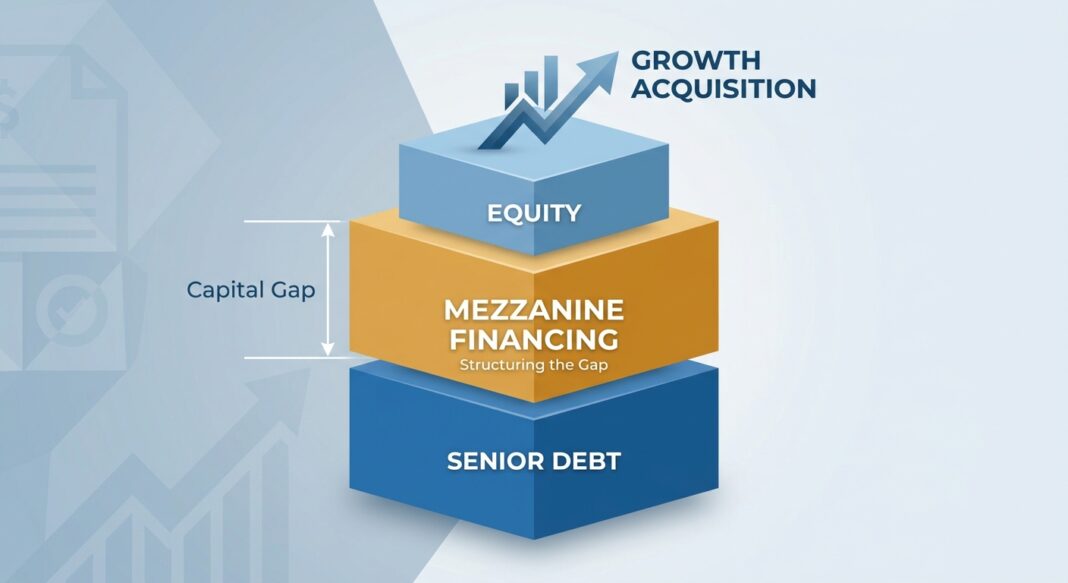
This is the classic growth-stage financing problem, and it is precisely the scenario mezzanine debt is engineered to solve. The mezzanine layer — capital that sits between the senior lender and the equity in the capital stack — is not the cheapest instrument in the toolkit. But for operators who need to fill a $5 million to $15 million gap above senior capacity without surrendering control, it frequently represents the most capital-efficient path available. Understanding how to structure it, price it, and negotiate it is a core competency for any operator running an acquisition-oriented growth strategy in 2026.
Structure Breakdown: How Mezzanine Debt Works and What It Actually Costs
Position in the Capital Stack
Mezzanine debt sits between senior secured debt and equity in a company’s payment waterfall. In a liquidation or default, senior lenders are made whole first. Equity holders receive whatever remains last. Mezzanine providers wait in the middle — junior to all senior creditors, senior to common equity — and price accordingly for that subordinated risk.
The Three Defining Structural Features
Mezzanine debt has three structural features that distinguish it from senior debt: its subordinated and typically unsecured position, its option for Payment-in-Kind (PIK) interest, and an equity kicker — almost always in the form of stock warrants. Each of these features carries both a cost and a functional benefit for the borrower.
- Cash Coupon: The base cash interest component that the borrower pays periodically. In 2026, this component typically runs 8–12% per annum, depending on deal size, credit quality, and lender competition.
- PIK Interest: Rather than requiring cash payment, PIK interest accretes directly to the outstanding principal balance. With PIK interest, the interest amount is added to the total loan balance, causing the principal to grow over time. This preserves borrower liquidity in the near term but compounds leverage at bullet maturity — a dynamic that demands careful modeling against the business’s projected cash generation curve.
- Equity Kicker / Warrant Coverage: Mezzanine lenders require an equity participation right — typically warrants granting the right to purchase 1–20% of the borrower’s equity at a fixed price — to earn the IRR required for a subordinated, illiquid position. Warrant coverage of 1–5% of fully diluted equity is the standard range for lower-middle-market transactions. In a successful exit, this dilutes existing owners but is finite: warrants granted at close do not creep.
2026 Pricing: A Worked Example
Consider a $30 million acquisition of a niche industrial services company with $5 million EBITDA. The capital stack is structured as follows:
| Tranche | Amount | Multiple | Pricing / Terms |
|---|---|---|---|
| Senior Bank Debt | $17.5M | 3.5x EBITDA | SOFR + 250–350 bps; quarterly maintenance covenant |
| Mezzanine Debt | $7.5M | 1.5x EBITDA | 10% cash + 3% PIK + 3% warrant coverage; 5-year bullet |
| Sponsor / Operator Equity | $5.0M | 1.0x EBITDA | Common equity; residual claim |
In this structure, the mezzanine tranche fills the gap between senior capacity and total equity deployment — enabling the operator to close a 6x deal while limiting the equity check to $5 million. Total leverage reaches 5.0x EBITDA, which is consistent with market norms: average total leverage in sponsored middle-market unitranche and split senior/mezz structures has hovered around 5.0x EBITDA in recent periods, with senior bank loans typically capped at 3–4x leverage while mezzanine or unitranche facilities extend that to 4–5x.
The mezzanine all-in cost for this structure — approximately 13% blended (10% cash + 3% PIK) plus warrants targeting a 16–22% IRR for the lender — is expensive relative to senior debt. The cost structure is not arbitrary: mezzanine lenders price for a subordinated, illiquid position with limited security and no public price discovery. Competition has compressed all-in mezzanine cash-plus-PIK yields from 14–16% a decade ago to roughly 12–14% in today’s market, according to 2026 pricing data. But compared to selling equity at a compressed valuation, the calculus frequently favors the debt instrument.
Mezzanine vs. Alternatives: Trade-Offs and the Optimal Use Case
Mezzanine vs. Unitranche
The most direct structural alternative to a senior/mezz split is a unitranche facility, which blends senior and subordinated debt into a single instrument under one credit agreement. A unitranche typically delivers 4–5x total leverage in the $25 million to $200 million enterprise value band, prices at SOFR + 450–650 bps (compared to SOFR + 250–350 bps for plain first-lien), and closes in 45–90 days versus 90–150 days for a traditional senior-plus-mezz syndication. The speed advantage and documentation simplicity are material: no intercreditor agreement, one covenant package, one lender relationship.
The trade-off is nuanced. Traditional senior plus mezzanine can achieve a lower weighted cost of capital if the mezz carries equity kickers that satisfy lender return requirements at a lower cash coupon — but intercreditor complexity slows execution and reduces flexibility. The unitranche wins on speed, confidentiality, and single-document control. For most operators running a deal timeline under 90 days with an enterprise value under $200 million, unitranche is the default; the split structure becomes preferable when maximizing cheap senior bank leverage to reduce blended cost is worth the execution risk and timeline.
Mezzanine vs. Preferred Equity
Preferred equity occupies a position above common equity but below all debt in the waterfall. It does not create a leverage covenant default, carries no maturity date risk, and is often more flexible on payment mechanics — but it is treated as equity for tax purposes (interest is not deductible) and frequently carries stronger governance rights than mezzanine debt. For operators who are already at the boundary of covenant-permissible leverage, preferred equity may be the only viable instrument. For operators with headroom who want the interest tax shield and less governance friction, mezzanine debt is typically the superior choice.
When Mezzanine Is the Wrong Answer
Mezzanine amplifies risk without adequate return when the business exhibits: customer concentration above 30%, organic EBITDA growth consistently below 5%, CapEx intensity above 8% of EBITDA, cyclical or seasonal cash flow, or a capital structure where debt service already exceeds 60–80% of EBITDA. In these conditions, the PIK compounding dynamic — whereby delayed PIK payments create a growing balloon that refinancing must absorb at maturity — can become structurally untenable. The instrument is purpose-built for high-conviction growth stories with predictable, expanding cash flows, not for businesses with unstable earnings profiles.
Current Market Terms: What Mezzanine Looks Like in 2026
The 2024–2026 mezzanine market for business acquisition has been shaped by three structural forces: private credit AUM growth, senior bank retrenchment leaving a gap of 1.0x to 1.5x EBITDA in middle-market structures, and private equity dry powder chasing scarce quality assets. These dynamics pushed sub-debt origination volume up meaningfully year-over-year in 2025. Here are the key market data points operators need to anchor term sheet negotiations:
- Cash coupon + PIK structure (2026): Mezzanine debt financing in the lower middle market is priced today at roughly 11–14% cash coupon plus 1–4% PIK, often stapled to warrant coverage of 1–5% of fully diluted equity. This is consistent across major published comp sets for 2026 LMM transactions.
- All-in cost and target IRR: The total cost structure — 8–12% cash interest + 2–4% PIK + warrants or equity co-investment creating a 1–5% equity position — targets a 16–22% all-in IRR for the mezzanine lender. Competition has compressed that range from the 14–16% cash-plus-PIK era of a decade ago to roughly 12–14% today.
- Leverage multiples: Senior bank debt is limited to 3.0–3.5x EBITDA in most lower-middle-market transactions. Mezzanine fills the band from 3.5x to 5.0x, with total leverage rarely exceeding 5.0x for LMM operators.
- Covenant regime (private credit): Maintenance covenants remain the standard in private credit and direct lending, in contrast to the broadly syndicated market where over 85% of institutional leveraged loans now lack quarterly financial maintenance testing. Maintenance covenants require quarterly compliance with financial metrics; incurrence covenants are tested only when the borrower takes a specific action — incurring new debt, paying a dividend, or executing an acquisition. In the middle market, lenders typically require both: a quarterly leverage maintenance test plus incurrence-based gates on dividends and add-on acquisitions.
- PIK as percentage of BDC income: By mid-2024, approximately 10% of all BDC interest income was PIK rather than cash, demonstrating how broadly mezzanine-style PIK features now appear across private credit portfolios — a signal of how normalized the instrument has become in deal construction.
- Process timeline: Mezzanine underwriting from term sheet to close runs 60–90 days, roughly comparable to a full senior credit process and shorter than a priced equity round in most scenarios.
Key Active Lenders in 2026
Active mezzanine capital providers in the lower and core middle market include BDCs (Ares Capital, Blue Owl, Main Street, FS KKR, Hercules) and specialty mezzanine funds (Audax Mezzanine, Madison Capital, Twin Brook Capital Partners, Babson, Brookfield, Maranon, Antares, NewSpring Mezzanine). Real-sector applications in 2026 span HVAC and plumbing roll-ups, MSP consolidators, veterinary hospital groups, home services platforms, and professional services buyouts.
The Gap Capital Playbook: Quantifying the Need, Preparing Materials, Running the Process
Step 1: Quantify the Gap Before You Go to Market
The most common mistake operators make is approaching mezzanine lenders before they have defined the capital stack with precision. The gap capital calculation is straightforward: (Total acquisition price or capital need) − (Maximum senior debt capacity at 3.0–3.5x EBITDA) − (Equity available for deployment) = Mezzanine requirement. If the mezzanine requirement exceeds 1.5–2.0x EBITDA, revisit the equity contribution first — lenders will not stretch to fill a gap that signals equity undercapitalization.
Step 2: Prepare the Materials That Price the Deal
The deals that price cleanest are those where the operator arrives with three years of audited financials, a quality of earnings (Q of E) report from a recognized advisory firm, a normalized EBITDA build, and a clear use-of-proceeds narrative. Mezzanine lenders are underwriting your ability to service cash interest quarterly and refinance or exit before bullet maturity — they need to believe both. Your CIM should explicitly model the PIK accrual schedule and show remaining debt service coverage at each annual period under a downside scenario.
Step 3: Run a Parallel Process, Not a Sequential One
Do not wait for the senior credit commitment before approaching mezzanine providers. The best capital structures are negotiated in parallel: senior lender and mezz provider both see the same package, both understand their position in the stack, and the intercreditor terms (or AAL, in a unitranche-adjacent structure) are negotiated simultaneously. Sequential processes add 30–60 days of timeline risk and reduce the operator’s negotiating leverage at each stage.
Step 4: Model the PIK Compounding Risk Explicitly
When borrowers elect PIK interest, the outstanding balance compounds, increasing the total debt burden. If an anticipated liquidity event — a sale, refinancing, or recapitalization — is delayed, the growing PIK balance creates a larger refinancing burden at bullet maturity. Operators should model PIK accrual under a base case (exit at year 4–5) and a stressed case (exit delayed to year 6–7), stress-testing the terminal leverage ratio before committing to a PIK-heavy structure.
Structuring Guidance: Negotiation Points for Operators and Investors
For Operators: What to Push On
- PIK vs. Cash Split: Every percentage point shifted from cash coupon to PIK preserves near-term liquidity but compounds leverage. Negotiate the ratio based on your Year 1–2 free cash flow after debt service, not your projected Year 3 steady state. A 10% cash / 3% PIK split is materially different from 8% cash / 5% PIK over a 5-year hold.
- Warrant Coverage Cap: Push to cap warrant coverage at 2–3% of fully diluted equity for transactions under $10 million of mezzanine. Lenders seeking 5%+ warrant coverage are pricing in equity-like returns; if you are offering that, negotiate a lower cash coupon in exchange.
- Maintenance Covenant Headroom: Maintenance covenants are tested quarterly against specific financial metrics — most commonly maximum leverage (total debt / EBITDA, typically set at 4–6x) and minimum interest coverage (EBITDA / interest, typically 1.5–2.5x). Negotiate 20–25% headroom above your Year 1 base case projections, not your Year 2 growth projections. Covenants set to growth-case assumptions create unnecessary technical default risk in a flat year.
- Call Protection: Most mezzanine facilities carry 12–24 months of no-call protection and a 1–2% prepayment premium in years 2–3. If you anticipate a refinancing event (e.g., a sale, an upgrade to a BSL at scale), negotiate the call schedule explicitly at term sheet stage, not at amendment.
For Investors: What to Evaluate in Structure
- Verify that PIK income is modeled separately from cash interest in return calculations — PIK accretes to principal and is received only at bullet maturity or exit, not as current yield.
- Assess warrant dilution in total return: every warrant granted to a mezzanine lender dilutes existing common equity, and in a successful exit, the equity kicker reduces returns available to the sponsor and management team.
- Evaluate the intercreditor agreement or AAL terms carefully: the first-out/last-out priority arrangement between senior and junior providers governs cure rights, enforcement standstills, and payment blockage mechanics that are invisible to the borrower but critical to lender recovery in a stress scenario.
Key Takeaways
- 🔑 Mezzanine fills the structural gap between senior bank capacity (3.0–3.5x EBITDA) and total acquisition leverage (4.5–5.0x EBITDA) — enabling growth-stage operators to close larger deals with smaller equity checks and without permanent ownership dilution from a priced round.
- 🔑 The all-in cost is real and compound: At 11–14% cash coupon + 1–4% PIK + 1–5% warrant coverage targeting a 16–22% IRR, mezzanine is expensive capital. Model PIK accrual under a delayed-exit stress scenario before committing to a PIK-heavy structure.
- 🔑 Covenant design matters as much as pricing: Maintenance covenants are tested quarterly against fixed financial metrics; incurrence covenants only activate on specific actions like new debt or acquisitions. In private credit, both typically apply — negotiate headroom against base-case financials, not growth projections.
- 🔑 Warrant coverage is a negotiable lever: Lenders seeking 5%+ warrant coverage are targeting equity-like returns. If you are granting that exposure, you should receive a lower cash coupon in exchange. Cap warrant coverage at 2–3% for sub-$10M mezzanine tranches where lender competition is active.
- 🔑 Run a parallel process: Negotiating senior debt and mezzanine sequentially adds 30–60 days of timeline risk and reduces borrower leverage at each stage. Bring both lenders to the table simultaneously with the same materials, a clear use-of-proceeds narrative, and a Q of E-backed EBITDA build — that is the combination that prices deals cleanest and closes fastest.


