
The DNA of a Deal: Understanding the Capital Stack
In the world of private credit and corporate finance, not all dollars are created equal. Whether you are an investor seeking yield or a business owner seeking growth capital, the single most important concept to master is the Capital Stack. This structure acts as the blueprint for any transaction, dictating who has control, who gets paid first, and who bears the risk when things don’t go according to plan.
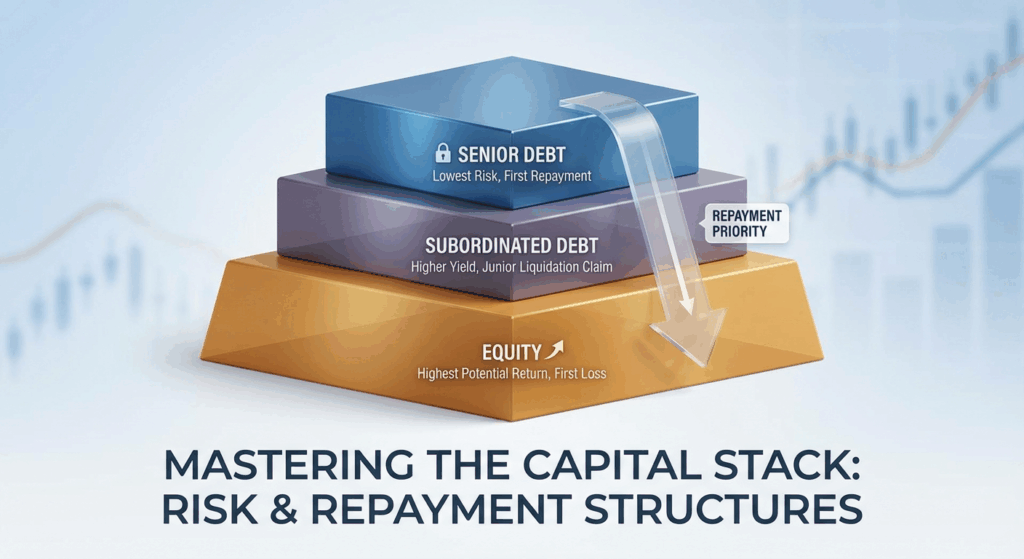
At its core, the capital stack organizes the different layers of financing used to fund a company or acquisition. It establishes a strict hierarchy of claims—a “waterfall” of repayment that flows from the top (safest) to the bottom (riskiest). Understanding where you sit in this stack is not just a technical detail; it is the primary determinant of risk-adjusted return.
The Concept: A Layered Hierarchy of Risk
Imagine the capital stack as a tiered structure. At the top sits Senior Debt, followed by Subordinated (Mezzanine) Debt, and finally, Equity at the bottom. The fundamental rule of the stack is simple: priority decreases as you move down, while potential return increases.
- Senior Debt: This is the “top” of the stack. Senior lenders have the first claim on assets and cash flow. Because they are paid first and often have their loans secured by collateral (assets), they accept a lower yield in exchange for safety.
- Subordinated (Junior) Debt: Sitting below senior debt, this layer is “subordinate” in repayment. If a company liquidates, senior lenders must be made whole before subordinated lenders see a dime. To compensate for this increased risk, these lenders command higher interest rates and sometimes equity “kickers” (warrants).
- Equity: The base of the stack. Equity holders (founders, PE firms) are the last to be paid. They absorb the first losses if the company’s value drops. However, they also enjoy uncapped upside if the company grows, whereas debt holders typically only receive their fixed interest payments.
How It Works: A $100 Million Example
To see the mechanics in action, let’s look at a hypothetical acquisition of a manufacturing company valued at $100 million. A private equity sponsor might structure the deal as follows:
- Senior Debt: $50 million (50% of stack). Interest rate: ~8-10%.
- Subordinated Debt: $20 million (20% of stack). Interest rate: ~12-14%.
- Common Equity: $30 million (30% of stack). Residual claim.
Scenario A: Success
The company grows and is sold five years later for $150 million.
The debtholders generally get their principal back plus the interest they earned along the way. The remaining proceeds (approx $80 million after debt payoff, depending on amortization) go to the equity holders. The equity holders more than doubled their money because of leverage.
Scenario B: Distress
The company struggles and is forced to liquidate assets for only $60 million.
The Senior Lenders get their full $50 million back.
The Subordinated Lenders are owed $20 million but only $10 million remains. They suffer a 50% loss of principal.
The Equity holders get zero. Their entire $30 million investment is wiped out.
This “waterfall” demonstrates why position matters. The senior lenders were protected by the Equity Cushion (the $30M) and the Subordinated debt layer ($20M) beneath them.
Current Market Relevance
As of 2026, the distinctions within the capital stack have become even more critical due to the massive growth of the asset class. According to recent data referencing the Preqin 2025 Global Report, private credit assets under management (AUM) surged to approximately $1.7 trillion by the end of 2024, with forecasts suggesting a climb toward $2.6 trillion by 2029.
In the current environment, we are seeing specific trends reshaping the stack:
- Rise of Unitranche: Lenders are increasingly blending senior and subordinated debt into a single “unitranche” facility. This simplifies the creation of the stack but requires investors to carefully evaluate the “attachment point” (the total debt relative to enterprise value).
- Equity Cushion Focus: With interest rates remaining elevated compared to the prior decade, interest coverage ratios have tightened. Lenders are demanding thicker equity cushions—often 40-50% in middle-market deals—to ensure there is enough buffer against volatility.
- The “Search for Yield”: As noted by Capital Market Insights, senior debt typically covers 2.0x to 3.0x EBITDA. For investors unsatisfied with bank yields, the “technical” shift toward private credit offers a premium, but it requires understanding that these loans are illiquid compared to public bonds.
Decision Framework
Whether you are allocating capital or seeking it, the capital stack structures your incentives.
For Investors: The “Sleep At Night” Test
When evaluating a private credit fund or direct deal, ask: What is the attachment point?
If a loan attaches at 0% and detaches at 50% of the company’s value (Senior Debt), the company’s value would have to drop by half before your principal is at risk. If you are buying Junior Debt that attaches at 50% and detaches at 75%, you are taking significantly more risk for arguably only 200-400 basis points of extra yield. In uncertain economic times, the seniority premium is often under-priced.
For Operators: Cost vs. Dilution
For business owners, the stack represents a trade-off between cost of capital and control.
Senior debt is the cheapest capital but comes with strict covenants (rules). Equity is the most expensive capital (because you give up future upside) but it is patient and doesn’t trigger bankruptcy if a payment is missed. Using subordinated debt can be a strategic middle ground—it costs more cash interest than a bank loan, but it prevents you from having to sell more equity shares, minimizing dilution.
Key Takeaways
- Seniority equals safety: In a liquidation scenarios, senior lenders are paid first. Junior lenders and equity holders stand in line behind them.
- Equity is the shield: Ideally, the larger the equity cushion beneath the debt, the safer the loan. It acts as the “first loss” tranche.
- Risk dictates cost: The lower you go in the stack, the higher the return potential needs to be to justify the risk of total loss.
- Structure serves strategy: Operators use the lower layers (equity/mezzanine) to fuel growth without the rigid constraints of bank debt covenants.
- Know your position: For investors, the gross yield matters less than the Loan-to-Value (LTV) ratio. A 12% yield is not attractive if there is only a 5% equity buffer protecting it.


