
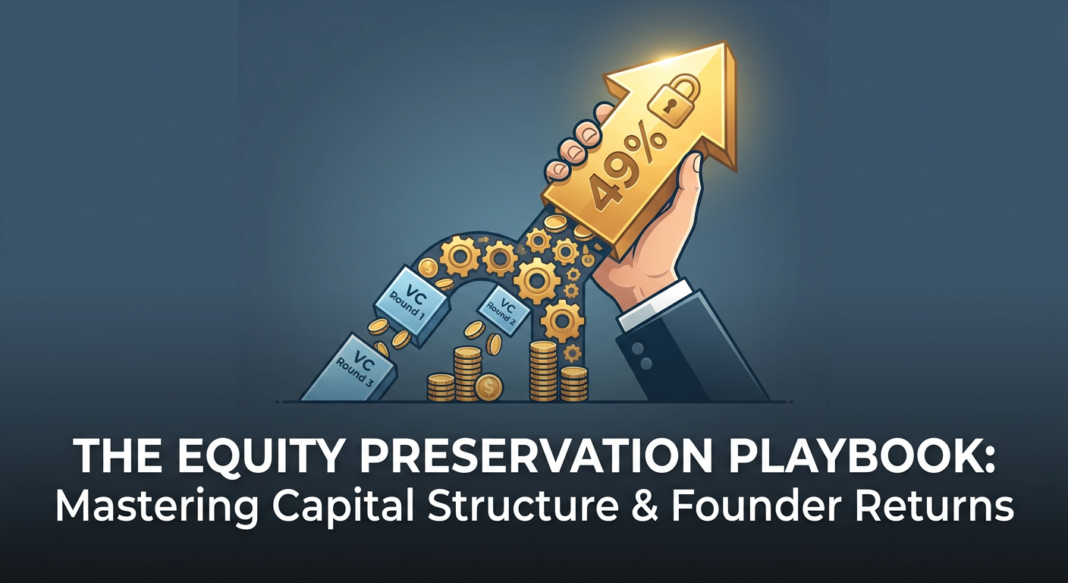
The Story: A £420M Exit That Almost Didn’t Happen This Way
In 2026, Danone paid €1 billion for Huel — a UK-based complete nutrition brand that began life mixing powdered food in a Northamptonshire kitchen. When the exit proceeds were distributed, founder Julian Hearn walked away with £420 million personally. That was 49.3% of the total payout — a number so anomalous in the world of venture-backed consumer brands that it demands a closer look.
For context: most direct-to-consumer founders who raise $184 million across three institutional rounds exit owning somewhere between 15% and 25% of their business. The dilution math is brutal and compounding. Every round of equity sold at a lower-than-deserved valuation, every board seat surrendered prematurely, every option pool shuffled in ahead of a term sheet — it all erodes the founder’s share of the outcome they spent a decade building.
Hearn didn’t avoid that fate by accident. He avoided it by making one foundational decision at the very beginning and holding it through every subsequent round of pressure: he would not raise a penny of institutional capital until the business had already proven it didn’t need it.
By the time Hearn approached his first institutional investors, Huel had already reached £18 million in annual revenue — bootstrapped, profitable, and growing on the strength of a product that worked and a direct distribution model that didn’t require massive upfront capital to sustain. That sequencing changed everything that followed.
The Decision: Raise Late, Raise Minimally, Raise at Your Terms
The conventional venture playbook encourages founders to raise early and raise large. The logic is momentum: get capital before you need it, grow fast enough to justify the next round, and let the valuation step-ups paper over the dilution. For some businesses — particularly those requiring enormous upfront infrastructure or that operate in winner-take-all markets where speed is survival — that logic holds.
Huel’s business didn’t require that trade. It was a direct-to-consumer model with favourable gross margins, low capital intensity, and a customer acquisition channel (early-internet word-of-mouth and SEO-driven content) that could be scaled incrementally. There was no infrastructure cliff, no manufacturing bet requiring nine figures upfront. Which meant Hearn had something most founders never get: the option to wait.
By waiting until £18 million in revenue before approaching institutional investors, Hearn negotiated from demonstrated performance rather than projected potential. Investors were no longer funding a hypothesis — they were buying into a proven operation. That shift in leverage (the negotiating kind) is worth millions at the cap table. Hearn raised what the business needed, not what the market was willing to give, and structured each round to preserve his controlling position through every dilution event.
The outcome across three funding rounds totalling $184 million: 49.3% ownership retained at exit. The math isn’t magic. It’s sequencing and discipline applied consistently over a decade — as documented in public Companies House filings and cap table analyses reviewed by financial commentators tracking the deal in 2026. According to analysis published by creatorsblueprint.co, Hearn’s bootstrapped foundation gave him the pricing power to resist dilutive terms at every subsequent fundraise.
The Outcome: Premium Multiple, Premium Ownership, Premium Exit
Danone’s acquisition wasn’t just notable for its size. It was notable for its multiple. Public reporting indicates Danone paid approximately 17–20× EBITDA for Huel — a premium valuation — despite the brand’s revenue growth having slowed to approximately 17% in the period preceding the transaction. That premium is directly attributable to the unit economics Hearn built over a decade of capital discipline: expanding gross margins through vertical integration, improving marketing efficiency ratios despite scaling, and building an omnichannel revenue base that reduced platform dependency risk.
The counterfactual is worth examining carefully. Had Hearn raised a Series A at £3 million in revenue — as many DTC founders do — the valuation would have been a fraction of what he commanded at £18 million. Had he raised aggressively at each subsequent step, accepting maximum dilution in exchange for maximum speed, his ownership at exit would likely have landed in the 18–22% range. On a €1 billion exit, the difference between 22% and 49.3% is approximately £230 million in personal proceeds — a number that dwarfs the theoretical benefit of having grown faster with more capital.
Critically, the investors who backed Hearn also generated strong returns. This is not a zero-sum story. As reported by bondtv.vaultai.ca, equity preservation and investor returns are not mutually exclusive when the underlying business is built properly. Hearn’s discipline made the pie bigger for everyone — he simply ensured he retained a larger slice of it.
The Lessons: What Founders and Operators Can Extract
Huel’s story is not an argument against venture capital. It is an argument for sequencing capital correctly — understanding when you need outside money, how much you actually need, and what you surrender in exchange. The distinction matters enormously in practice.
The broader market is beginning to reflect this logic in new financial structures. General Catalyst’s Customer Value Fund, for example, now offers non-dilutive revenue-share financing to profitable, growth-stage companies — a direct response to founder demand for capital without equity cost. Musely co-founder Jack Jia, who had not raised equity since 2014 despite building a cash-flow-positive DTC business, accessed $360 million through this structure rather than surrender ownership to a traditional VC. As reported by lazytechtalk.com, Jia “mathematically modeled” the revenue-share terms and found them “absolutely compelling” compared to the dilution cost of a conventional equity round.
The pattern emerging across Huel, Musely, and structures like the leveraged dividend recapitalization — explored in depth by bondtv.vaultai.ca — is consistent: founders with proven cash flows have more capital options than they are typically shown. Equity is not the only currency of growth. It is simply the most aggressively marketed one.
As inthemoneyhq.com observed in a recent analysis of capital structure as strategic advantage: “How you finance the business is increasingly as important as what the business does.” That principle applies whether you are a DTC nutrition brand approaching your Series A or a family-owned services business considering your first institutional partner.
Framework: The Founder’s Equity Preservation Decision Tree
- Do you have proven cash flows? If yes, debt-based or revenue-share structures should be modeled before any equity conversation begins. The cost of non-dilutive capital is typically fixed and recoverable. The cost of equity is permanent and compounding.
- How much do you actually need? Founders consistently over-raise because institutional investors incentivise it. Model the minimum capital required to hit the next inflection point — not the maximum available at current terms.
- Can you wait? Every month of bootstrapped growth before an equity raise shifts pricing power toward the founder. If the business can sustain itself, the option to wait is worth exercising.
- What are you surrendering beyond money? Equity rounds transfer governance rights, impose exit timelines, and introduce incentive misalignment. Debt instruments, revenue-share agreements, and recap structures rarely carry those provisions.
- What does the counterfactual cost? Model the diluted outcome explicitly. If a conventional VC round would reduce your ownership from 70% to 45%, calculate what that 25% costs you at your expected exit multiple. Make the trade consciously — not by default.
Key Insights
- Bootstrapping to product-market fit is the most valuable form of leverage: Hearn’s decision to reach £18M in revenue before raising institutional capital is what made his 49.3% exit ownership mathematically possible. Time and traction are negotiating assets.
- Dilution is a compounding cost, not a one-time fee: Every percentage point surrendered in an early round is a percentage point absent from every future valuation step-up, every strategic premium, and every exit multiple. Model it forward, not just at the moment of signing.
- Non-dilutive structures are now institutional-grade: General Catalyst’s $360M revenue-share facility for Musely is not a niche workaround — it signals that the capital markets are building products for founders who refuse to pay the equity cost of growth capital.
- Founder returns and investor returns are not a zero-sum trade: Hearn’s investors generated strong returns alongside his £420M personal exit. Equity preservation is not about denying investors upside — it is about building enough value that everyone wins proportionally.
- Capital structure is a strategic decision, not just a financial one: The founders and operators winning right now are those who treat financing decisions with the same rigour as product, distribution, and operations. How you capitalise the business shapes who controls it, when it must exit, and how much of the outcome you keep.


