
The Problem That Sits in the Middle of the Stack
A manufacturing company generating $12M in EBITDA wants to acquire a competitor at a $40M enterprise value. Its senior bank lender will stretch to 3.0x leverage — roughly $36M — leaving a $4M funding gap that is too small to justify a full equity raise but too large to paper over with working capital. This is the growth-stage gap capital problem, and it plays out across thousands of mid-market deals every year.
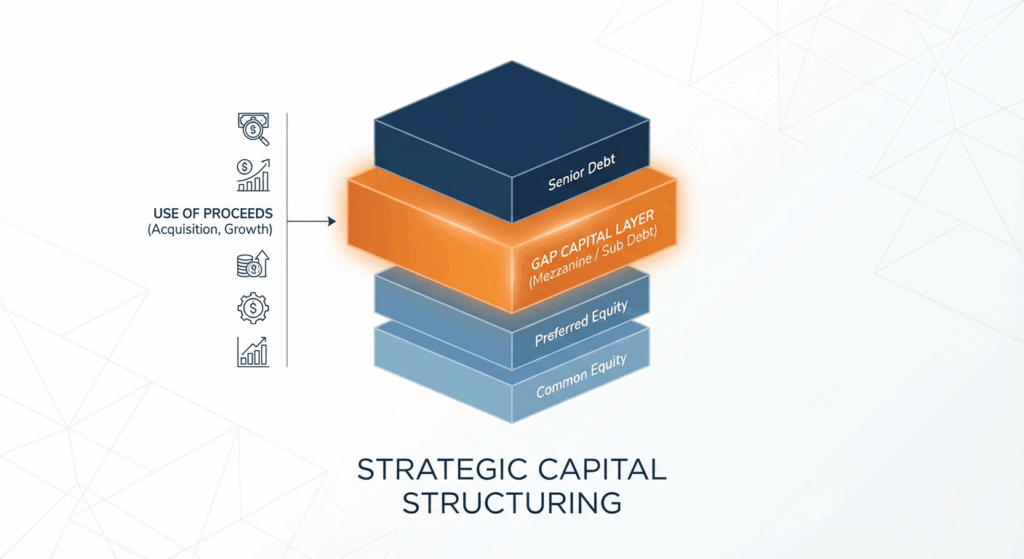
The capital stack is not a single instrument. It is a layered architecture in which each tier — senior debt, subordinated debt, mezzanine, preferred equity, and common equity — carries a distinct cost, a distinct risk profile, and a distinct set of structural requirements. As the CapitalXO capital stack framework explains, senior lenders sit at the top with first claim on cash flows and collateral, while equity holders absorb losses first and get paid last. Everything in between fills the gap. Understanding which instrument belongs in that gap, and why, is the core competency of growth-stage capital strategy.
Stage-Specific Capital Logic: Why Growth Is the Inflection Point
Capital strategy is not one-size-fits-all. The right instrument at one stage is almost always the wrong instrument at another.
- Seed and early stage: The business is essentially a funded hypothesis. Revenue is thin or absent, collateral is limited, and the primary capital tool is equity — first common, then convertible instruments. As the Lendity capital stack guide notes, early equity is rocket fuel — it buys time to test assumptions when no lender will absorb speculative risk.
- Growth stage ($2M–$15M ARR or EBITDA): The business has proven its model and now needs capital to scale, acquire, or recapitalize. Revenue is predictable enough to service debt, but the growth trajectory may not yet support the full leverage a senior lender requires. This is where the gap opens — and where mezzanine, unitranche, and preferred equity structures become operationally relevant.
- Mature and succession stage: The capital question shifts to optimizing the existing stack — lowering blended cost, extending maturities, or funding ownership transitions without destroying enterprise value.
The growth stage is the inflection point precisely because the business has earned access to debt but has not yet earned the leverage multiples that would make a single senior tranche sufficient. That structural gap is the practitioner’s primary working surface.
Mapping Use-of-Proceeds to the Cost of Capital Spectrum
Before selecting an instrument, operators must be explicit about what the capital is actually for. Use-of-proceeds is not administrative language — it is the primary variable that determines which part of the stack is structurally appropriate.
| Use of Proceeds | Preferred Capital Layer | Why It Fits |
|---|---|---|
| Working capital / receivables | Senior revolving credit / ABL | Self-liquidating nature matches asset cycle; cheapest capital available |
| Equipment / real estate | Senior term debt (bank or non-bank) | Hard collateral supports first-lien underwriting; low cost of capital |
| Acquisition financing (gap) | Mezzanine / subordinated debt | Fills leverage gap without equity dilution; interest often partially PIK |
| Organic growth / hiring / marketing | Growth loans / venture debt / preferred equity | Cash flows are prospective, not current; lenders price forward risk |
| Ownership transition / recapitalization | Preferred equity + subordinated debt combo | Balances liquidity for exiting owner with manageable cash obligations |
The cost of capital spectrum runs — in ascending order of cost — from senior bank debt through non-bank senior credit, subordinated debt, mezzanine, preferred equity, and finally common equity. As Swingbridge’s capital stack analysis notes, each step down the stack requires a higher required return because the capital provider accepts less seniority and less certainty of repayment. The practitioner’s objective is to use the cheapest instrument that is structurally available for the stated purpose — and to reach for more expensive capital only to fill what the cheaper tier cannot cover.
The Gap Capital Playbook: Four Steps from Quantification to Close
Step 1 — Quantify the Gap Precisely
The gap is the difference between the total capital required for the transaction and what the senior lender will provide at an acceptable leverage level. To define it, operators need three numbers: total capitalization required (purchase price plus transaction costs plus working capital reserve), maximum senior debt capacity (typically expressed as a multiple of trailing EBITDA or a percentage of appraised asset value), and available equity (cash on hand, retained earnings, or committed co-investment). The gap is what remains. Do not estimate it — model it at three scenarios: base, downside, and stress. Lenders will.
Step 2 — Prepare the Capital Package
Gap capital providers — mezzanine funds, private credit lenders, family offices providing subordinated notes — require a different information package than senior banks. The senior bank underwrites backward, against historical cash flow and collateral. The mezzanine or preferred equity provider underwrites forward, against the business plan and management’s ability to execute. The capital package must therefore lead with: a three-year integrated financial model with clearly labeled use-of-proceeds, a management presentation that explains why the gap exists and how cash flow services all tranches, a clean legal and ownership structure, and evidence of senior lender commitment (even a term sheet) to confirm the senior layer is in place.
Step 3 — Run a Parallel Process
Unlike senior bank debt, gap capital is not a commodity. Terms vary materially across providers. Run a parallel outreach to four to six appropriate capital sources simultaneously — not sequentially. This creates competitive tension, compresses timeline, and surfaces the market-clearing terms faster. Segment the outreach: institutional mezzanine funds for larger gaps ($5M+), private credit or family office lenders for smaller or more structured needs, and preferred equity providers if the business cannot support additional fixed-rate debt obligations.
Step 4 — Structure the Instrument to Match Cash Flow Capacity
Gap capital instruments are flexible by design. The key structural variables to negotiate are: cash pay versus PIK (payment-in-kind) interest split, maturity relative to the senior tranche, covenant package (incurrence versus maintenance), equity participation (warrants or conversion rights), and prepayment mechanics. A business with tight near-term cash flow should push hard for a higher PIK component, which defers interest to maturity rather than requiring current cash payment. A business confident in its growth trajectory should resist warrant coverage aggressively — the equity given up in warrants is expensive capital that only becomes visible at exit.
Negotiation Guidance: The Terms That Matter Most
When the term sheet arrives, operators should concentrate negotiating capital on four points:
- Cash pay / PIK ratio: Push for the highest PIK allocation the lender will accept. Even 25% PIK on a $5M mezzanine note at 12% interest saves $150,000 in annual cash outflow and preserves operating liquidity.
- Warrant coverage: Mezzanine providers frequently propose warrants covering 1–5% of fully diluted equity. These are negotiable. Lower-risk credits with strong cash flow coverage should target zero warrant coverage or a defined buyout right at a fixed price.
- Covenant package: Incurrence-based covenants (triggered only when you take an action, such as incurring additional debt) are materially more borrower-friendly than maintenance covenants (tested quarterly regardless of action). Growth-stage businesses should resist any maintenance leverage covenant that could trip during a planned investment period.
- Prepayment flexibility: Negotiate for a no-call or soft-call period of no more than two years, with step-down premiums thereafter. Capital structures that served the business at acquisition may need to be refinanced as the business scales — locking in a five-year hard call is a structural trap.
Key Takeaways
- Use-of-proceeds drives layer selection. Working capital belongs in a revolver; acquisition gaps belong in mezzanine or subordinated debt — never the reverse.
- The gap is always calculable. Quantify it at base, downside, and stress before approaching any lender, and lead every capital conversation with the number.
- Parallel process creates terms. Sequential outreach to gap capital providers yields the first provider’s terms, not the market’s terms. Run four to six providers simultaneously.
- PIK is a cash flow lever, not a red flag. Partial PIK interest is a legitimate structural tool for businesses in active growth or investment phases — negotiate the ratio based on projected free cash flow, not convention.
- Covenants and warrants are where value is won or lost. Pricing gets the headlines; covenant headroom and equity dilution through warrants determine long-term economic outcomes for the operator.


