
The Financing Challenge: Growth Stage, First Acquisition
A founder-owned distribution business with $18M in EBITDA has spent three years proving its model. Now management wants to double revenue by acquiring a complementary regional competitor priced at $90M—roughly 5.0x EBITDA on the target. The business has an existing revolving credit facility, modest leverage, and a clean balance sheet. But the acquisition price creates an immediate gap: the company cannot self-fund the equity check, and the existing bank relationship alone cannot absorb the full debt load without covenant strain.
This is the defining capital challenge of the growth stage: the business has outgrown bootstrapped and early-stage instruments but has not yet reached the scale or optionality of a mature, publicly rated issuer. The use-of-proceeds here—an acquisition—demands a purpose-built capital structure, not a recycled one. How the stack is assembled in the next 90 days will determine ownership dilution, cash flow flexibility, and the company’s capacity to execute the next acquisition.
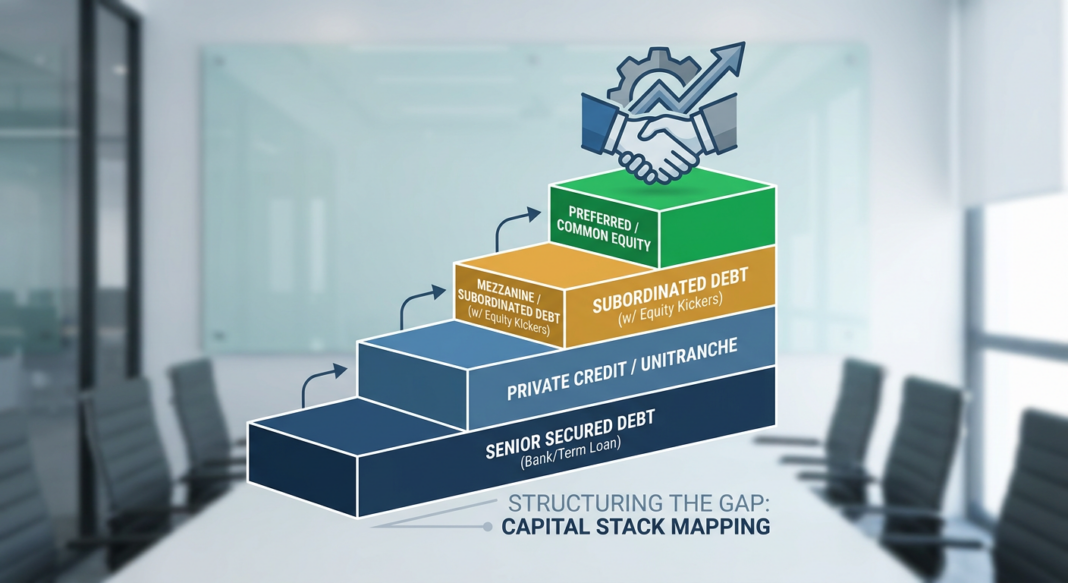
Mapping the Capital Stack: From Banks to Equity
Every acquisition financing begins with the same exercise: lay out the full cost-of-capital spectrum and map what each layer can realistically contribute, given the business’s cash flow profile, asset base, and risk tolerance. For this $90M deal, the stack might look like this:
Layer 1 — Senior Secured Bank Debt (Lowest Cost, Highest Priority)
A traditional leveraged loan or term loan from a bank or club of regional lenders will anchor the stack. At current market levels, well-structured senior secured facilities for middle-market companies are pricing in the range of SOFR plus 250–350 basis points, subject to leverage, coverage ratios, and industry. For a distribution business with stable, recurring revenue, a bank syndicate can typically lend up to 3.0x–3.5x EBITDA on a senior secured basis before maintenance covenants become restrictive. On $18M of combined pro forma EBITDA, that suggests $54M–$63M of senior capacity—a meaningful starting point but still $27M–$36M short of the purchase price before equity.
Layer 2 — Private Credit / Unitranche (Middle Cost, Flexible Structure)
If the business wants to avoid a traditional senior/mezz split and the administrative complexity of multiple lenders, a unitranche facility from a direct lender can collapse the stack into a single instrument. As frameworks from re-cap.com note, junior debt layers in a conventional stack typically price between 12–18% all-in, while senior debt sits at the lower end. A unitranche blends these into a single spread—often SOFR plus 500–650 bps in today’s middle market—and can stretch to 4.5x–5.5x EBITDA. The trade-off is higher all-in cost versus the bank option, but the speed of execution, structural flexibility, and single-lender relationship often justify the premium on acquisitions with a tight timeline.
Layer 3 — Mezzanine / Subordinated Debt With Equity Features (Higher Cost, Subordinated)
If the business wants to maximize leverage without giving up equity outright, a mezzanine tranche can bridge the remaining gap. Mezz lenders at the growth stage commonly require 14–18% total return, delivered through a combination of cash pay interest, PIK (payment-in-kind) accrual, and an equity kicker in the form of warrants or a co-investment right. On a $15M mezz tranche, a structure might carry 10% cash pay plus 4% PIK, with warrant coverage of 3–5% of diluted equity—giving the lender equity upside without requiring a full equity sale. PIK preserves near-term cash flow, which matters when integrating an acquisition, but compounds the debt burden if the integration stalls.
Layer 4 — Preferred or Common Equity (Highest Cost, Most Dilutive)
At the top of the risk tower, equity fills whatever gap debt cannot. A growth equity sponsor or family office co-investor writing a $10M–$15M preferred equity check will typically target 20–30%+ IRR, demand a liquidation preference of 1.0x–1.5x invested capital, and negotiate for a board observer seat or information rights. As capital stack frameworks consistently highlight—including structural guides from firstratefunding.net—founders often underestimate how stacked liquidation preferences affect common equity in downside scenarios. Every preferred dollar added is a claim that sits ahead of the founder in an exit waterfall.
Structuring the Gap: Access vs. Cost Trade-Offs
For this $90M acquisition, a practical stack might allocate as follows:
- $55M Senior Secured Term Loan — Bank or direct lender, ~3.0x EBITDA, SOFR + 300 bps, maintenance covenants on leverage and coverage
- $15M Mezzanine Tranche — Subordinated, 10% cash / 4% PIK, warrant coverage of 4% diluted equity
- $12M Seller Note — Fully subordinated, 6–8% PIK, 5-year maturity, deferred payment aligns seller with integration success
- $8M Management / Sponsor Equity — Common equity rolled by existing owners, preserving majority control
This structure keeps cash-pay debt service manageable in year one of integration while giving the mezz lender an equity participation that lowers the cash coupon demand. The seller note—often overlooked—is one of the most cost-effective gap instruments available: sellers are frequently willing to accept subordinated paper at below-market rates in exchange for deal certainty and tax deferral.
The Gap Capital Playbook: Quantify, Prepare, Run, Negotiate
Step 1 — Quantify the Gap
Before approaching any capital provider, build a sources-and-uses table that stress-tests the stack under a downside scenario: what if EBITDA comes in 15% below plan in year one? Identify the minimum debt service coverage ratio that keeps the company compliant with maintenance covenants and work backward to determine how much PIK versus cash pay the business can tolerate. This number—the true gap—is your negotiating anchor.
Step 2 — Prepare the Materials
Lenders and equity partners evaluating an acquisition need a unified credit narrative, not two separate pitch decks. Prepare a combined company model showing pro forma EBITDA, synergies (clearly labeled as projected, not guaranteed), integration costs, and a three-year debt paydown schedule. Include a covenant compliance model that maps quarterly leverage against proposed maintenance tests. As capital stack design frameworks from alvren.com emphasize, a clean, fully documented data room shortens diligence loops and signals institutional readiness to sophisticated lenders.
Step 3 — Run the Process in the Right Order
Always secure senior debt commitments before approaching mezz lenders or equity co-investors. The senior lender’s term sheet defines the intercreditor framework that subordinated capital must work within. Approaching mezz capital without a senior anchor creates uncertainty about structural seniority—a dealbreaker for most subordinated lenders. Once senior terms are locked, the mezz conversation becomes a negotiation about gap-filling, not a full credit underwrite from scratch.
Step 4 — Negotiate the Structure
Three terms determine the quality of the final structure:
- Covenant headroom — Push for 20–25% cushion above day-one leverage on any maintenance covenant. Integration creates noise; a tight covenant tested quarterly is a restructuring trap.
- PIK toggle optionality — If the mezz lender will accept a cash/PIK toggle rather than mandatory cash pay, negotiate that flexibility into the instrument. It costs little at origination and is invaluable if free cash flow is diverted to integration capex.
- Warrant strike and expiration — Warrants issued to mezz lenders should have clearly defined strike prices, anti-dilution protections, and expiration dates. An open-ended warrant is a structural liability in future financing rounds. Push for a fixed-price call option buyout right after year three.
Key Takeaways
- Use-of-proceeds drives structure: An acquisition demands a purpose-built stack. Recycling an existing revolving credit facility into acquisition currency creates covenant strain and mismatched maturities.
- The unitranche simplifies execution: For growth-stage companies with tight timelines, a single direct-lender facility at SOFR plus 500–650 bps can replace a fragmented senior/mezz split and reduce intercreditor complexity.
- PIK and seller notes are underutilized gap tools: Both preserve cash in the integration period. Seller notes in particular offer below-market cost of capital when the seller has tax or deal-certainty motivations.
- Covenant design is a first-order negotiation: A 15–20% maintenance covenant cushion is not a luxury—it is the operational flexibility buffer that allows management to execute without lender interference during integration.
- Sequence the process correctly: Lock senior terms first, then approach subordinated and equity layers. The senior term sheet is the structural blueprint every other capital provider needs to price their position.


