
The Streamlining of Debt: Understanding Unitranche Financing
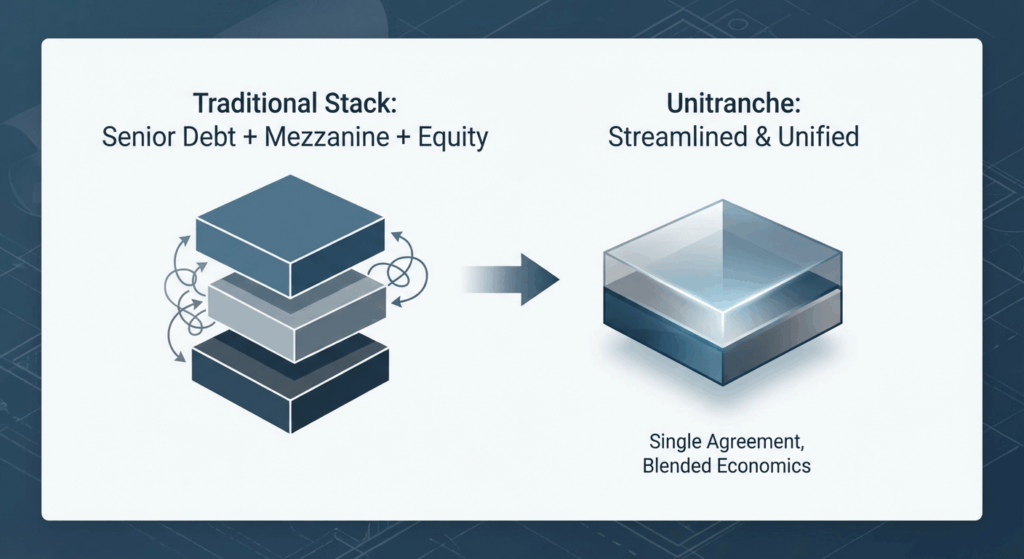
In the evolution of private credit, few innovations have altered the deal-making landscape as significantly as the unitranche facility. For decades, the middle-market capital stack was a layer cake of complexity: senior bank debt at the bottom, mezzanine debt in the middle, and equity on top. Today, unitranche financing has compressed these debt layers into a single, streamlined instrument.
For operators and private equity sponsors, the unitranche offers speed and certainty in an era where traditional bank lending can be fragmented. For investors, it represents a core structural pillar of the direct lending boom that, according to recent forecasts, is propelling the asset class toward $2.6 trillion.
This article dissects the mechanics of unitranche financing, provides a concrete numerical example of how it competes with traditional syndication, and analyzes its role in the 2026 credit environment.
The Concept: One Agreement, Blended Economics
A unitranche loan combines senior secured debt and junior (subordinated) debt into a single debt instrument. Instead of dealing with two separate lenders—a commercial bank for the senior portion and a mezzanine fund for the junior portion—the borrower interfaces with a single private credit manager.
To the borrower, the structure appears monolithic:
- One Credit Agreement: A single set of covenants and documents.
- One Interest Rate: A blended cost of capital that sits between senior and mezzanine rates.
- One Agent: A single point of contact for administration and amendments.
However, behind the scenes, the structure may be bifurcated. This is governed by an Agreement Among Lenders (AAL). The AAL dictates a “first-out” and “last-out” waterfall. If the loan defaults, the “first-out” provider (often a partner bank or the safer slice of the fund) gets paid first, while the “last-out” provider takes higher risk for higher return. Crucially, the borrower is not party to the AAL; it is an internal arrangement between lenders.
How It Works: The Cost vs. Certainty Trade-off
To understand why a borrower would choose a potentially more expensive unitranche over a traditional bank deal, let’s look at the math of a hypothetical $100 million financing for an acquisition.
Option A: Traditional Stratified Debt
The borrower secures two distinct loans:
- Senior Loan ($70M): SOFR + 3.50% (Bank provided). Strict covenants.
- Mezzanine Loan ($30M): 12.0% Fixed. Loose covenants but expensive.
- Execution: Requires an intercreditor agreement. Timeline: 10-12 weeks.
- Weighted Average Cost of Capital (WACC): ~7.5% (depending on SOFR spot rates).
Option B: Unitranche Facility
The borrower secures one loan from a Direct Lender:
- Total Facility ($100M): SOFR + 5.75%.
- Execution: Single document. Timeline: 4-6 weeks.
- WACC: Higher than the blended senior rate, but lower than pure mezzanine.
The Trade-off: On paper, the Unitranche appears more expensive (SOFR + 5.75% vs. a lower weighted average). However, the borrower chooses Option B for three reasons: Closing Certainty (no risk of the bank syndication failing), Speed (critical in competitive auctions), and Leverage Depth (unitranche lenders often lend up to 5.5x or 6.0x EBITDA, whereas banks may cap at 4.5x).
Current Market Relevance (2026)
As of March 2026, the data reflects a maturation of the private credit market where unitranche has become the standard for middle-market buyouts. While banks have attempted to re-enter the market through partnerships, direct lenders retain dominance due to their ability to hold large transaction sizes ($1B+) on a single balance sheet.
According to Coller Capital (June 2025), global private credit AUM reached approximately $1.7 trillion at the end of 2024 and is forecast to surpass $2.6 trillion by 2029. This growth validates the unitranche model as a scalable replacement for the syndicated loan market.
Furthermore, allocations are increasing. A UBS Global Family Office Report cited in March 2026 noted that family offices doubled their private credit holdings from 2% in 2023 to 4% in 2024. However, this influx of capital has come with liquidity “stress tests,” as redemption gates were triggered at major firms in early 2026, highlighting the importance of understanding the illiquidity premium inherent in these structures.
data box: 2024-2026 market metrics
- $1.7 Trillion: Estimated Private Credit AUM as of late 2024 (Coller Capital).
- 40%: Approximate market share of Direct Lending within the total U.S. private credit market (NAIC 2024).
- 4%: Average Family Office allocation to private credit, up from 2% the previous year (UBS / Capital Founders 2026).
Decision Framework
For Operators (Borrowers)
When financing a transition or acquisition, choose Unitranche if:
- Speed is paramount: You are in a competitive auction and need to close in under 6 weeks.
- Complexity is high: The business has a “story” (e.g., tough previous year, adjustments to EBITDA) that requires a lender to do deep diligence rather than a bank’s check-the-box approach.
- Buy-and-Build strategy: The single lender can offer a “delayed draw” facility to fund future acquisitions easily.
For Investors (allocators)
When evaluating private credit funds utilizing unitranche strategies:
- Assess the AAL: Understanding whether the fund is holding the “last-out” (riskier) or “first-out” tranche is critical to return expectations.
- Check Liquidity Terms: As seen in the March 2026 liquidity events, investors must align their time horizon with the fund’s lock-up period. Unitranche loans are illiquid; the fund structure must match that reality.
Key Takeaways
- Singular Efficiency: Unitranche replaces multi-lender complexity with a single credit agreement and blended interest rate.
- Hidden Mechanics: The “Agreement Among Lenders” (AAL) parses risk internally between first-out and last-out participants without involving the borrower.
- Premium Pricing for Premium Features: Borrowers pay a higher headline rate for higher leverage ceilings, execution speed, and lack of “market flex” risk.
- The Growth Engine: Direct lending (primarily unitranche) now accounts for roughly 40% of the U.S. private credit market.
- Liquidity Awareness: Investors must recognize that while yields remain attractive relative to public debt, the asset class requires true capital patience.


