
The Buyout Nobody Saw Coming
In 2021, Francis Pedraza did something almost unheard of in Silicon Valley: he borrowed money to buy out his own investors.
Pedraza is the founder of Invisible Technologies, an AI-and-human-operations company that had quietly grown from $3 million in revenue in 2020 to $134 million by 2024 — profitable, bootstrapped, and structurally different from nearly every other startup in the AI frenzy. While competitors like Scale AI were raising at $14 billion valuations and burning through venture equity, Invisible had taken just $23 million in outside capital across its entire life. And rather than go back to the well for more, Pedraza chose to go the other direction entirely.
He borrowed $20 million — first from growth fund Level Equity, later from JPMorgan — and used it to buy out his early passive investors, including VC shops Day One, Greycroft, and Backed. The early investors, who had likely written their stakes down to near zero years before, got a clean exit. Pedraza got his company back. And his employees — 300 current and former staff whom he calls “partners” — retained a collective 55% stake worth an estimated $275 million at the company’s last $500 million valuation.
“I believed that our equity would 10x in value, so it was an amazing arbitrage,” Pedraza told forbes.com.au.
That arbitrage is the entire thesis. And it is one more founders and operators need to understand.
The Decision Most Founders Never Get to Make
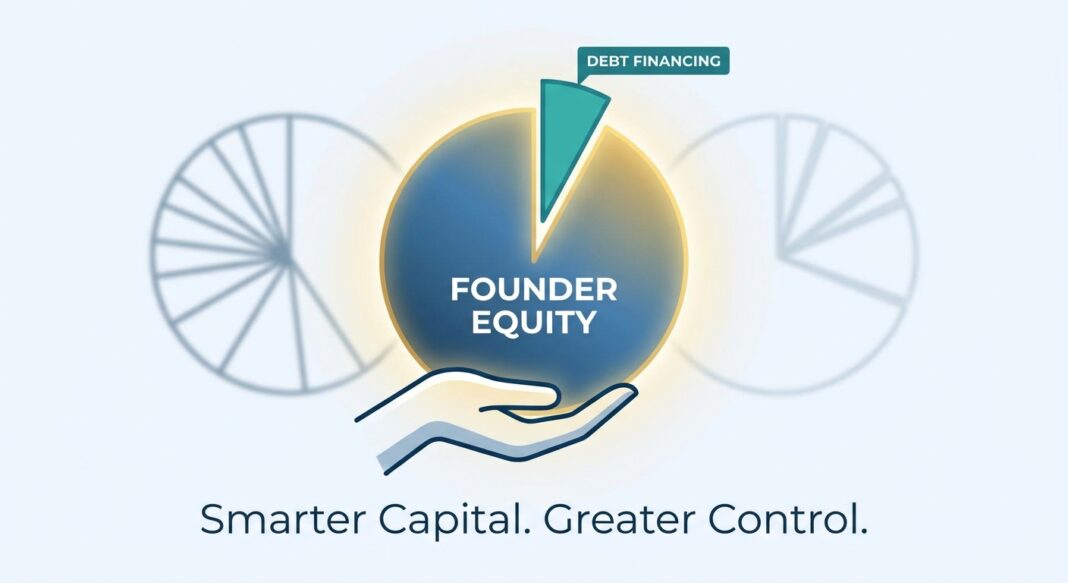
Pedraza’s situation crystallizes the central tension in founder capital strategy: equity feels safe because it doesn’t require repayment, but its hidden cost compounds quietly and permanently. Every point of equity sold to a venture investor is a claim on every future dollar of value the founder creates. Debt, correctly sized and structured, is a finite obligation — pay it back, and the obligation is gone. The equity stays yours.
The key phrase is correctly sized. This is where the story gets instructive — and where a cautionary counterpoint enters the picture.
In October 2021, the same period Pedraza was executing his buyout, rent-to-own startup Divvy Homes was taking on approximately $735 million in debt financing on top of hundreds of millions in preferred equity with liquidation preferences. The logic at the time seemed reasonable: interest rates were near zero, housing prices were rising, and the model appeared airtight. Then rates surged in 2022. Divvy’s model broke. And in January 2025, Brookfield acquired the company for roughly $1 billion — a figure that sounds impressive until you run the waterfall. After repaying the debt, covering transaction costs, and satisfying preferred shareholder liquidation preferences, common shareholders and founders received nothing. As saastr.com summarized bluntly: “$1 billion in. $0 out. For the builders.”
Two founders. The same moment in history. Two completely opposite uses of debt. Two completely opposite outcomes. The difference wasn’t the instrument — it was the discipline.
The Founders Who Got It Right — And the Math Behind Why
Pedraza’s debt was used not to fund operations or scale a capital-intensive model, but to realign the ownership structure of a profitable, cash-generative business. The $20 million he borrowed was modest relative to Invisible’s revenue and valuation. The repayment was manageable. And the benefit — eliminating passive investors who had no alignment with his long-term vision of never selling or IPO-ing — was durable. His debt raised the floor on what success looks like. Divvy’s debt raised the floor on what survival looks like. That distinction is everything.
The same principle plays out at smaller scale with equally compelling clarity. Take SafePointe, the AI-based weapons detection startup founded by Greg and Timothy Holifield. Ahead of a planned acquisition, the father-son team turned to venture debt provider TIMIA Capital for a $1 million facility, drawn in three tranches. The capital allowed them to finance the hardware required to serve new customers, triple their monthly recurring revenue, and execute a clean sale to public safety firm SoundThinking (Nasdaq: SSTI) — all within twelve months of securing the debt. Per timiacapital.com, this marked the Holifields’ fourth successful exit.
Greg Holifield’s observation about cost of capital is worth quoting directly: “They think the interest rate is too high, but when there are no warrants associated with debt, it is truly fantastic money — and much cheaper than equity.” The equity investors who came in alongside TIMIA made 10x in nine months. TIMIA’s cost of capital was a small fraction of that. For the founders, choosing a mix weighted toward debt meant they captured proportionally more of the exit than they would have under a pure equity structure.
And at the micro-SaaS level, Modigi CEO Ken Hoppe used $400,000 in revenue-based financing from Founderpath to hire his first salesperson and customer success manager, scale to $1.7 million in ARR with just six employees, and retain 100% equity throughout. No board. No dilution. No liquidation preference queue. As he told founderpath.com: “Founderpath helped us keep control of the company while still getting the capital we needed to grow.”
The Framework: When Debt Liberates and When It Destroys
These stories collectively surface a framework that any operator or founder can apply before taking on debt or equity:
1. Model Your Waterfall First
Every founder should be able to answer one question before signing any financing document: at what exit price do I personally receive $0? Divvy’s founders apparently didn’t have a clear answer — or if they did, they assumed the exit price would never test it. Every dollar of debt raises that floor. Know your number.
2. Match Debt to Business Model, Not Ambition
Debt works when the business generates predictable, recurring cash flow sufficient to service it. Invisible Technologies was profitable when Pedraza borrowed. SafePointe had growing MRR contracts. Modigi was cash-flow positive. Divvy was buying houses with rate-sensitive financing in a market that could turn. The instrument isn’t the risk — the fit is.
3. Understand the True Cost of Equity
The hidden cost of venture equity is not the percentage on the term sheet — it’s the liquidation preference stack, the governance control, the pressure to optimize for IRR rather than durability, and the asymmetric upside your investors capture when you exit. Swayable co-founder James Slezak put it plainly when evaluating revenue-based financing against a VC offer: “If we’re 10xing their money, they’re earning 1,000% returns — the piece of paper you’re giving your VC is worth 10x more when they cash it out. Their gain is your cost.” As documented by arc.tech, Swayable chose non-dilutive capital, executed 73% quarter-on-quarter topline growth, and maintained near-zero cash burn.
4. Size Conservatively, Draw Strategically
SafePointe’s TIMIA facility was drawn in three disbursements, timed to actual business milestones rather than taken upfront as a lump sum. This approach reduced carrying cost, maintained flexibility, and aligned capital deployment with revenue recognition. The Holifields treated debt as a precision instrument, not a safety blanket.
5. Never Operate on Debt as If It Were Revenue
Divvy’s most instructive failure was not the amount borrowed — it was that the $735 million was structural to the operating model, not supplemental to it. The business could not function without continuing to access and deploy that debt. When market conditions shifted, the mechanism that powered growth became the mechanism that destroyed equity. Debt should accelerate a working model, never enable a broken one.
Key Insights
- Debt is non-dilutive on the cap table but not in outcomes — without discipline on sizing, it can consume the entire exit waterfall before founders see a dollar, as Divvy Homes’ $1 billion sale demonstrated.
- Profitable businesses can use debt to reclaim equity — Invisible Technologies’ Francis Pedraza borrowed $20 million to buy out passive VCs, preserving long-term control and capturing upside that would otherwise have been shared.
- Non-dilutive capital can be the decisive variable in an exit — SafePointe used a $1 million TIMIA facility to triple MRR and complete a strategic acquisition to SoundThinking within twelve months, all without equity dilution.
- The real cost of VC equity is not the headline percentage — it is the liquidation preference stack, governance transfer, and asymmetric investor upside that accumulate quietly until the exit waterfall is run.
- The discipline of the borrower matters more than the terms of the lender — the same instrument that liberated Invisible Technologies and SafePointe destroyed founder equity at Divvy Homes. Fit, sizing, and use of proceeds are everything.


