
Where You Stand Determines What You Earn — and Whether You Get Paid Back
In private credit, one question matters above all others before a single dollar is committed: where does this loan sit in the capital stack? That position — senior, subordinated, mezzanine, or equity — determines the order in which investors get repaid if a borrower defaults, how much interest they earn for taking that risk, and ultimately, how much capital protection they actually have. For business owners seeking financing, that same stack determines the true cost of capital and how much ownership or control they surrender to access it.
The capital stack isn’t an abstract concept. It is the legally binding hierarchy that governs every dollar flowing out of a distressed or solvent company. Understanding it is the single most foundational skill for anyone participating in private credit markets — whether as a lender, investor, or borrower.
What the Capital Stack Is and How Subordination Works
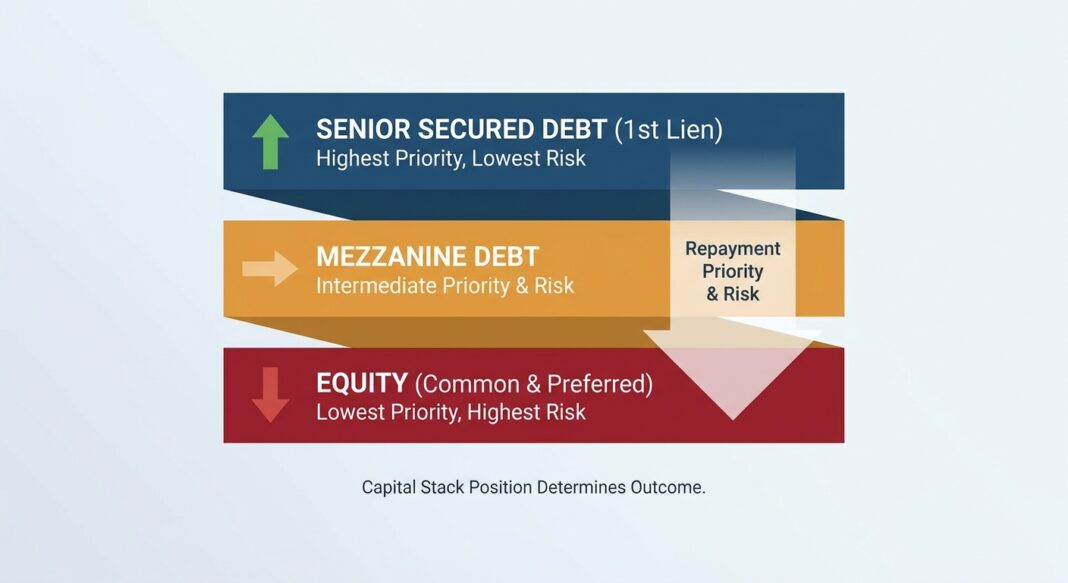
The capital stack is the ordered hierarchy of financing layers in a company’s balance sheet. From top to bottom, it typically runs: senior secured debt, unitranche debt, subordinated (junior) debt, mezzanine debt, preferred equity, and common equity. Each layer carries a distinct risk profile, repayment priority, and return expectation.
Subordination is the legal mechanism that establishes this hierarchy. A subordinated creditor contractually agrees to be repaid only after senior creditors have been made whole. In a liquidation or restructuring, senior lenders with a first lien — a legal claim on specific assets — get paid first. Junior creditors receive whatever remains. Equity holders get nothing until all debt obligations are satisfied.
This ordering creates a direct trade-off: the higher your position in the stack, the safer your capital but the lower your yield. The lower your position, the greater your potential return — and the greater your exposure to loss. As one framework from Capital Market Compass (2025) describes it, moving down the stack means “increasing subordination, increasing return, and increasing dilution.”
A Concrete Example with Real Numbers
Consider a private equity-sponsored buyout of a manufacturing company with $10 million in EBITDA and a total enterprise value of $50 million. The deal is financed as follows:
- Senior Secured Debt (First Lien): $25 million at SOFR + 300 bps (approximately 6.5–7% all-in). First lien on all company assets. Repaid first in any default scenario.
- Mezzanine Debt: $10 million at 13–15% cash interest, sometimes with equity warrants attached. Repaid only after senior debt is fully satisfied.
- Equity (Sponsor Contribution): $15 million. Last in line; absorbs all losses before lenders are impaired.
Now stress-test this structure: the company’s value falls 40% in a distressed scenario, leaving $30 million available for creditors and equity. The senior lender recovers their full $25 million. The mezzanine lender recovers $5 million — a 50% loss. Equity is wiped out entirely. Same company, same event — but completely different outcomes based purely on stack position.
The equity cushion protecting the senior lender here is $25 million (mezzanine + equity combined), or 50% of enterprise value. That buffer is what private credit analysts call the loan-to-value (LTV) ratio — and the lower it is for a senior lender, the more protected their capital.
Current Market Relevance: Where Private Credit Sits Today
Understanding subordination is especially critical in today’s market environment, where private credit has scaled dramatically and structural nuances are intensifying.
According to Long Angle’s Private Credit Investment Guide (2026), private credit assets under management surpassed $2 trillion in 2025 and are projected to reach $4.5 trillion by 2030. Direct lending — predominantly senior secured, first-lien loans — accounts for approximately 38% of private credit capital raised in H1 2025, making it the largest single sub-strategy by volume.
That senior-secured dominance reflects deliberate risk management by institutional allocators. As noted in Meketa Investment Group’s Private Credit Primer (2024), direct lending loans are typically senior in the capital structure — one of the defining structural protections of the asset class. Roughly 80% of the direct lending market is sponsor-backed, meaning private equity firms provide the equity cushion that sits beneath lenders in the stack.
Private credit has also displaced banks as the primary source of senior financing for mid-market companies. According to Long Angle (2026), bank lending as a share of U.S. GDP declined from 59% in Q4 2008 to 44% as of Q1 2025, opening the door for non-bank lenders to occupy the senior secured position that banks once dominated. Private credit now commands roughly 20% market share of existing leveraged credit demand.
Meanwhile, the Coller Capital Secondaries Institute (2025) notes that global private credit AUM reached approximately $1.7 trillion at end of 2024, more than fivefold the $300 billion recorded in 2010. The expansion of the asset class has brought more complex, multi-tranche structures to market — raising the stakes for understanding exactly where each dollar sits in the hierarchy.
Decision Framework: Investors and Operators
For Investors Evaluating Private Credit Opportunities
- Identify lien position first. First lien senior secured is not equivalent to second lien, even if both carry the label “private credit.” Understand what claim you hold on specific assets.
- Quantify the equity cushion. Measure how much subordinated capital sits beneath your position before losses reach you. A 40–50% equity cushion in a first-lien deal provides meaningful downside protection.
- Match yield expectations to stack position. A senior secured loan yielding SOFR + 300 bps and a mezzanine note yielding 14% represent fundamentally different risk profiles. Investors consider whether the spread adequately compensates for subordination risk.
- Evaluate covenant protections. Senior debt in private credit typically includes financial maintenance covenants — ongoing tests of leverage and coverage — that give lenders early warning and intervention rights not available in broadly syndicated loans.
For Operators and Business Owners Seeking Capital
- Senior debt is the cheapest non-dilutive option. If your business can support first-lien borrowing, it is almost always the most cost-efficient capital available — lower rates and no equity dilution.
- Mezzanine fills the gap, but at a price. When senior capacity is exhausted and equity is expensive, mezzanine debt can bridge the gap. Operators evaluate the all-in cost — including any warrant or PIK components — against the dilution cost of issuing additional equity.
- Stack complexity adds negotiating leverage, but also risk. Multi-tranche structures introduce intercreditor agreements and potential conflict between lender classes in a stress scenario. Operators benefit from understanding these dynamics before signing.
Key Takeaways
- Position is protection. In private credit, your place in the capital stack — not just the borrower’s credit quality — determines your recovery outcome in a default. Senior secured lenders with first liens receive payment before all other claimants.
- Subordination creates the yield spectrum. Every step down the capital stack — from senior to mezzanine to equity — compensates investors with higher yields in exchange for accepting greater loss exposure and later repayment priority.
- The equity cushion is your margin of safety. Investors in senior positions benefit from the equity and junior debt below them absorbing losses first. A thicker cushion means a wider buffer before principal is impaired.
- Private credit now owns the senior lending role. As banks have retreated from middle-market lending, non-bank direct lenders have stepped into the first-lien senior position — capturing both the yield premium and the structural protections that come with it.
- Operators should optimize the stack, not just access it. Business owners benefit from understanding the full cost and control implications of each capital layer — choosing the right mix of senior debt, subordinated capital, and equity to minimize dilution while maintaining financial flexibility.


