
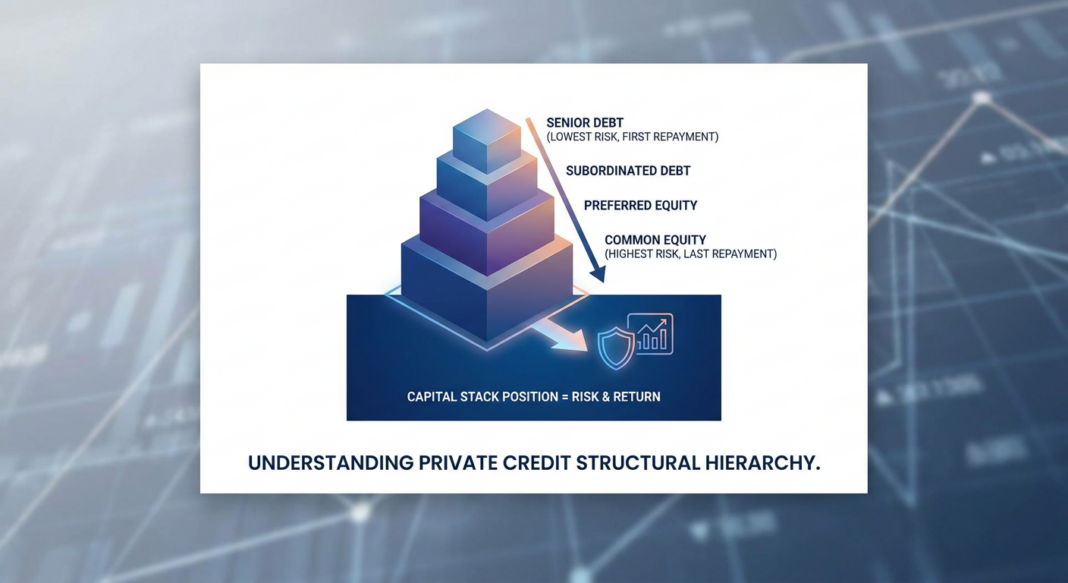
The Capital Stack: The Most Important Concept in Private Credit
Before a single dollar is deployed in a private credit transaction, one question determines everything: where does this loan sit in the capital stack? Your position in the hierarchy of claims — senior secured at the top, common equity at the bottom — dictates your repayment priority, your legal protections, your interest rate, and ultimately your probability of recovering capital if a borrower runs into trouble.
Most investors new to private credit focus on yield. Experienced practitioners focus on subordination — the formal legal ordering of who gets paid first when cash flows get tight or a business enters distress. Understanding this hierarchy is the single most important foundational concept in private credit.
How the Capital Stack Works
The capital stack is the structured hierarchy of financing sources used to fund a company. Think of it as a layered waterfall: in normal operations, all parties receive their contractual payments. In a default or liquidation, cash flows from assets are distributed strictly from top to bottom — senior creditors are made whole first, and only the residual reaches those lower in the structure.
The primary layers, from lowest risk to highest, are:
- Senior Secured Debt (First Lien): The top of the stack. Backed by a first-priority lien on the company’s assets — meaning lenders have the legal right to seize collateral first. Lowest interest rate because lenders bear the least risk. Typical coverage structures require the business to generate 2x its interest expense in operating cash flow.
- Unitranche Debt: A hybrid instrument that blends senior and subordinated debt into a single loan from one lender. Widely used in private credit today because it simplifies deal execution. The interest rate sits between what a pure senior or pure subordinated lender would charge.
- Subordinated / Mezzanine Debt (Second Lien): Sits below senior debt. Only repaid after first-lien lenders are fully recovered. Carries a meaningfully higher interest rate to compensate for this added risk — and is frequently structured with equity warrants that give lenders upside participation if the company performs well.
- Preferred Equity: Not technically debt, but senior to common equity. Preferred holders receive fixed dividends before any distributions reach common shareholders.
- Common Equity: The bottom of the stack. Last to be repaid, first to absorb losses. Highest risk, highest potential return if the business succeeds.
According to Corporate Finance Institute, a well-structured capital stack optimizes risk and return, allowing businesses to expand sustainably while managing financial obligations — and each layer carries a distinctly different risk-return profile that investors must evaluate before committing capital.
A Concrete Example With Real Numbers
Consider a private equity-sponsored acquisition of a manufacturing business valued at $50 million. The deal is structured as follows:
- Senior Secured Loan: $25 million at SOFR + 350 bps (approximately 7.0% all-in as of mid-2026) — 50% of the capital stack
- Mezzanine Debt: $10 million at a fixed 13.0% cash coupon — 20% of the stack
- Equity (Private Equity Sponsor): $15 million — 30% of the stack
Now imagine the business underperforms and is liquidated for $32 million — a 36% haircut from its purchase price. Here is how that $32 million flows through the waterfall:
- The senior lender receives the first $25 million — fully recovered.
- The mezzanine lender receives the remaining $7 million — recovering 70 cents on the dollar.
- The equity sponsor receives nothing.
This single example illustrates why structural seniority is such a powerful form of downside protection — and why private credit lenders sitting at the top of the stack can absorb significant value deterioration and still emerge intact.
Current Market Relevance
The capital stack concept is not merely theoretical — it is actively shaping how capital is being deployed in 2026. Several market dynamics make an understanding of subordination more important than ever:
According to Long Angle’s Private Credit Investment Guide 2026, private credit assets under management were estimated at over $2 trillion in 2025 and are projected to reach $4.5 trillion by 2030. That explosive growth means more capital is competing for positions across the entire stack — and the terms and protections within each layer are evolving rapidly.
The same guide notes that bank lending as a share of U.S. GDP has declined from 59% in Q4 2008 to 44% as of Q1 2025, as post-crisis regulation and recent banking stress events have pushed traditional lenders away from corporate credit. Private credit has stepped in to fill that structural gap — particularly in senior secured positions that banks once dominated.
According to Long Angle, direct lending — predominantly senior secured — accounted for 38% of all private credit capital raised in H1 2025, reflecting continued institutional preference for the top of the stack in an environment where credit quality is under scrutiny.
Meketa Investment Group’s Private Credit Primer notes that private credit financed approximately 85% of leveraged buyouts in 2023, up from 65% in 2021 — evidence that private lenders have structurally displaced banks as the primary source of deal financing across the capital stack.
Meanwhile, default rates for senior secured direct lending have remained below 4% since 2021, according to the Proskauer Private Credit Default Index cited in Long Angle’s guide — a figure that underscores how structural seniority and collateral protection have historically contained losses even through market volatility.
| Metric | Data Point | Source |
|---|---|---|
| Private Credit AUM (2025 est.) | $2 trillion+ | Long Angle, 2026 |
| AUM Projection (2030) | $4.5 trillion | Long Angle, 2026 |
| LBOs Financed by Private Credit (2023) | ~85% | Meketa / Blackstone via LCD, 2024 |
| Direct Lending Default Rate (post-2021) | <4% | Proskauer Default Index via Long Angle, 2026 |
| Bank Lending Share of U.S. GDP (Q1 2025) | 44% (down from 59% in 2008) | Long Angle, 2026 |
Decision Framework: Investors and Operators
For Investors Evaluating Private Credit:
- Identify your position before evaluating yield. A 12% return in a second-lien position is not the same as a 12% return in a first-lien position. Assess what lies above and below you in the stack before modeling recovery scenarios.
- Quantify the equity cushion. Investors typically evaluate how much enterprise value would have to decline before their position incurs a loss. A 30–35% equity contribution by a private equity sponsor provides meaningful buffer before senior lenders are impaired.
- Examine covenant structures. Senior secured loans in private credit typically carry maintenance financial covenants — ongoing tests that trigger lender protections before a full default. Subordinated debt may offer weaker covenant packages.
- Understand concentration and collateral. Asset-backed structures (equipment, receivables, real estate) provide liquidation value independent of business performance. Cash-flow-based loans rely entirely on the company continuing to operate.
For Business Operators Seeking Capital:
- Start with senior debt. The cheapest capital in your stack is always senior secured. Max out this layer before moving down the stack, as each additional layer is progressively more expensive.
- Evaluate the true cost of mezzanine and equity. A mezzanine lender charging 13% all-in is expensive — but equity capital that requires a 25–30% return and dilutes your ownership may cost far more over a five-year horizon.
- Match capital structure to cash flow visibility. Businesses with predictable, recurring revenues can support more senior debt. Cyclical or early-stage businesses may find subordinated or equity capital more appropriate even at higher cost.
Key Takeaways
- Position determines protection. In a distressed scenario, senior secured lenders at the top of the capital stack are repaid first. Even a significant decline in business value may leave senior lenders whole while equity is wiped out entirely.
- Risk and return travel together through the stack. Every layer down the capital stack — from senior to mezzanine to equity — demands incrementally higher returns to compensate for subordinated repayment priority and weaker collateral claims.
- Private credit has structurally replaced bank lending across the stack. Regulatory pressure since 2008 has pushed banks out of corporate lending, and private credit managers now occupy senior, unitranche, and mezzanine positions that banks once filled.
- The equity cushion below you is a lender’s first line of defense. A 30% equity contribution means enterprise value must fall by nearly a third before a senior lender faces any impairment — a concept investors evaluate before pricing any deal.
- Operators should view the capital stack as a cost-of-capital spectrum. Senior debt is the cheapest capital available. Moving down the stack toward equity increases cost and dilution. A well-structured stack minimizes the blended cost of capital while preserving ownership and operational flexibility.


