
Why Your Position in the Stack Is Everything
In private credit, not all lenders are created equal — and that inequality is entirely by design. Before a single dollar of interest is paid, before any collateral is liquidated, before equity holders see a cent, a strict pecking order governs who gets paid first. That pecking order is called the capital stack, and understanding where a loan sits within it is arguably the single most important concept in private credit investing.
For investors evaluating private credit funds or direct lending strategies, capital stack position determines the risk-return profile of every deal. For business owners and operators seeking growth capital, it determines the cost of that capital, what you give up to get it, and how much breathing room you retain when business conditions tighten. Whether you’re allocating institutional capital or funding a middle-market acquisition, the stack tells the story.
The Concept: Seniority, Subordination, and the Repayment Waterfall
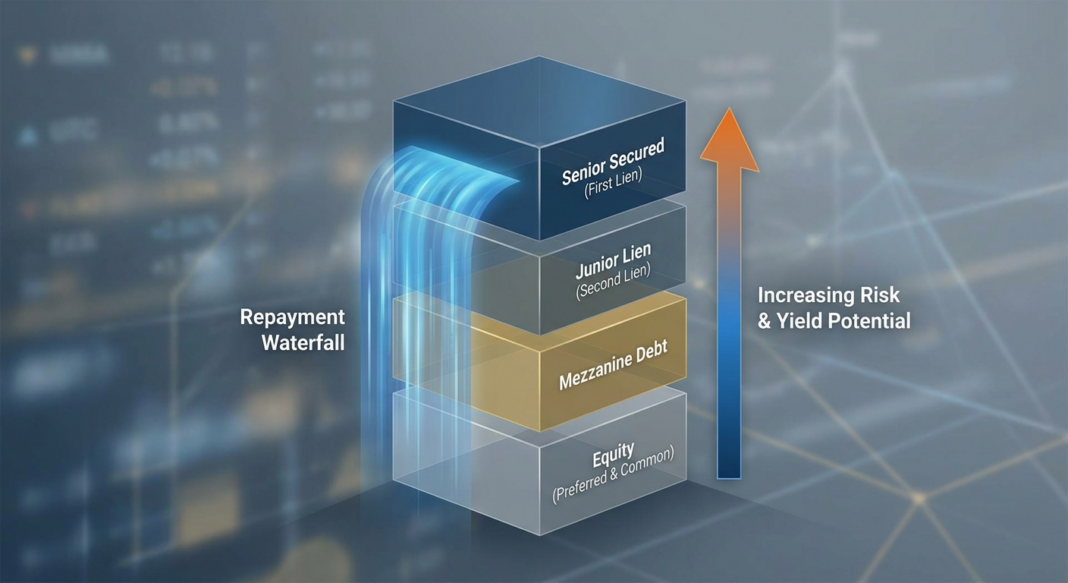
The capital stack is the layered architecture of all claims on a company’s assets and cash flows. Each layer, or tranche, is defined by two things: its priority of repayment in a default scenario, and the return it demands in exchange for accepting its level of risk. The layers, from most to least senior, typically look like this:
- Senior Secured Debt — First lien on assets; paid first in bankruptcy; lowest yield.
- Junior / Second Lien Debt — Paid after senior lenders; higher yield to compensate for subordination.
- Mezzanine Debt — Unsecured or deeply subordinated; often carries equity warrants; higher yield again.
- Preferred Equity — Not debt, but senior to common equity; fixed or negotiated return.
- Common Equity — Last to be paid; highest risk; highest potential upside.
The principle governing this structure is called subordination: a junior lender contractually agrees to receive payment only after all senior lenders have been made whole. In exchange for that deferred claim, they demand a higher interest rate or additional economic participation. This trade-off — yield for priority — is what calibrates the entire private credit market.
How It Works: A Concrete Example with Numbers
Imagine a private equity firm acquires a regional manufacturing company for $100 million. The deal is financed as follows:
- Senior Secured Term Loan (First Lien): $50 million — priced at SOFR + 300 bps (roughly 8.3% all-in as of early 2026)
- Junior / Second Lien Loan: $15 million — priced at SOFR + 700 bps (roughly 12.3% all-in)
- Mezzanine Note: $10 million — fixed at 14%, plus equity warrants for 2% of the company
- Sponsor Equity: $25 million — no guaranteed return; all upside and residual risk
Now suppose the company runs into trouble and is liquidated for $60 million — a 40% haircut to the purchase price. Here’s how the waterfall flows:
- Senior Secured lender receives: $50 million — fully recovered.
- Second Lien lender receives: $10 million of their $15 million — a $5 million loss.
- Mezzanine lender receives: $0 — fully wiped out.
- Equity sponsor receives: $0 — fully wiped out.
This is subordination in action. The senior secured lender accepted a lower yield precisely because they get the first claim on assets. The mezzanine lender accepted the risk of total loss in a distress scenario — but in a successful exit at $130 million, their warrants might produce an additional $600,000 in upside. Every position in the stack is a deliberate risk-return trade.
Current Market Relevance: Where the Stack Stands in 2026
Understanding the capital stack isn’t just theoretical — it has direct implications for how capital is being deployed right now.
According to the Federal Reserve’s Senior Loan Officer Opinion Survey (SLOOS), Q4 2025, a net positive share of large domestic banks continued to report tighter lending standards on commercial and industrial loans, sustaining the post-2022 tightening cycle. When banks retreat, the senior secured layer of the private capital stack becomes the primary battleground for non-bank lenders — and direct lenders have stepped in aggressively.
According to Preqin’s Global Private Debt Report 2025, private credit assets under management surpassed $1.7 trillion globally, with direct lending — overwhelmingly concentrated in first-lien senior secured positions — accounting for the largest single strategy by AUM. The demand for senior secured exposure reflects institutional capital’s preference for stack position over raw yield.
Meanwhile, the Cliffwater Direct Lending Index (CDLI) has consistently tracked middle-market senior secured loans delivering net returns in the 9%–11% range through 2024 and into 2025, demonstrating that senior position does not mean sacrificing competitive income. Spreads on first-lien middle-market loans remained well above those available in broadly syndicated markets, partly because direct lenders retain structural protections — including maintenance covenants — that syndicated markets have largely abandoned.
According to data tracked by S&P Global’s Leveraged Commentary & Data (LCD), the share of covenant-lite structures in the broadly syndicated loan market remained above 85% through 2025 — a structural vulnerability that private credit’s senior secured positions, with their negotiated covenant packages, are specifically designed to address.
For operators and private equity sponsors, this environment means that first-lien senior debt remains the most competitively priced layer of the stack — while mezzanine and junior capital has become significantly more expensive relative to pre-2022 benchmarks, reflecting both rate normalization and lender selectivity.
Decision Framework: Investors and Operators
For Investors Evaluating Private Credit Exposure:
- Identify stack position before yield. A 13% yield in the mezzanine layer carries fundamentally different risk than a 9% yield in a senior secured first lien. Compare the loss-given-default scenario for each, not just the coupon.
- Assess the equity cushion below you. Senior lenders are protected by the equity beneath them. A deal with 35–40% equity as a percentage of enterprise value provides meaningfully more downside protection than one with 15–20%.
- Evaluate covenant protections by tranche. Senior secured private credit loans in the middle market frequently carry maintenance covenants — metrics the borrower must continuously meet — which give lenders early warning and negotiating leverage before a situation deteriorates.
For Operators and Business Owners Seeking Capital:
- Use the cheapest senior debt available first. Senior secured debt — from banks or direct lenders — is the lowest cost of capital in the stack. Exhaust this layer before exploring subordinated or equity alternatives.
- Understand what subordinated capital costs you beyond the coupon. Mezzanine and preferred equity often come with warrants, PIK toggles, or equity conversion rights. Model the full economic dilution, not just the stated interest rate.
- Stack position affects your flexibility. Senior lenders with maintenance covenants will have more contractual involvement in your business during stress. Junior capital providers may accept looser terms — but at a much higher price.
Key Takeaways
- Seniority determines survival in a downturn. In a liquidation, the capital stack is not a suggestion — it is a binding legal waterfall. Senior secured lenders get paid first, period.
- Every yield premium in the stack has a structural explanation. Higher returns in junior tranches are not a gift — they are compensation for accepting a subordinated, higher-risk position with less collateral protection.
- Bank retrenchment has made senior private credit the dominant institutional play. As banks tighten standards, direct lenders occupying the first-lien senior secured layer are capturing deal flow that traditional lenders have ceded.
- Operators should model total cost, not headline rate. Mezzanine and subordinated capital may carry equity participation features that make the true cost of capital significantly higher than the stated coupon suggests.
- Covenant structure tracks with stack position. Senior private credit lenders typically negotiate stronger covenant packages, giving both parties clearer guardrails — a feature that broadly syndicated, covenant-lite alternatives cannot match.


