
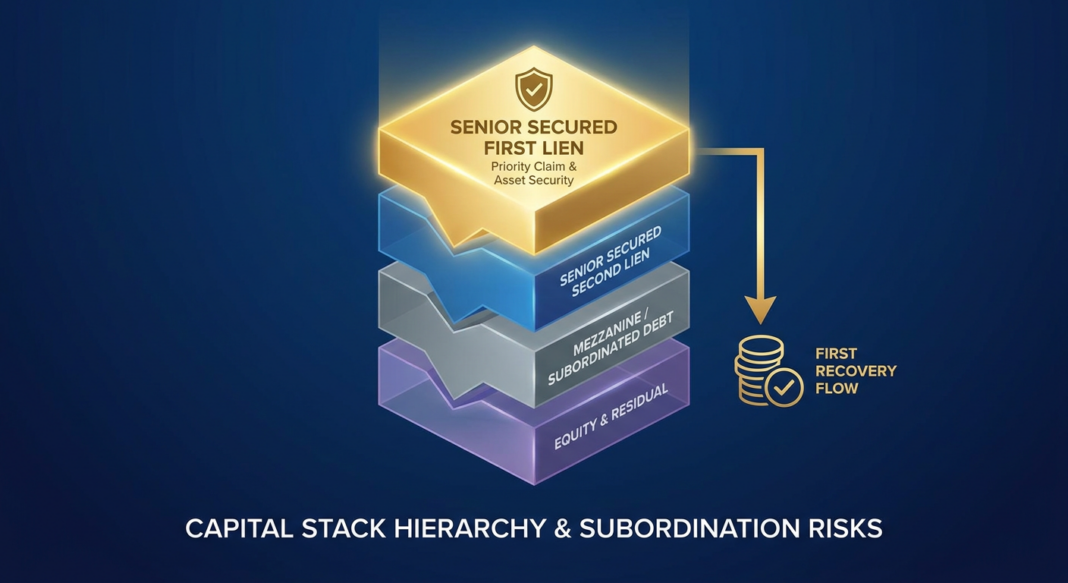
Why Your Position in the Stack Is Everything
In private credit, not all lenders are created equal. When a company borrows money from multiple sources — or even a single structured facility — the order in which each lender gets repaid in a default scenario is arguably the most important variable in determining risk-adjusted return. That order is defined by the capital stack, a layered hierarchy of debt and equity claims on a borrower’s assets and cash flows.
Understanding capital stack position and subordination — the legal and contractual arrangement that places one lender’s claim below another’s — is foundational for anyone evaluating private credit as an asset class or seeking structured financing as a business operator. Position determines priority. Priority determines recovery. Recovery determines whether a lender earns its expected return or absorbs a loss.
In an era when private credit has grown into a multi-trillion-dollar asset class, with institutional allocations rising and bank lending standards remaining selective, knowing exactly where you sit in the capital stack has never been more consequential.
The Capital Stack: Definition and Mechanism
Think of the capital stack as a building. The lowest floors are the foundation — the most secure, first to be protected, last to absorb damage. The highest floors get the best views (highest returns) but are first to fall in a storm. In finance, this structure works the same way.
A typical private credit capital stack, from most to least senior, includes:
- Senior Secured First Lien Debt: The top-priority claim, secured by a first-priority lien on the borrower’s assets. In liquidation, this lender is paid first from asset proceeds.
- Senior Secured Second Lien Debt: Also secured, but subordinated to the first lien. Paid only after the first lien lender is made whole.
- Unitranche Debt: A blended single-lender facility that economically combines first and second lien risk, common in middle-market direct lending.
- Mezzanine / Subordinated Debt: Unsecured or junior-secured debt, carrying higher interest rates to compensate for its lower recovery priority.
- Preferred Equity: Hybrid instrument with fixed return features but still subordinate to all debt in a default.
- Common Equity: The residual claimant — last to be paid, first to be wiped out.
Subordination is the legal mechanism — codified in intercreditor agreements — that formally ranks these claims and restricts junior lenders from taking enforcement actions before senior lenders are satisfied.
How It Works: A Concrete Example with Numbers
Consider a private equity-backed manufacturing company, Acme Industrial LLC, with the following capital structure:
- Enterprise Value: $100 million
- Senior Secured First Lien Term Loan: $40 million (direct lender, 9.5% interest)
- Second Lien Term Loan: $15 million (specialty finance firm, 13% interest)
- Mezzanine Note: $10 million (12% cash + 3% PIK)
- Sponsor Equity: $35 million
Acme enters financial distress and its enterprise value falls to $48 million in a distressed sale. Here is how recoveries flow:
- First Lien Lender: Receives $40 million — fully repaid. Recovery rate: 100%.
- Second Lien Lender: Receives the remaining $8 million of a $15 million claim. Recovery rate: ~53%.
- Mezzanine Lender: Receives $0. Claim of $10 million is entirely wiped out.
- Sponsor Equity: Receives $0. The $35 million equity check is a total loss.
This example illustrates subordination in action: the same company, the same distress event, but radically different outcomes depending solely on stack position. The first lien lender structured its risk correctly. The mezzanine lender took on junior risk for a higher coupon — and paid the price when enterprise value deteriorated past its attachment point.
The critical concept here is the equity cushion: the amount of enterprise value that must be destroyed before a lender’s position is impaired. In Acme’s case, the first lien lender had a $60 million equity cushion (60% of EV) absorbing losses before their $40 million was touched.
Current Market Relevance
Capital stack discipline is not abstract theory — it is being tested in real time by current credit market conditions.
According to the Federal Reserve’s Senior Loan Officer Opinion Survey (SLOOS), January 2025, a net positive share of domestic banks continued to report tighter standards for commercial and industrial loans to middle-market firms, sustaining a restrictive lending environment that began tightening in 2022. This persistent tightening has pushed more borrowers into the private credit market — often accepting more complex stack structures to access capital.
According to Preqin’s Global Private Debt Report 2025, global private debt assets under management reached approximately $1.7 trillion by mid-2024, with direct lending representing the largest sub-strategy by AUM. Preqin projects the asset class could exceed $2.6 trillion by 2029, reflecting sustained institutional demand.
According to Cliffwater’s Direct Lending Index (CDLI), Q3 2024, average yields on middle-market direct loans remained elevated near 11–12%, driven by floating-rate structures tied to SOFR and persistently wide credit spreads relative to broadly syndicated loans.
According to PitchBook’s 2024 Annual U.S. PE Breakdown, sponsor-backed buyout loan-to-value (LTV) ratios for middle-market transactions averaged in the 40–50% range, meaning equity cushions of 50–60% were common in new direct lending deals — consistent with the protective stack positioning described above.
According to Apollo Global Management’s 2024 Investor Insights, senior secured direct lending has demonstrated historically lower loss rates than broadly syndicated leveraged loans, attributed in part to stronger covenant packages and first-lien structural protections available in the private credit market.
| Metric | Value | Source |
|---|---|---|
| Global Private Debt AUM (mid-2024) | ~$1.7 trillion | Preqin, 2025 |
| Avg. Middle-Market Direct Loan Yield (Q3 2024) | ~11–12% | Cliffwater CDLI, Q3 2024 |
| Sponsor Buyout Average LTV (2024) | 40–50% | PitchBook, 2024 |
| Banks Tightening C&I Loan Standards (Jan 2025) | Net positive share | Fed SLOOS, Jan 2025 |
| Private Debt AUM Projection (2029) | >$2.6 trillion | Preqin, 2025 |
Decision Framework: Investors and Operators
For Investors Evaluating Private Credit Funds:
- Ask: What position does this fund lend into? Senior secured first lien funds carry fundamentally different risk profiles than mezzanine or opportunistic credit funds — even if both are labeled “private credit.”
- Evaluate the attachment point. What percentage of enterprise value must be destroyed before the loan is impaired? A loan at 45% LTV has a 55% equity cushion — far more protective than a loan at 70% LTV.
- Examine intercreditor agreements. In unitranche or split-lien structures, investors should understand what rights junior tranches have relative to senior during a default — standstill periods, enforcement restrictions, and voting rights all matter.
- Assess vintage diversification. Capital stack risks often correlate with credit cycle timing. Loans originated during periods of loose underwriting may carry hidden subordination risk through aggressive leverage multiples.
For Business Operators Seeking Capital:
- Understand what you are giving up at each layer. Mezzanine and second lien capital typically costs 300–500 basis points more than senior secured debt — that spread compensates the lender for its subordinated position and should be weighed against the dilution cost of raising additional equity instead.
- Consider how stack complexity affects future flexibility. Multiple lenders at different stack positions create intercreditor dynamics that can complicate amendments, covenant waivers, and refinancing. Unitranche structures with a single lender can simplify this — at a blended cost.
- Model your downside enterprise value. If your business is worth $50 million today, consider how much value could erode in a stress scenario — and whether your senior lender’s claim fits comfortably within that floor.
Key Takeaways
- Position is priority. In private credit, where you sit in the capital stack directly determines your recovery outcome in a default. Senior secured lenders recover first; equity absorbs losses first.
- Subordination is contractual, not just conceptual. Intercreditor agreements legally enforce payment priority and restrict junior lenders from acting against a company before senior lenders consent.
- The equity cushion is your margin of safety. Investors should evaluate how much enterprise value must be destroyed before their loan position is impaired — the larger the cushion, the lower the effective credit risk.
- Higher yield = lower stack position. In private credit, additional coupon income typically signals additional subordination risk. Understanding what drives that yield spread is essential before accepting it.
- Bank tightening has made stack literacy essential. As traditional lenders remain selective and borrowers turn to private credit markets, the range of capital stack structures — and the complexity of terms within them — has expanded. Investors and operators alike benefit from understanding exactly where each dollar sits.


