
Why Where You Sit in the Stack Determines Everything
In private credit, not all debt is created equal. Two lenders can fund the same company, charge interest on the same collateral, and still face dramatically different outcomes in a default. The difference comes down to one concept: capital stack position. Understanding how repayment priority is structured — and what sits above or below your claim — is the single most important framework for evaluating risk in any private credit transaction.
Whether you are an institutional investor evaluating a direct lending fund or a business owner weighing financing options, the capital stack tells you who gets paid first, who absorbs losses first, and why each layer carries a different price tag.
What the Capital Stack Is and How It Works
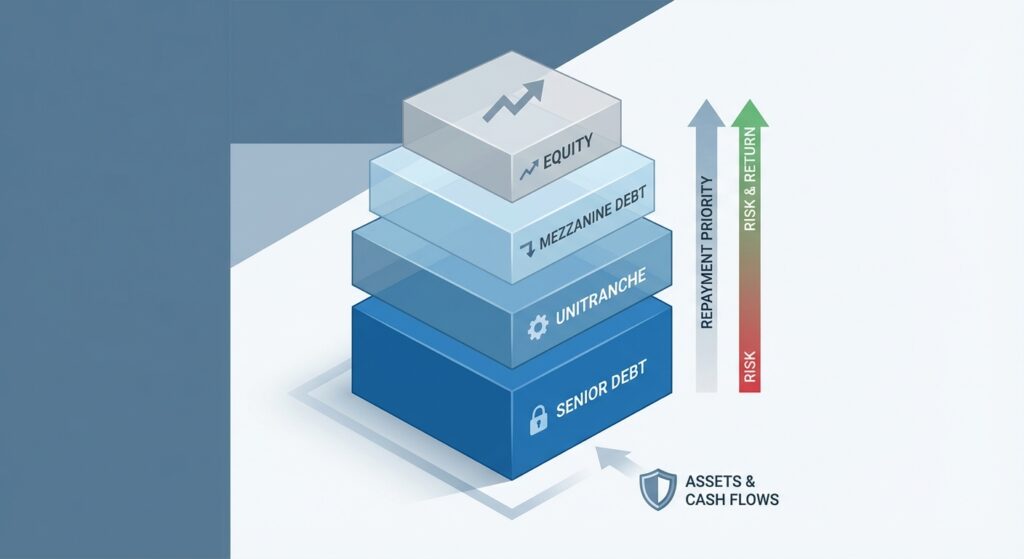
The capital stack is the structured hierarchy of all financing sources used to fund a business or project, organized by repayment priority. Think of it as a building: the foundation bears the most weight and carries the most security; the upper floors offer more upside but less protection. From most senior to most junior, the standard layers are:
- Senior Secured Debt — First-lien claim on assets and cash flows; lowest cost, highest protection
- Unitranche Debt — A blended single-facility combining senior and subordinated elements, common in middle-market direct lending
- Subordinated / Mezzanine Debt — Sits below senior debt; higher yield, lower recovery in distress
- Preferred Equity — Ahead of common equity but behind all debt; fixed return with limited upside
- Common Equity — Last in line; absorbs losses first, captures the most upside
The governing principle is subordination: each layer agrees to be repaid only after all layers above it are made whole. A mezzanine lender, for example, contractually subordinates its claim to the senior lender. In exchange for that concession, the mezzanine lender charges a materially higher interest rate to compensate for the elevated default risk it accepts.
A Concrete Example with Real Numbers
Consider a private equity-backed acquisition of a middle-market manufacturing company valued at $50 million. The deal is structured with the following capital stack:
- Senior Secured Term Loan: $30M (60% of total capital) — priced at SOFR + 300 bps (~6.7% all-in as of early 2026)
- Mezzanine Note: $10M (20%) — priced at a fixed 13%, including a payment-in-kind (PIK) component
- Common Equity: $10M (20%) — contributed by the private equity sponsor
Now stress-test the structure. The company underperforms, and in a sale or liquidation, the business recovers only $35 million. Here is how each layer fares:
- Senior lender recovers: $30M — fully repaid (100%)
- Mezzanine lender recovers: $5M of $10M owed (50% recovery)
- Equity sponsor recovers: $0 (total loss)
This is subordination in action. The equity cushion — the $10M of common equity below the mezzanine note — absorbs the first $10M of any loss before mezzanine holders are impaired. That cushion is why senior lenders accept lower yields: they are insulated by every dollar of junior capital sitting beneath them in the stack.
Current Market Relevance
Capital stack dynamics are not abstract — they are actively shaping where institutional capital is flowing in 2025 and into 2026. Several data points illustrate the current environment:
According to Long Angle’s Private Credit Investment Guide (2025), direct lending — predominantly first-lien senior secured debt — accounted for 38% of all private credit capital raised in H1 2025, making it the largest private credit sub-strategy by assets under management. Investor preference for senior stack positioning reflects a deliberate risk-mitigation posture in a higher-rate, uncertain credit environment.
The same guide notes that private credit AUM exceeded $2 trillion in 2025 and is projected to reach $4.5 trillion by 2030, with the asset class now holding approximately 20% market share of all leveraged credit in the U.S. — up from a fraction of that a decade ago. Much of this growth has been concentrated in senior secured direct lending, precisely because stack position offers the downside protection institutional allocators demand.
According to Gridline’s Private Credit Capital Structure Overview (2024), nearly half of all capital raised by private debt funds in 2021 went to senior debt strategies, a trend that has only accelerated as banks have retrenched from corporate lending following post-2023 banking sector stress. Meanwhile, mezzanine and subordinated strategies have seen renewed interest as spreads widen and deal structures require more junior capital to bridge valuation gaps.
Bank lending as a share of U.S. GDP has declined from approximately 59% in Q4 2008 to 44% as of Q1 2025, per the Long Angle guide — a structural shift that has opened the middle market to private credit lenders willing to occupy every layer of the stack that banks have vacated.
| Stack Layer | Typical LTV Range | Approximate Yield | Source |
|---|---|---|---|
| Senior Secured (First Lien) | 0%–60% | SOFR + 250–400 bps | Long Angle, 2025 |
| Mezzanine / Subordinated | 60%–80% | 11%–15% (fixed/PIK) | Gridline, 2024 |
| Common Equity | 80%–100% | 20%+ target IRR | CFI, 2024 |
Decision Framework: Investors and Operators
For investors evaluating private credit: Stack position should be the first filter — before yield, before manager, before sector. Investors consider several questions when assessing where a loan sits: What is the loan-to-value ratio? How thick is the equity cushion below? Are there intercreditor agreements that could limit recovery rights in a restructuring? Senior secured first-lien positions in deals with 30–40% equity cushions have historically offered the most resilient risk-adjusted profiles. Investors who reach for yield by moving down the stack into mezzanine or subordinated positions should understand they are explicitly accepting the risk of a partial or total loss in a stress scenario — and price that risk accordingly.
For operators and business owners seeking capital: The capital stack determines both your cost of financing and the control you retain. Senior debt is the cheapest capital available, but it comes with collateral requirements, covenants, and lender approval rights. Mezzanine debt is more expensive — often 13–15% all-in — but may allow an owner to avoid significant equity dilution in a growth transaction. Operators evaluate the blended or weighted average cost of capital (WACC) across the full stack, not just the rate on any single instrument. Adding a mezzanine layer may raise the blended cost slightly, but preserving equity ownership at the bottom of the stack can be worth that premium if the business grows into a higher valuation.
Key Takeaways
- Position is protection. In any private credit transaction, where a loan sits in the capital stack is the primary determinant of downside risk. Senior secured first-lien lenders are insulated by every layer of junior capital below them.
- Subordination is priced, not assumed. Mezzanine and junior lenders accept contractually inferior repayment rights — and they charge materially higher rates (often 5–8 percentage points above senior debt) to compensate for that risk.
- The equity cushion is your margin of safety. Investors consider the size of the equity layer below their debt position as a direct measure of how much loss the structure can absorb before their principal is impaired.
- Structural trends favor senior stack lending. With banks retreating from corporate lending and private credit AUM projected to reach $4.5 trillion by 2030, the senior secured layer of the middle-market capital stack has become a primary destination for institutional capital seeking yield with structural downside protection.
- Operators should model the full stack, not just the cheapest layer. The goal is the lowest blended cost of capital that preserves equity ownership and operational flexibility — not simply the cheapest individual instrument available.


