
Why Your Position in the Stack Is Everything
When a company borrows money, not all lenders are created equal. Some get paid first if things go wrong. Others wait — and sometimes wait forever. This ordering of repayment claims is called the capital stack, and understanding where you sit within it is arguably the single most important concept in private credit.
For investors evaluating private credit funds, capital stack position determines how much risk they are actually taking on — not just the headline yield. For business owners and operators raising capital, it determines how much that capital will cost and what strings come attached. Whether you are allocating to a direct lending fund or negotiating a financing package for a mid-market acquisition, the stack is the architecture that governs everything.
The Concept: Priority, Subordination, and the Waterfall
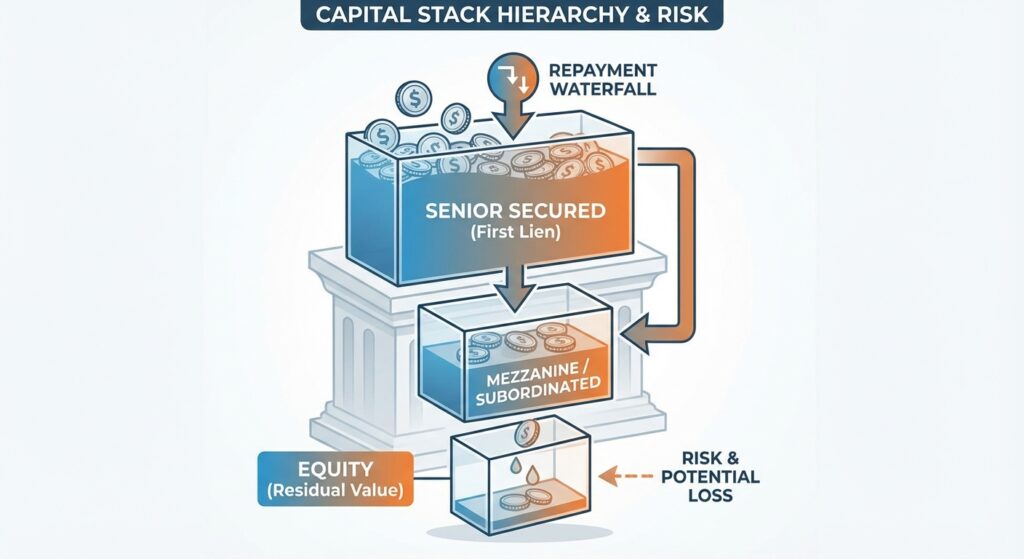
The capital stack is the full picture of how a business is financed, organized strictly by repayment priority. At the top sits senior secured debt — lenders with a first-lien claim on the company’s assets and cash flows. If the business defaults, senior lenders are first in line to recover. At the bottom sits equity — shareholders who absorb losses first and only receive value after every creditor has been repaid.
Between these two poles sits a range of subordinated instruments: second-lien loans, mezzanine debt, and preferred equity. Each layer accepts more risk than the one above it in exchange for a higher return. This ordering is often called the repayment waterfall — cash flows down from the top, and each layer gets paid before the next one below it sees a dollar.
Subordination is the formal legal mechanism that enforces this hierarchy. A subordinated lender contractually agrees that in a default or liquidation, they will not receive repayment until the senior lender is made whole. The greater the subordination, the greater the risk — and accordingly, the higher the required yield. This inverse relationship between seniority and cost of capital is one of the most durable principles in all of finance.
How It Works: A Concrete Example with Numbers
Consider a private equity sponsor acquiring a mid-market manufacturing company for $100 million. The deal is financed with three layers of capital:
- Senior Secured Term Loan (First Lien): $50 million — Provided by a direct lending fund at SOFR + 550 bps, approximately 9.8% all-in. First-lien claim on all assets. Lowest risk in the stack.
- Mezzanine / Second Lien: $20 million — Subordinated to the senior loan, pricing at 13–14%. Lender accepts that senior lender recovers first in any default scenario.
- Equity: $30 million — Contributed by the sponsor. No contractual return. Last in the waterfall, but captures all upside if the business thrives.
Now assume the business deteriorates and is sold in a distressed process for $60 million. Here is how the waterfall distributes those proceeds:
- Senior lender collects first: $50 million recovered in full (100 cents on the dollar).
- Mezzanine lender collects next: $10 million of the remaining $10 million — recovering only 50 cents on the dollar.
- Equity: $0. Fully wiped out.
This example illustrates why seniority is so valuable in a credit-stress scenario. The senior lender absorbed zero loss. The mezzanine lender took a 50% haircut. The equity holder was entirely eliminated. The stack position — not the borrower’s story — determined the outcome.
Current Market Relevance: Why Stack Position Matters More Right Now
The capital stack concept is not merely textbook theory. As of mid-2026, private credit markets are undergoing what analysts describe as a liquidity, valuation-credibility, and underwriting-discipline repricing — making subordination risk especially consequential for investors reassessing their exposures.
According to Atlas Peak Research (March 2026), the sharpest stress in private credit is concentrated not in classic closed-end direct lending funds — which hold predominantly senior, first-lien positions — but in semi-liquid structures that have packaged illiquid middle-market loans inside wealth-channel vehicles. This distinction maps directly onto the capital stack: senior, well-structured closed-end funds are weathering the environment; more complex, subordinated, and liquidity-mismatched structures are showing cracks.
According to Capital Founders OS (March 2026), with SOFR at approximately 4.3%, senior direct lending is currently paying 10–12%+ all-in yields without requiring investors to reach further down the risk curve into subordinated or mezzanine positions. That pricing dynamic makes senior secured positions unusually attractive on a risk-adjusted basis — investors are being compensated for stack position without sacrificing seniority. The same source reports private credit default rates running at approximately 1.45% versus 3.37% for broadly syndicated loans, according to Cambridge Associates data.
The global private credit market has grown from $557 billion in AUM in 2014 to more than $2 trillion by 2023, according to PitchBook (2025), with projections pointing toward $3 trillion by 2028 per Mayer Brown (March 2025). As the asset class scales, stack discipline — knowing exactly where in the repayment hierarchy your capital sits — becomes non-negotiable due diligence.
| Metric | Value | Source |
|---|---|---|
| Senior direct lending all-in yield (approx.) | 10–12%+ | Capital Founders OS, Mar 2026 |
| Private credit default rate (Cambridge Associates) | ~1.45% | Capital Founders OS, Mar 2026 |
| Global private credit AUM (2023) | $2 trillion+ | PitchBook, 2025 |
| Projected global private credit AUM (2028) | ~$3 trillion | Mayer Brown, Mar 2025 |
| Family office private credit allocation (2024) | 4% of AUM (up from 2%) | Capital Founders OS / UBS 2025 Survey, Mar 2026 |
Decision Framework: Investors and Operators
For Investors Evaluating Private Credit Funds: Before allocating, investors consider precisely where a fund’s loans sit in the capital stack. A fund marketing “private credit” exposure could hold first-lien senior secured loans or deeply subordinated mezzanine paper — the yield will differ, but so will the loss-given-default profile. Key questions investors ask include: Does the fund document specify first-lien or second-lien positions? What is the weighted average loan-to-value across the portfolio? Does the fund’s legal structure — closed-end versus semi-liquid — match the illiquidity of the underlying loans? In the current environment, many institutional allocators are gravitating toward senior, closed-end structures precisely because the stack position and fund structure are aligned, as highlighted by Atlas Peak Research (March 2026).
For Operators and Business Owners Raising Capital: Operators evaluate the capital stack from the opposite direction — as the entity whose cash flows must service every layer. Adding mezzanine debt below a senior loan lowers average cost of capital versus all-equity financing, but increases fixed payment obligations and reduces financial flexibility. A well-designed stack, as CapitalXO (March 2026) notes, balances cost, control, and flexibility. Operators who layer capital instruments one at a time without considering the full stack often end up with a structure that is more expensive, more restrictive, and more fragile than necessary. The question operators must answer: can the business’s cash flows comfortably service every layer above equity, even in a downside scenario?
Key Takeaways
- Position is risk. In private credit, your place in the repayment waterfall — not the borrower’s narrative — determines your actual risk exposure. Senior secured lenders with first-lien claims carry fundamentally different risk profiles than subordinated or mezzanine lenders in the same deal.
- Higher yield signals lower stack position. When a private credit instrument offers a meaningfully higher yield than comparable senior debt, that premium typically reflects subordination risk — the likelihood of partial or zero recovery in a default scenario. There is no free lunch in the stack.
- Current pricing makes seniority unusually attractive. With senior direct lending yielding 10–12%+ in mid-2026, investors are not required to reach into subordinated positions to generate compelling returns — a dynamic worth understanding when evaluating private credit fund mandates.
- Operators must stress-test the full stack. Business owners raising capital across multiple layers should model debt service obligations under downside revenue scenarios before adding any subordinated instrument. Each new layer adds fixed cost and reduces covenant headroom for every layer above it.
- Fund structure must match stack position. As demonstrated by redemption gate events in early 2026, packaging illiquid subordinated loans inside semi-liquid fund vehicles creates a structural mismatch that seniority alone cannot fix. The vehicle structure and the underlying loan position must be evaluated together.


