
Why Where You Sit in the Stack Defines Everything
In private credit, the single most important question is not “what is the interest rate?” — it is “where does this capital sit in the repayment hierarchy?” That hierarchy is called the capital stack, and understanding it is foundational to evaluating any private credit investment or financing decision. Whether you are an institutional investor deploying capital into a direct lending fund or a business owner structuring a leveraged buyout, your position in the stack determines how much protection you have, how much you are paid, and who absorbs losses first when things go wrong.
What the Capital Stack Is and How It Works
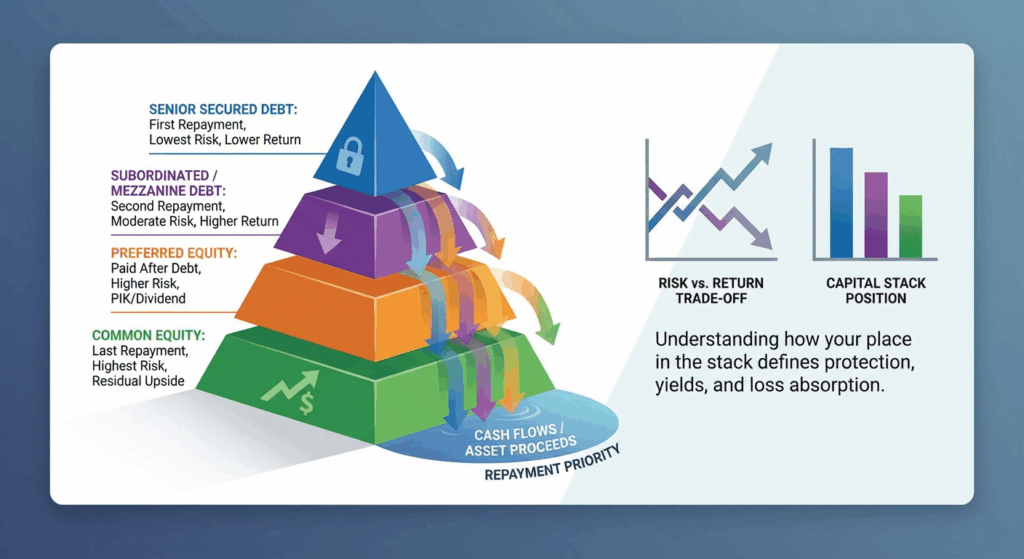
The capital stack is the structured hierarchy of all financing sources used to fund a company or project, organized by their legal priority of repayment. Think of it as a waterfall: cash flows and asset proceeds fill the pool from the top down, but lenders and investors are paid from the bottom up — the most senior claimants are made whole first, and whatever remains flows upward to increasingly junior stakeholders.
A typical leveraged buyout capital stack, from most to least senior, looks like this:
- Senior Secured Debt — First-lien loans backed by company assets; paid first in any liquidation or restructuring. Carries the lowest interest rate because it carries the lowest risk.
- Subordinated / Mezzanine Debt — Sits below senior debt; paid only after senior obligations are satisfied. Commands a higher yield to compensate lenders for absorbing more risk.
- Preferred Equity — Hybrid instrument with debt-like features (fixed dividends, liquidation preference) but legally classified as equity. Paid before common equity holders.
- Common Equity — Last in line. Absorbs all losses first but captures all upside if the company performs well.
Each layer down the stack accepts subordination — the legal agreement to wait — in exchange for a higher potential return. This risk-return tradeoff is not arbitrary; it is the engine that makes structured finance work. As Corporate Finance Institute explains, a well-structured capital stack “optimizes risk and return, allowing businesses to expand sustainably while managing financial obligations.”
A Concrete Example: The $50 Million LBO
Consider a private equity firm acquiring a manufacturing business for $50 million. The deal is financed as follows:
- Senior Secured Term Loan (Direct Lending): $25M — SOFR + 550 bps, first-lien on all assets, ~9.5% all-in yield at current benchmark rates
- Mezzanine Debt: $10M — 13–15% fixed rate, second-lien or unsecured
- Preferred Equity: $5M — 10% PIK dividend, liquidation preference
- Common Equity (PE Sponsor): $10M — Residual upside after all layers repaid
Now imagine the company runs into difficulty and is sold in a distressed scenario for $30 million. The waterfall pays out as follows: the senior lender recovers their full $25M. The mezzanine lender receives the remaining $5M — absorbing a $5M loss. Preferred and common equity holders receive nothing. The senior lender’s loan-to-value ratio of 50% ($25M loan against $50M enterprise value) provided a $25M equity cushion that protected their principal entirely, even in a severe distress scenario. The mezzanine lender had only a $15M cushion — and it wasn’t enough.
This arithmetic is not theoretical. It is why subordination is the defining variable in private credit underwriting.
Current Market Relevance
Understanding the capital stack has never been more practically important. Private credit has become the dominant financing mechanism for middle-market companies, displacing traditional bank lending at scale.
According to Long Angle’s 2026 Private Credit Investment Guide, bank lending as a share of U.S. GDP has declined from 59% in Q4 2008 to approximately 44% as of early 2025, with private credit filling much of the void left by retreating banks. Private credit assets under management were estimated at over $2 trillion in 2025 and are projected to reach $4.5 trillion by 2030.
Within that universe, direct lending — the senior secured layer of the private credit stack — accounted for approximately 38% of all private credit capital raised in the first half of 2025, according to the same source. This concentration at the senior level reflects investor preference for stack position during a period of elevated interest rates and tightening credit conditions.
Mezzanine and subordinated strategies have historically delivered meaningfully higher annualized returns than senior debt to compensate for their junior stack position. According to Long Angle, default rates across direct lending have remained below 4% since 2021 (per Proskauer’s Private Credit Default Index), but divergence between senior and junior outcomes widens significantly in stress scenarios — precisely the risk that subordination math quantifies.
| Layer | Typical Yield | Stack Position | Risk Level |
|---|---|---|---|
| Senior Secured (Direct Lending) | SOFR + 500–600 bps | 1st Lien | Lowest |
| Mezzanine / Subordinated | 13–16% fixed | 2nd Lien / Unsecured | Moderate–High |
| Preferred Equity | 10–14% PIK | Junior to all debt | High |
| Common Equity | Residual / Uncapped | Last | Highest |
Sources: Long Angle 2026 Private Credit Guide; re:cap, Jan 2026; CFI Capital Stack Overview. Yield ranges are illustrative and reflect current market conditions.
Decision Framework
For Investors Evaluating Private Credit
Stack position is not just a label — it is a loss-absorption sequence. Investors evaluating a private credit fund or direct lending opportunity consider the following questions: What is the loan-to-value ratio at the time of origination? A senior secured lender at 50% LTV has far more downside cushion than a mezzanine lender at 80% LTV. How much equity sits below the debt? More equity subordination means more protection for debt holders. What collateral secures the position? First-lien claims on hard assets or cash flows provide recovery value that unsecured positions do not. Senior secured positions trade yield for certainty; junior positions trade certainty for yield. Neither is inherently superior — the alignment must match the investor’s risk mandate.
For Operators and Business Owners
Business owners seeking capital evaluate the stack from the opposite direction: cost and control. As Peach Tree Capital notes, senior debt carries the lowest cost of capital but imposes the most restrictive covenants and repayment schedules. Moving down the stack — toward mezzanine or preferred equity — costs more but offers greater flexibility. Operators consider layering when a single source of capital cannot fund the full project, or when rigid senior debt covenants would constrain operations. The key tradeoff is cost versus flexibility, not simply how much capital is available.
Key Takeaways
- Stack position is the primary determinant of risk in private credit. Senior secured lenders are paid first and lose last; common equity holders are paid last and lose first. All pricing follows from this sequence.
- Subordination is not a flaw — it is a feature. Junior capital providers accept subordination voluntarily in exchange for higher yields. The capital stack works because each layer is compensated appropriately for its place in the loss waterfall.
- Equity cushion below the debt is a lender’s first line of defense. In the $50M LBO example, the senior lender’s 50% LTV meant they could absorb a 40% decline in enterprise value before losing a dollar of principal.
- Private credit’s growth has been led by senior secured direct lending. With over $2 trillion in AUM and direct lending capturing roughly 38% of new capital raised in H1 2025, the senior layer of the private credit stack is now a mainstream institutional asset class.
- Business owners benefit from understanding the stack before approaching lenders. Designing a capital structure that pairs the right type of capital with the right layer of risk — rather than asking one source to carry all risk — is what makes complex deals financeable.


