
Where You Sit Determines What You Get
In private credit, the single most important question an investor or a business owner can ask about any financing arrangement is deceptively simple: where does this capital sit in the repayment waterfall? That position — senior, subordinated, or somewhere in between — drives nearly every other variable in the deal: the interest rate, the covenant package, the collateral rights, and ultimately, the probability of getting repaid if things go wrong.
This concept is called capital stack position, and understanding it is foundational to reading any private credit transaction. Whether you are an institutional investor evaluating a direct lending fund or a business owner deciding how to finance a growth acquisition, the architecture of the capital stack governs your risk, your return, and your rights.
What Is the Capital Stack?
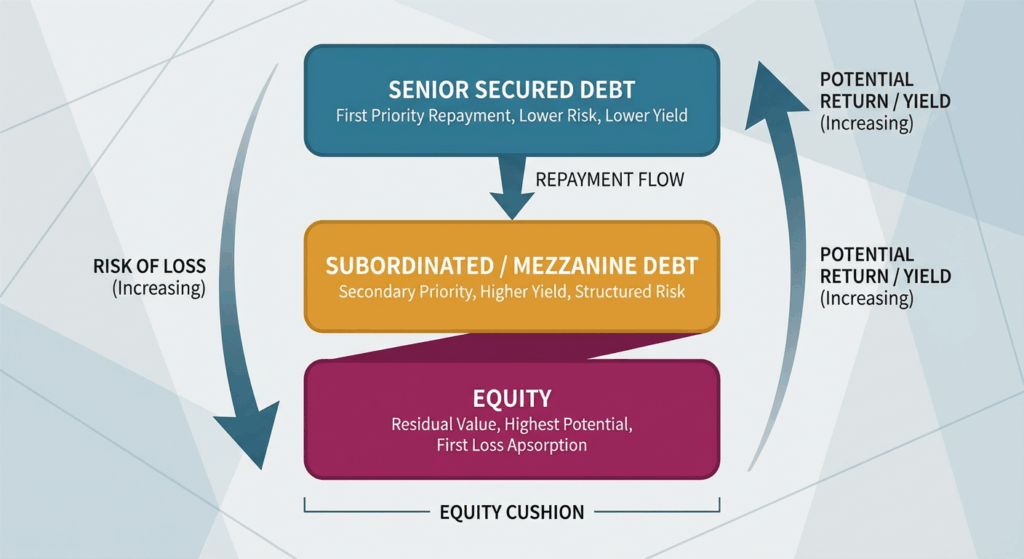
The capital stack is the structured hierarchy of all financing sources used to fund a business or project, organized from the highest repayment priority to the lowest. Think of it as a building: the most secure tenants occupy the top floors and are protected from flood damage. The equity holders live in the basement — they absorb losses first.
A typical private credit capital stack for a middle-market leveraged buyout moves through the following layers, from most senior to most junior:
- Senior Secured Debt — First-lien term loans and revolving credit facilities. These lenders hold a perfected first-priority lien on all company assets and are repaid before everyone else. As a result, they accept the lowest yield in the structure — typically SOFR + 300 to 450 basis points for a direct lending term loan.
- Second-Lien or Unitranche Debt — A secured position, but junior to the first lien. These lenders receive more yield to compensate for their lower position in the collateral waterfall.
- Subordinated or Mezzanine Debt — Unsecured debt that sits below all senior creditors. Mezzanine lenders are compensated through higher coupons (typically 10% to 16% cash or PIK) and often receive equity warrants that provide upside participation if the business performs well.
- Preferred Equity — Not technically debt, but senior to common equity. Preferred holders receive a fixed return before common equity participates in distributions.
- Common Equity — The sponsor or owner. Common equity absorbs all losses first but captures all of the upside if the business succeeds.
Each layer is priced for its specific position. The further down the stack, the higher the required return — because the further down you sit, the less likely you are to recover your capital in a distressed scenario.
How It Works: A Concrete Example with Numbers
Consider a private equity sponsor acquiring a manufacturing company for $50 million at a 5.0x EBITDA multiple, with the company generating $10 million in annual EBITDA. Here is how the capital stack might be structured:
- Senior Secured Term Loan (First Lien): $25 million at SOFR + 375 bps. This represents 2.5x EBITDA leverage. The lender holds a first-priority lien on all assets. In a liquidation scenario where the business is sold for even $28 million, this lender is made whole.
- Mezzanine Debt: $10 million at 13% (cash + PIK blend). This represents an additional 1.0x EBITDA, bringing total debt to 3.5x. The mezzanine lender is unsecured and only recovers principal after the $25 million senior loan is fully repaid. Their protection is the equity cushion — $15 million of sponsor equity sitting below them.
- Sponsor Equity: $15 million. This capital absorbs the first $15 million of any loss. If the company is sold in distress for $34 million, senior debt recovers in full, mezzanine recovers in full, and equity receives $9 million — a loss of $6 million. If the sale price drops to $24 million, equity is wiped out and mezzanine begins to take losses.
This is subordination in action. The mezzanine lender charges 13% not because the underlying business is necessarily risky, but because its structural position makes it riskier than the senior lender in the same deal.
Current Market Relevance
Understanding capital stack position has become particularly critical in the current lending environment. According to the Federal Reserve’s Senior Loan Officer Opinion Survey (SLOOS), U.S. banks have reported tightening lending standards for commercial and industrial loans across multiple consecutive survey periods, reducing the volume of senior bank debt available to middle-market borrowers.
This structural withdrawal by banks has directly benefited private credit lenders. According to Preqin, global private debt assets under management have grown to over $1.7 trillion, with direct lending representing the largest sub-strategy. Managers including Apollo, Blackstone Credit, Ares Management, and KKR Credit have scaled their senior direct lending platforms substantially, deploying capital into first-lien positions that banks have vacated.
According to Cliffwater’s Direct Lending Index, senior secured direct loans have historically delivered lower loss rates than their subordinated counterparts precisely because of capital stack position — first-lien lenders benefit from both collateral priority and the equity cushion absorbing initial losses. Meanwhile, data from S&P LCD shows that the proportion of covenant-lite structures in broadly syndicated loans has remained elevated, making capital stack position an even more important form of structural protection when traditional financial maintenance covenants are absent.
For middle-market borrowers specifically, the tightening of bank standards has meant that mezzanine and subordinated structures — once reserved for complex transactions — are now being used more routinely to fill gaps left by retreating bank lenders, increasing the cost of capital for businesses in the subordinated layers of their own capital stacks.
Decision Framework
For Investors Evaluating Private Credit
- Identify your position before pricing the return. A 12% yield in a mezzanine position and a 12% yield in a senior secured position represent entirely different risk profiles. Ask: what sits above you, what sits below you, and how much equity cushion exists?
- Stress-test the equity cushion. If enterprise value declines 30%, does the equity layer absorb that loss fully before your debt tranche is impaired? Investors typically evaluate loan-to-value ratios and attachment points under downside scenarios — not just base-case assumptions.
- Understand the intercreditor agreement. In structures with multiple debt layers, the intercreditor agreement defines when subordinated lenders can act, when payments can be blocked, and who controls enforcement. Investors in subordinated or mezzanine tranches should review these terms carefully to understand the practical limitations on their rights in a restructuring.
For Business Owners and Operators
- Start with senior debt — always. Because senior debt is cheapest, filling as much of the capital need as possible with first-lien borrowings reduces blended cost of capital. Subordinated capital fills the gap but at a meaningful cost premium.
- Model the full cash flow waterfall. Each debt layer claims operating cash flow before equity. Adding mezzanine at 13% on top of a senior loan at 8% raises the blended rate and reduces cash available for reinvestment or distribution. Operators benefit from mapping the full debt service schedule before committing to a multi-layered structure.
- Weigh the cost of equity dilution against the cost of subordinated debt. Mezzanine debt with equity warrants is more expensive than senior debt but avoids the immediate equity dilution that comes with a preferred equity raise. The right answer depends on the expected exit timeline and the business’s ability to service the higher coupon.
Key Takeaways
- Position determines protection. Senior secured lenders hold collateral claims and repayment priority. Subordinated lenders trade structural protection for higher yield. Every layer is priced for its exact position in the waterfall.
- The equity cushion is a buffer, not a guarantee. The size of the equity layer below a debt tranche directly determines how much value destruction the business can absorb before that tranche faces impairment. Investors evaluate this cushion — expressed as LTV or attachment point — as a primary risk metric.
- Bank withdrawal has structurally elevated private credit’s role. With banks tightening standards, private credit managers are increasingly filling first-lien and unitranche positions, not just subordinated roles. Capital stack position analysis is now essential for evaluating any direct lending opportunity.
- For operators, blended cost of capital matters most. Stacking debt layers reduces equity dilution but increases cash flow obligations. Business owners evaluating multi-layered capital structures should model the weighted average cost across all tranches before committing to a structure.
- Covenant packages and capital stack position are linked. Senior lenders typically impose the most protective covenants; mezzanine lenders often impose fewer, relying on structural subordination and the equity cushion instead. Understanding this trade-off clarifies why different layers have such different governance terms.


