
The Most Important Question in Private Credit
Before evaluating any private credit investment or financing structure, one question cuts through all the complexity: where in the repayment line do you stand? That question is answered by the capital stack — the legally defined hierarchy that determines who gets paid first when a borrower generates cash flow, and who absorbs losses first when things go wrong. Understanding this hierarchy is not optional. It is the foundation of every private credit decision, whether you are an institutional investor evaluating a direct lending fund or a business owner negotiating a financing package.
The capital stack is not a Wall Street abstraction. It is a contractual reality embedded in every loan agreement, intercreditor agreement, and operating covenant. In a market where global private credit assets under management exceeded $1.7 trillion as of Q1 2026 according to PitchGrade, and where non-bank lenders now provide 75% or more of leveraged buyout financing in deals below $500M in EBITDA, knowing where each dollar sits in the stack is more consequential than ever.
What the Capital Stack Actually Is
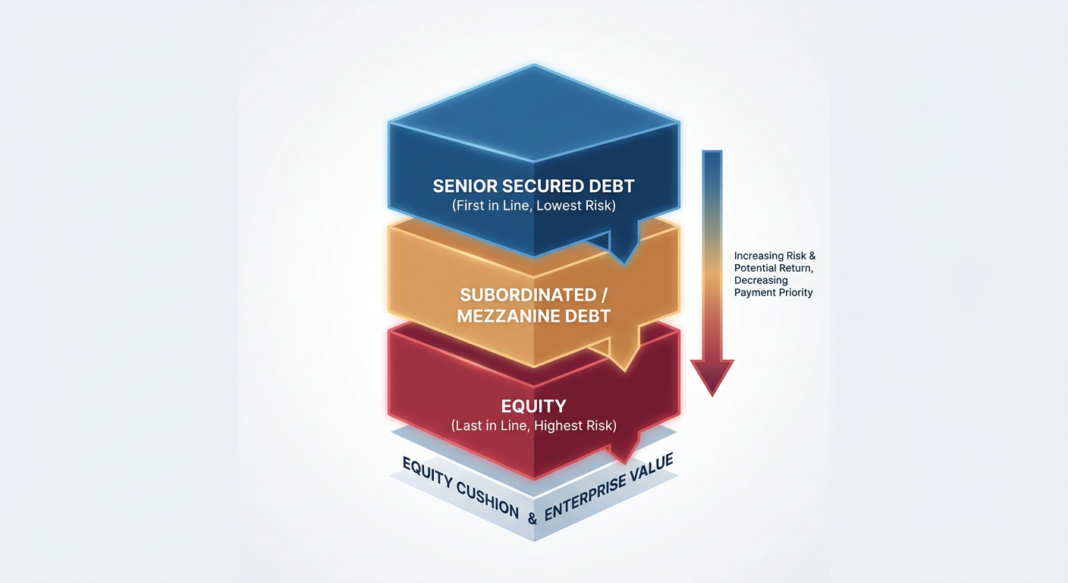
Think of the capital stack as a line of creditors and owners standing outside a company’s vault. The person at the front of the line — the senior secured lender — gets paid before anyone behind them, regardless of what happens to the business. The person at the very back — the common equity holder — only receives anything if every creditor ahead has been made whole. In between sit layers of subordinated debt, mezzanine capital, convertible instruments, and preferred equity, each accepting greater risk in exchange for a higher potential return.
As BIP Wealth’s capital stack framework explains, the layers from lowest to highest risk are typically structured as follows:
- Working Capital / Revolving Credit: Short-term obligations covering day-to-day operations. Repaid first, lowest yield.
- Senior Secured Debt: Backed by collateral, first priority lien on company assets. The dominant instrument in direct lending.
- Subordinated / Mezzanine Debt: Repaid only after senior lenders are satisfied. Higher coupon compensates for lower priority.
- Convertible Debt: A hybrid that begins as debt and can convert to equity under defined conditions.
- Preferred Equity: Ownership with distribution priority over common shareholders, but subordinate to all debt.
- Common Equity: Last in line for everything — distributions, liquidation proceeds, and recovery in default.
Every layer earns a return calibrated to its position. The further back in line, the higher the required return — and the greater the exposure to loss.
A Concrete Example: The Same Company, Three Different Positions
Consider a hypothetical manufacturing company, Ridgeline Industrial, valued at $100 million. Its capital structure is financed as follows:
- Senior Secured Term Loan: $50 million at SOFR + 550 bps (approximately 10.8% all-in as of mid-2026)
- Mezzanine Note: $15 million at a fixed 14% coupon
- Common Equity (Private Equity Sponsor): $35 million
Now suppose Ridgeline encounters severe operational difficulty and its enterprise value drops to $55 million in a distressed sale. Here is what each layer recovers:
- Senior Secured Lender: Recovers its full $50 million. The equity cushion ($35M) and mezzanine ($15M) absorb the $45M shortfall from peak valuation before the senior lender loses a dollar.
- Mezzanine Lender: Recovers $5 million of its $15 million — a 67% loss.
- Equity Sponsor: Recovers $0. The equity is entirely wiped out.
This arithmetic illustrates the core protection mechanism of senior secured lending: the equity cushion. In Ridgeline’s case, the $35 million of sponsor equity represents a 35% buffer that must be erased before the senior lender takes a single dollar of loss. This is why institutional private credit managers, as Blackstone’s private credit framework notes, concentrate overwhelmingly on senior secured, first-lien positions backed by private equity sponsors who have significant capital at risk.
Where the Current Market Stands
The structural shift away from bank lending has made the capital stack more relevant — and more competitive — than at any prior point. Several current dynamics shape how each layer is being priced and accessed:
- Bank retreat is structural, not cyclical. According to Long Angle’s 2026 Private Credit Guide, bank lending as a share of U.S. GDP has declined from 59% in Q4 2008 to 44% as of Q1 2025, driven by post-GFC regulation and the 2023 regional banking stress. Private capital has filled that gap.
- Regulatory leverage limits push borrowers to private lenders. As PitchGrade’s 2026 private credit primer details, OCC and Federal Reserve leveraged lending guidance effectively restricts banks from underwriting loans with debt-to-EBITDA above 6.0x. Transactions above that threshold now flow directly to private credit funds.
- Senior secured direct lending prices at SOFR + 500–650 bps for middle market borrowers, according to PitchGrade, reflecting both the illiquidity premium and the structural position advantage over broadly syndicated loans.
- Recovery rates for senior secured direct loans range from 65–80%, meaningfully above high yield bond recoveries of approximately 40%, per PitchGrade’s analysis — a direct function of collateral priority and covenant protections.
- Private credit AUM is projected to reach $4.5 trillion by 2030, per Long Angle’s 2026 guide, as institutional and retail allocators increase exposure to the asset class.
Decision Framework: Investors and Operators
For Investors Evaluating Private Credit Funds: Stack position is the first filter, not the last. A fund described simply as a “private credit fund” may hold senior secured first-lien loans or deeply subordinated mezzanine notes — instruments with fundamentally different risk profiles. Investors consider: What lien position does the fund hold? What is the average loan-to-value at origination? What equity cushion exists below the debt? Is there a maintenance covenant that triggers intervention before the cushion erodes? Return dispersion between top- and bottom-quartile private credit managers is estimated at roughly 8 percentage points annually according to Long Angle — a gap largely explained by underwriting discipline and stack positioning.
For Business Owners Seeking Capital: Your position in the stack determines the cost and flexibility of each financing layer. Senior secured debt carries the lowest coupon but the tightest covenants and collateral requirements. Mezzanine capital is more expensive but does not dilute ownership. Equity is the most expensive long-term cost — founders surrender both upside and control. Operators evaluate the all-in cost of each layer against the expected return on the capital deployed, asking whether the incremental cost of a junior layer is justified by the growth or acquisition it funds.
Key Takeaways
- Position defines risk, not asset class. Two private credit instruments in the same company can have entirely different risk profiles based solely on their place in the capital stack.
- The equity cushion is the senior lender’s primary protection. The larger the sponsor equity contribution at deal inception, the more enterprise value must be destroyed before senior lenders face impairment.
- Higher yield always means lower stack position. When evaluating any credit instrument, ask what risk is being compensated — and whether the return justifies the subordination.
- Bank retreat has permanently expanded the private credit opportunity set, particularly for transactions above 6.0x leverage or below $500M in EBITDA, where private lenders now dominate as the primary capital source.
- Recovery rates are a function of structure, not luck. Senior secured lenders historically recover 65–80 cents on the dollar in default because the contractual priority and collateral backing are negotiated before the loan is made, not after problems emerge.


