
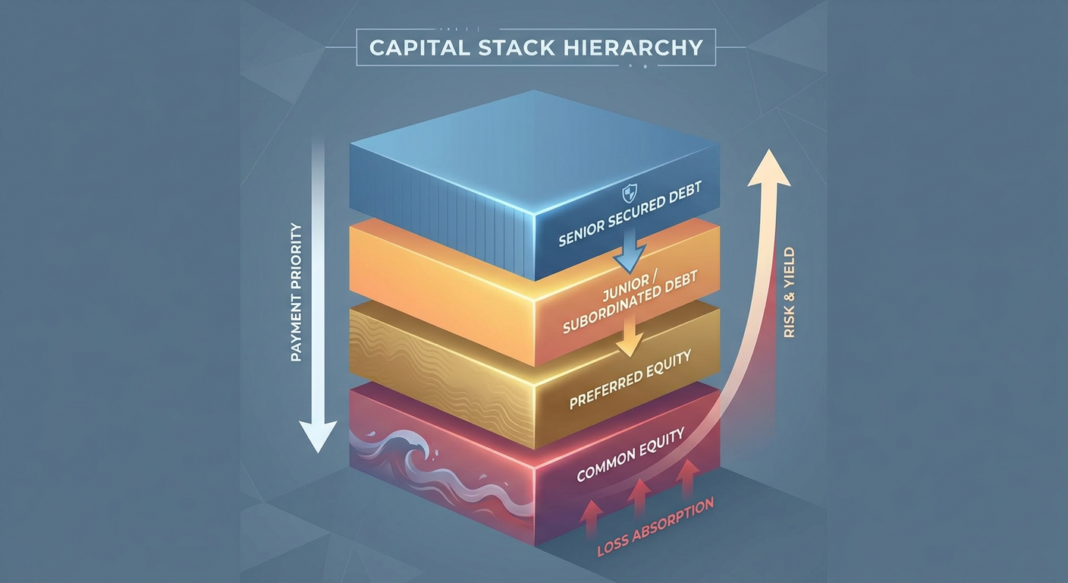
Why Where You Sit in the Stack Decides Everything
Imagine a building with three floors. If the building floods, the ground floor drowns first. The top floor stays dry the longest. In private credit, this building is called the capital stack — and the floor you occupy determines how much risk you absorb, how much return you earn, and how quickly you get paid back if things go wrong.
For investors evaluating private credit funds or direct lending opportunities, understanding capital stack position is the single most foundational skill in the asset class. For business owners raising capital, it determines how much of your company you keep, what rate you pay, and what covenants you accept. Whether you are allocating capital or raising it, the stack is where every negotiation begins.
As banks have pulled back from middle-market lending throughout 2024 and into 2025 — a trend confirmed by multiple quarters of net tightening in the Federal Reserve’s Senior Loan Officer Opinion Survey (SLOOS) — private credit managers have stepped in to fill the gap at every level of the stack. Understanding how these layers work is no longer optional knowledge. It is the grammar of the asset class.
The Concept: What the Capital Stack Actually Is
The capital stack is the ordered hierarchy of all financial claims on a business or asset. It defines who gets paid first, who bears losses first, and who has the strongest legal claim in a restructuring or liquidation. The stack is typically divided into four broad layers, from most senior (safest, lowest return) to most junior (riskiest, highest return):
- Senior Secured Debt — First-lien loans backed by a priority claim on company assets. Lenders here are paid before anyone else and hold collateral rights. This is where most direct lending sits.
- Junior / Subordinated Debt — Second-lien loans and mezzanine debt. These lenders sit below senior debt and absorb losses before senior creditors, but ahead of equity holders. They earn a higher yield to compensate.
- Preferred Equity — A hybrid layer with equity-like characteristics but priority over common equity in distributions and liquidation. Often carries a fixed dividend or PIK (payment-in-kind) component.
- Common Equity — The owners of the business. Highest risk, highest potential upside, and the very last to be repaid. Private equity sponsors typically sit here.
Subordination is the legal mechanism that enforces this order. A subordinated lender formally agrees, via an intercreditor agreement, that its claim ranks below the senior lender’s. In a default scenario, senior creditors must be made whole before subordinated creditors see a single dollar.
How It Works: A Concrete Example with Real Numbers
Consider a private equity buyout of a manufacturing company valued at $100 million. The acquisition is financed with the following capital stack:
- First-Lien Senior Secured Loan: $50 million at SOFR + 550 bps (all-in ~10.8% as of early 2025 market conditions)
- Second-Lien / Mezzanine: $20 million at a fixed 14% cash-pay or PIK rate
- Common Equity (PE Sponsor): $30 million
The Loan-to-Value (LTV) for the senior lender is 50% ($50M loan ÷ $100M enterprise value). This means the company’s value would need to fall by more than 50% before the senior lender suffers a principal loss. The equity cushion — the $30M of sponsor equity — provides the first layer of loss absorption.
Now suppose the company deteriorates and is sold in distress for $65 million. Here is how proceeds are distributed:
- Senior lender receives: $50 million (fully recovered)
- Mezzanine lender receives: $15 million (takes a $5M loss)
- Equity sponsor receives: $0 (wiped out)
This is subordination in action. The senior lender was protected by both the collateral pledge and the equity cushion below it. The mezzanine lender bore partial loss. Equity was eliminated. Each layer’s yield premium over the senior loan reflects the additional loss exposure it accepted when the deal was structured.
Current Market Relevance: Where the Stack Stands in 2025–2026
Capital stack dynamics are being shaped by several measurable forces in today’s private credit market:
According to the Federal Reserve’s SLOOS (Q1 2025), a net positive share of large domestic banks reported tightening lending standards for commercial and industrial loans over multiple consecutive quarters — a trend that has meaningfully reduced bank availability for middle-market borrowers and redirected demand toward private credit lenders.
According to Preqin’s 2025 Global Private Debt Report, private credit assets under management reached approximately $1.7 trillion globally by late 2024, with direct lending representing the largest strategy by capital deployed — underscoring that senior secured, first-lien private credit has become the institutional default position.
According to the Cliffwater Direct Lending Index (CDLI), Q4 2024, the annualized return on the index was approximately 10–11% over the trailing year, with senior secured loans composing the majority of underlying exposures — demonstrating the return competitive senior private credit can generate relative to public fixed income without moving down the stack.
According to S&P LCD’s Middle Market Monitor (2025), average leverage multiples for sponsored middle-market buyouts have been running in the 4.5x–5.5x Debt/EBITDA range, with senior debt typically representing 3.5x–4.0x — confirming that meaningful equity cushions (often 40–50% of the capital structure) remain a structural feature of the current market.
According to PitchBook’s Q4 2024 Private Credit Analyst Note, unitranche structures — a single blended first-lien loan replacing both senior and junior tranches — accounted for a growing share of direct lending deals in the US middle market, simplifying stack negotiations for both lenders and borrowers while compressing all-in cost for operators.
| Layer | Typical Size (% of EV) | Indicative All-In Yield | Source |
|---|---|---|---|
| First-Lien Senior Secured | 35%–45% | 10%–12% | Cliffwater CDLI, Q4 2024 |
| Second-Lien / Mezzanine | 10%–20% | 13%–16% | S&P LCD Middle Market Monitor, 2025 |
| Common Equity (PE Sponsor) | 40%–50% | 20%+ (target IRR) | Preqin Global Private Debt Report, 2025 |
Decision Framework: For Investors and Operators
For Investors Evaluating Private Credit Funds:
Stack position should be the first question asked of any private credit manager — before yield, before geography, before sector. Investors consider the following sequence when evaluating a strategy’s stack exposure:
- What lien position does the fund target? First-lien only, or does it blend senior and subordinated paper? The answer directly determines the loss-given-default profile.
- What is the average LTV or loan-to-cost at origination? A 50% LTV senior loan is structurally different from a 70% LTV senior loan, even if both are called "senior secured."
- What equity cushion exists below the debt? Sponsors with meaningful committed equity are economically incentivized to support portfolio companies through stress — reducing lender loss risk.
- What are the intercreditor terms if junior debt co-exists? In a multi-tranche deal, senior lenders want standstill provisions that prevent junior lenders from triggering acceleration.
For Operators and Business Owners Raising Capital:
Understanding the stack helps operators make better capital decisions — not just accept whatever a lender proposes. Operators evaluate these tradeoffs:
- Senior debt is cheapest but most restrictive. First-lien lenders set covenants, control collateral, and have the most leverage in a restructuring. Lower cost of capital comes with less operational flexibility.
- Mezzanine or subordinated debt is more expensive but preserves more equity. An operator who takes on $20M in mezzanine at 14% rather than issuing $20M in equity may retain significantly more enterprise value at exit, depending on growth trajectory.
- Stack choice is a function of growth stage and cash flow predictability. Businesses with stable, recurring revenues can service more senior debt efficiently. High-growth, pre-profitability businesses are better served by equity or hybrid instruments higher in the risk spectrum.
Key Takeaways
- Position determines protection: In any default scenario, senior secured lenders are paid first and lose last. Every layer below absorbs losses before those above it — this is what "subordination" means in practice.
- Yield must match stack risk: A second-lien lender earning 14% versus a first-lien lender earning 11% is not arbitrary — it reflects the incremental loss probability each layer accepts at origination.
- Equity cushions are a structural safety net: In today's middle market, sponsor equity of 40–50% of enterprise value provides a meaningful buffer that must be eroded before senior private credit lenders face impairment.
- Bank pullback has restructured the stack: As traditional banks have tightened commercial lending standards per Federal Reserve SLOOS data, private credit managers now occupy stack layers — particularly first-lien — that banks historically dominated, creating durable deal flow.
- Operators should model the full stack cost: The cheapest headline rate is not always the optimal choice. A business owner should compare total cost of capital — including covenants, equity dilution, and exit economics — across all available stack layers before selecting a financing structure.


