
Bond Capital | Market & Sector Intelligence | October 21, 2026
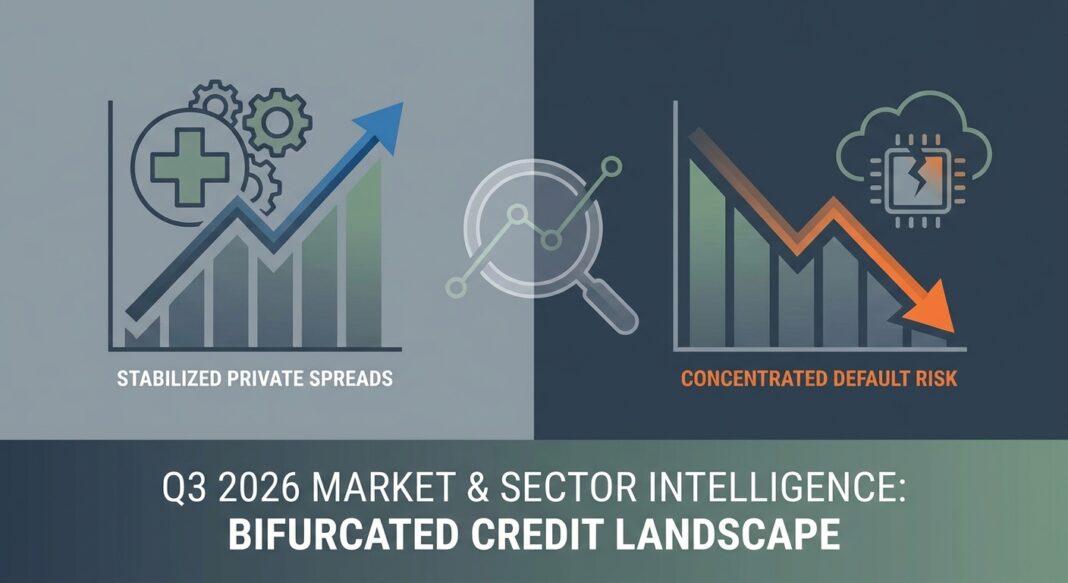
Bifurcated Credit: Private Spreads Stabilize at Elevated Levels as Default Risk Concentrates in Weaker Cohorts
Unitranche coupons hold at SOFR +500–575 bps. Fitch records a 6% private credit default rate — the highest since tracking began. Healthcare captures sector rotation while software credits face structural caution. Bank standards ease to 0.0% net tightening on C&I large/mid-market loans. Active lenders hold $280B+ in deployable dry powder.
I. The Macro Picture: A Mid-Cycle Credit Market Under Selective Stress
The U.S. credit cycle has entered a phase best characterized as stable-at-the-surface, stressed-underneath. The most recent Federal Reserve Senior Loan Officer Opinion Survey (July 2026 SLOOS, covering Q2 activity) showed that bank lending standards for commercial and industrial (C&I) loans to large and middle-market firms returned to 0.0% net tightening in Q3 2026 — a material easing from 8.1% in Q2 2026 and 9.5% a year earlier. [Source: FRED / Federal Reserve SLOOS] Meanwhile, loan demand from large and mid-market firms strengthened to a +16.1% net reading in Q3, the most positive reading since the cycle turned. [Source: MacroDataHub / FRED]
In private credit, the Q2 2026 volatility shock — driven by inflationary pressures, geopolitical uncertainty, and AI-related disruption concerns — has largely stabilized. Direct lending spreads held firm through Q3 2026, with unitranche coupon spreads unchanged at SOFR +500–575 bps and unitranche credit spreads at SOFR +525–600 bps, per Valuation Research Corporation (VRC) data. [Source: VRC Q3 2026 Private Credit Update] New issuance spreads remain approximately 25–50 bps above year-end 2025 levels, a residue of the March 2026 widening that has not fully retraced. [Source: VRC]
The headline stability, however, masks a sharp divergence in credit quality. Fitch Ratings recorded a U.S. private credit default rate of 6.0% for the 12 months ended April 30, 2026 — the highest since it began tracking this series in August 2024, with more than half of the 99 default events driven by interest deferrals or the conversion to payment-in-kind (PIK) interest. [Source: Financely Group / Fitch Ratings, May 2026] Proskauer’s Private Credit Default Index registered 2.73% in Q1 2026 — a third consecutive quarter of increases. [Source: CAPX / Proskauer] Importantly, this stress is not uniformly distributed: default rates for borrowers with sub-$100M EBITDA run at 3.0–3.6% by count, versus just 0.8% of principal across the broader market, per Houlihan Lokey. [Source: Houlihan Lokey, September 2026 / Financely Group]
The regulatory environment adds a further structural layer. The July 2026 SLOOS revealed that banks’ lending standards to Non-Depository Financial Institutions (NDFIs) — a direct proxy for their exposure to private credit — remain at the tighter ends of their historical ranges, a consistent signal that bank supervisors view private credit interconnectedness as a systemic monitoring priority. [Source: Federal Reserve SLOOS, July 2026] The Financial Stability Board’s May 2026 report on private credit vulnerabilities further flagged concerns over leverage concentration, liquidity mismatches in semi-liquid vehicles, and multi-layered interconnections between banks and private credit funds. [Source: FSB, Report on Vulnerabilities in Private Credit, May 2026]
II. Quantitative Market Snapshot
The table below aggregates current key metrics across public and private credit markets as of Q3/October 2026.
| Metric | Current Value (Q3 2026) | Prior Period | Change | Source |
|---|---|---|---|---|
| MM Unitranche Coupon Spread | SOFR +500–575 bps | SOFR +475–550 bps (YE 2025) | +25 bps (YoY) | VRC Q3 2026 |
| MM Unitranche Credit Spread | SOFR +525–600 bps | SOFR +500–575 bps (Q2 2026) | Unchanged QoQ | VRC Q3 2026 |
| Sponsor-Backed New Issue Spread (PitchBook LCD) | 500–549 bps range | <500 bps bucket dominant (Q1 2026) | Widened ~25 bps (H1) | PitchBook LCD, Aug 2026 |
| Private Credit All-In Yield (Unlevered) | High single-digit | High single-digit (Q2 2026) | +35 bps QoQ (SOFR lift) | Northleaf Q2 2026 |
| Senior-Secured DL Yield vs. HY Bond Yield | 10–13% (DL) vs. 7–9% (HY) | ~350 bps DL premium (2019) | Premium compressed to ~150–200 bps | Owners.pe / HedgeCo |
| US HY Composite OAS (ICE BofA) | 324 bps | 259 bps (Jan 2025 low) | +65 bps from cycle tights | InvestmentGrade.com / ICE BofA |
| BSL B-Rated Loan Spread-to-Maturity (Secondary) | S+412 bps (Sep 2026) | S+445 bps (Jun 2026) | Tightened –33 bps in Q3 | VRC Q3 2026 |
| Fitch U.S. Private Credit Default Rate | 6.0% (12 months to Apr 2026) | 5.7% (early 2025) | Record high for Fitch index | Fitch / Financely Group |
| KBRA DLD Default Rate (2026 Forecast) | 2.5% (by count) | 2.0% (prior forecast) | Forecast raised 50 bps | Northleaf / KBRA Q2 2026 |
| Median Portfolio Leverage (New Originations) | 5.0x–6.0x net debt/EBITDA | 6.5x–6.8x (2021–2022 vintage) | More conservative underwriting | VRC Q2 2026 |
| Median Interest Coverage (2021–2022 Vintages) | ~1.7x–1.8x | ~2.2x (at underwriting) | Deteriorated ~0.4–0.5x | VRC Q2 2026 |
| Bank C&I Standards — Large & Mid-Market (Net % Tightening) | 0.0% (Q3 2026) | 8.1% (Q2 2026) | Eased materially | FRED / Fed SLOOS, Aug 2026 |
| North American Private Credit Dry Powder | >$280B | ~$250B (start 2026) | Capital available; deployment selective | CAPX / Industry Data |
Key KPI Context: FCCR, Debt-to-Equity, and Underwriting Benchmarks
The interest coverage ratio — the private credit analogue to the Fixed Charge Coverage Ratio (FCCR) — is the most actively monitored KPI among direct lenders in the current environment. VRC proprietary data shows median interest coverage on 2021–2022 vintage loans has declined from approximately 2.2x at origination to the mid-1.5x range, with a further updated range of 1.7x–1.8x as of mid-2026. [Source: VRC Q2 2026] This deterioration is directly attributable to higher-for-longer base rates on floating-rate instruments: interest expense for early-2022 vintages increased approximately 40% from underwriting to 2024. [Source: VRC Q2 2026] The practical implication for borrowers is that any FCCR covenant set at 1.25x or below at underwriting may now be structurally impaired — a direct trigger for amendment requests, PIK elections, or lender intervention.
At the fund level, debt-to-equity ratios (fund leverage) have increased, with the current median at approximately 1.0x across the 69-fund Heron Finance sample — a manageable level, but one flagged for monitoring should it approach 1.2x, given its potential to amplify losses in a stress scenario. [Source: Heron Finance Q2 2026 Updated Edition] Borrower-level debt/EBITDA has shown no material upward drift in recent vintages, suggesting lenders have maintained origination discipline even as competition for quality deals remains intense. [Source: Heron Finance]
III. Sector-Level Lender Appetite: Structural Rotation Underway
The most significant structural shift in private credit in 2026 is a deliberate rotation away from technology — particularly legacy software — and toward healthcare, industrials, and essential services. This is not a marginal adjustment; it is reshaping origination pipelines, pricing differentials, and underwriting standards in real time.
Healthcare: The Dominant Growth Sector
Healthcare has emerged as the single largest sector for U.S. direct lending, accounting for approximately 22% of all direct lending issuance year-to-date through March 2026, up from 18% in 2025. [Source: RSM US / Health Care Industry Trend Watch, April 2026] Healthcare’s defensive demand characteristics, predictable cash flows, and non-cyclical service models make it a natural home for capital seeking yield with downside protection. [Source: RSM US] PitchBook LCD data from January 2026 confirmed that healthcare’s share of new-issue direct lending transactions rose relative to full-year 2025 levels — precisely as the tech sector’s share fell. [Source: PitchBook LCD] Healthcare remains the most resilient sector for private equity deployment as well, with take-privates and platform roll-ups continuing at pace according to PwC’s US Deals 2026 Midyear Outlook. [Source: PwC US Deals 2026] Pricing for healthcare credits has historically remained at approximately SOFR +500 bps on average — one of the few sectors that did not see significant year-over-year spread tightening in 2025. [Source: Octus Americas Private Credit 2026 Outlook]
Technology / Software: Caution and Pricing Penalty
Technology and software credits continue to face structural headwinds in 2026. Software and technology credits are pricing 50–100 bps wider than broader market levels, reflecting ongoing lender caution despite competitive demand for high-quality issuers. [Source: VRC Q3 2026] Stress remains concentrated among software-related credits and borrowers requiring amendments, maturity extensions, or cash-to-PIK conversions. [Source: VRC Q3 2026] Hamilton Lane has noted that AI disruption scenarios could push software-related defaults to 8%–15% in a downside case, creating a wide band of uncertainty for lenders with concentrated technology exposure. [Source: Hamilton Lane 2026 Private Credit Focus] The market bifurcation is stark: software-heavy funds face concentrated pressure while industrial-focused lenders are actively competing for quality credits. [Source: CAPX]
Industrials & Business Services: Active Competition
Industrials and business services represent the clearest beneficiaries of capital rotating out of software. Private credit fund managers are increasingly focused on portfolio diversification, lower-middle-market opportunities, and sectors less exposed to technology disruption. [Source: Sikich Q3 2026 Credit Market Update] Funds with deployment mandates in manufacturing, industrial, and essential services are actively seeking credits. [Source: CAPX] Credit Benchmark’s 2026 review of 20 major U.S. private credit funds finds that sector weights show little change year-on-year except for a switch of a few percentage points from Industrials (down) to Business Services (up), suggesting capital is migrating toward services-model businesses with more predictable cash flows. [Source: Credit Benchmark 2026]
Lower Middle Market: Wider Spreads, Higher Risk
The lower middle market (LMM — companies with $5M–$25M EBITDA) remains a structurally distinct segment. Spread compression has bypassed the LMM entirely: the spread premium of LMM deals over large-cap direct lending widened to 232 bps in Q3 2025 even as upper-market spreads hit record compression. [Source: Avante Capital / Muzinich & Co., Feb 2026] However, default and impairment risk at the lower end is materially higher: Houlihan Lokey’s Q2 2026 data shows LMM default rates of 3.0–3.6% by count, far exceeding the 0.8% of principal observed across the broader market. [Source: Houlihan Lokey / Financely Group]
IV. Implications for Institutional Investors and Operators
For Institutional Investors and Lenders
The stabilization of private credit spreads at 25–50 bps above year-end 2025 levels — combined with elevated base rates — continues to support attractive risk-adjusted returns for senior-secured direct lenders at high single-digit unlevered yields. [Source: Northleaf Q2 2026] However, the private credit premium over high yield has compressed from approximately 350 bps in 2019 to just 150–200 bps today — a structural shift that demands investors scrutinize whether remaining spread adequately compensates for illiquidity, concentration, and valuation uncertainty. [Source: Owners.pe, April 2026]
Vintage risk is now the primary differentiator in portfolio performance. Loans from 2021–2022 vintages — underwritten at low rates, peak leverage (6.5x–6.8x), and aggressive growth assumptions — carry median interest coverage of approximately 1.7x–1.8x, compared to more recently originated deals with coverage above 2.0x. [Source: VRC Q2 & Q3 2026] Investors should demand granular vintage-level transparency from fund managers, particularly regarding PIK accumulation, amendment frequency, and covenant headroom on legacy positions.
BDC-level stress warrants separate scrutiny. Non-traded BDCs reported redemptions above their 5% quarterly limits through Q2 2026, and publicly traded BDCs continue to trade at 10–20% discounts to reported NAV. [Source: VRC Q3 2026] A $12.7B BDC maturity wall further narrows refinancing bandwidth for fund managers simultaneously managing existing portfolio stress and new deployment. [Source: CAPX]
For Business Operators and Borrowers
The most actionable insight for operating companies seeking capital is that fund selection now matters as much as deal terms. North American private credit dry powder exceeds $280B, but availability is highly fund-specific: software-heavy or redemption-constrained vehicles are operating with reduced bandwidth regardless of a borrower’s own credit quality. [Source: CAPX] Operators in healthcare, industrials, and essential services should expect competitive lender engagement and favorable documentation. Operators in technology or software must price in a 50–100 bps spread penalty and more intensive lender diligence around AI disruption risk. [Source: VRC Q3 2026]
For companies with existing floating-rate private credit facilities from 2021–2022, covenant management is urgent. With median FCCR proxies deteriorating to 1.7x–1.8x on those vintages, companies approaching 1.25x coverage thresholds face amendment risk. Borrowers should proactively stress-test their interest coverage under scenarios where SOFR remains above 3.5% through 2027–2028 — current forward rate projections imply a base rate average of approximately 3.5% over that period. [Source: Northleaf Q1 2026]
V. Forward-Looking View: Q4 2026 and into H1 2027
The credit environment for Q4 2026 and early 2027 is best described as constructive but selective — a phrase that increasingly defines actionable opportunity in private credit. Four forces will shape near-term dynamics:
1. Spread Stability, Not Compression. With bank C&I lending standards having eased to 0.0% net tightening for large/mid-market firms and banks beginning to re-enter select markets, the window for meaningful additional spread widening appears to have passed for high-quality credits. [Source: VRC Q2 2026] Conversely, the weight of dry powder — over $280B in North America alone — means aggressive re-tightening is also unlikely absent a macro shock. The most probable outcome is range-bound spreads in the SOFR +500–575 bps corridor for traditional middle-market unitranche through at least Q1 2027.
2. Rising Restructuring and LME Activity. Elevated rates, inflation, and approaching maturities are expected to drive increased restructurings and liability management exercises through Q4 2026 and into 2027. [Source: Sikich Q3 2026] UBS projects private credit defaults could reach 9–10% by year-end 2026 on its Fitch-equivalent basis. [Source: Financely Group / UBS] Opportunistic and distressed credit funds — which have raised over $100B in the past two years — are positioned to capitalize on this activity. [Source: With Intelligence 2026 Private Credit Outlook]
3. Deal Flow Recovery Gaining Traction. Direct lending activity recovered over Q3 2026, with volume and deal count rising off Q2 lows, though the year-to-date pace remains behind 2025. [Source: PitchBook LCD August 2026 US Private Credit Monitor] Improving M&A pipelines, significant dry powder, and growing LP pressure to monetize aging investments support a more constructive transaction environment into 2027. [Source: VRC Q3 2026]
4. Regulatory Scrutiny Intensifying. The FSB’s May 2026 vulnerability report and persistent SLOOS findings showing NDFI lending standards at the tighter end of historical ranges signal that regulatory frameworks governing private credit interconnectedness — leverage disclosures, liquidity stress testing, and fund-level reporting — are likely to tighten further in 2027. Institutional allocators should factor evolving regulatory cost into their net return assumptions for new fund commitments.
VI. Key Market Insights: Five Actionable Takeaways
- Spreads Have Stabilized, Not Normalized: Unitranche coupons at SOFR +500–575 bps are ~25–50 bps above year-end 2025 levels — a residue of March volatility. This represents a modest but meaningful lender-friendly reset, not a return to 2019-era spread compression. Investors entering now lock in a structurally improved yield profile relative to 12 months ago. [VRC Q3 2026]
- FCCR Deterioration Is the Core Portfolio Risk: Median interest coverage on 2021–2022 vintage loans has fallen from ~2.2x to ~1.7–1.8x. For operators and investors, any position with coverage below 1.5x should be treated as requiring active management in a higher-for-longer rate environment. Lenders are prioritizing amendment-and-extend over outright default — but that creates PIK accumulation risk that defers, rather than eliminates, losses. [VRC Q2 2026]
- Healthcare Is the Highest-Conviction Sector for New Deployment: With 22% of direct lending issuance YTD March 2026 and confirmed lender competition from multiple capital sources, healthcare offers the best combination of deal volume, defensible cash flows, and spread levels for new originations in the current cycle. [RSM US, April 2026]
- Software Exposure Requires a Structural Discount: The 50–100 bps pricing penalty on software credits is not cyclical — it reflects a structural reassessment of AI disruption risk to business models, revenue retention, and exit valuations. Investors with legacy software concentration should seek updated independent credit assessments and model downside default scenarios of 8–15%. [Hamilton Lane 2026]
- Fund Selection Is Now a Credit Variable: With redemption stress, BDC NAV discounts of 10–20%, and a $12.7B BDC maturity wall, the credit quality of the lending institution — not just the borrower — is a material risk factor for new transactions. Borrowers and co-investors should evaluate lender bandwidth, portfolio stress, and redemption exposure before committing to a facility. [CAPX 2026]


