
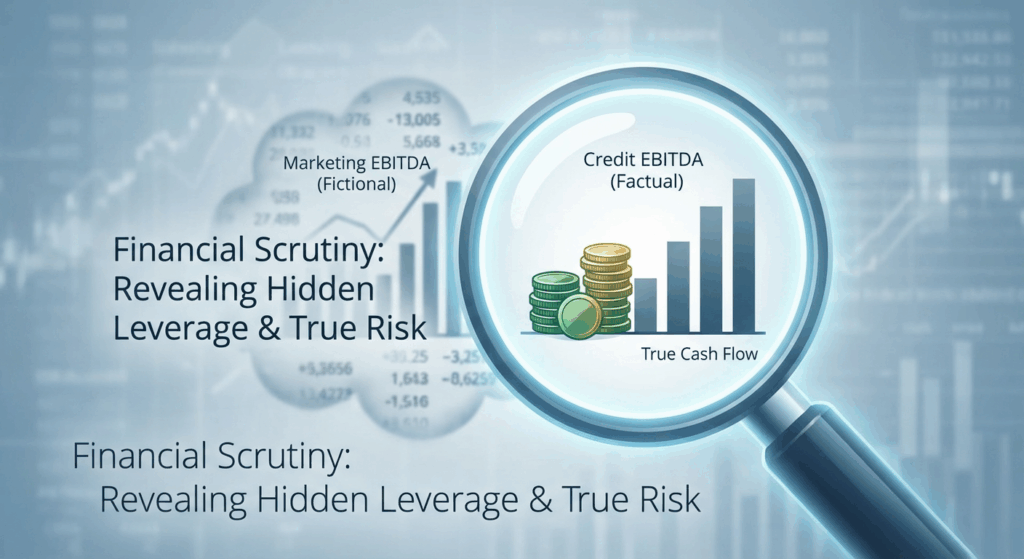
The Underwriting Challenge: Fact vs. Fiction in Financials
In the landscape of corporate credit, few metrics are as ubiquitous—or as manipulated—as EBITDA (Earnings Before Interest, Taxes, Depreciation, and Amortization). While intended to serve as a proxy for operating cash flow, “Adjusted EBITDA” has evolved into a heavily negotiated figure in credit agreements and offering memorandums. For underwriters, the primary challenge is distinguishing between legitimate normalizations that reflect recurring earnings power and aggressive add-backs that artificially deflate leverage ratios.
The difference is not merely academic. An inflated EBITDA number masks the true probability of default. As noted in fundamental credit analysis, credit risk is comprised of default risk and loss severity. When underwriters accept questionable adjustments, they effectively underprice risk by calculating leverage on a denominator that does not exist in cash terms. In an environment where updated guidance—such as the 2025 Principles for the Management of Credit Risk by the Basel Committee—emphasizes the need for “sound credit-granting processes,” rigor in validation is the underwriter’s first line of defense.
The Framework: A Methodology for Normalization
A robust underwriting framework does not simply accept the “Marketing EBITDA” presented in a Confidential Information Memorandum (CIM). Instead, it bridges the gap to “Credit EBITDA” through a systematic Quality of Earnings (QoE) validation process. This process typically categorizes adjustments into four distinct buckets:
- Non-Recurring Items: Extraordinary expenses that are not expected to repeat, such as litigation settlements or disaster recovery costs.
- Pro-Forma Adjustments: Annualizing the earnings of an acquired entity or a realized contract transparency.
- Run-Rate Synergies: Projected cost savings from mergers or operational improvements. These are the highest risk category, as they represent future hopes rather than historical facts.
- Management/Owner Add-backs: Excessive compensation or personal expenses often seen in private company lending.
According to Fitch Ratings’ methodology, the assessment of credit quality involves both quantitative metrics (the numbers) and qualitative metrics (the story behind the numbers). A borrower’s aggressiveness in defining “adjusted” earnings often serves as a qualitative signal of management’s governance and transparency.
The Analysis: Stress-Testing the Adjustments
Consider a hypothetical manufacturing borrower seeking a debt facility. The company reports an LTM (Last Twelve Months) Net Income of $2M and a “Marketing EBITDA” of $10M. The bridge includes $8M of total adjustments. Let us walk through the underwriting analysis:
Reported Adjustments ($8M total):
1. Restructuring Charges ($2M): Costs for closing a plant.
2. Projected Synergies ($3M): Savings “expected” from a new ERP system.
3. Inventory Write-down ($1M): Classified as “one-time” by management.
4. One-time Professional Fees ($2M): Management consultants.
The Underwriter’s Re-Calculation:
The underwriter accepts the Restructuring Charges ($2M) as they relate to a closed facility. However, they scrutinize the Projected Synergies ($3M). Institutional standards often cap synergies or require they be “realized” within 12 months; the underwriter haircuts this by 50% ($1.5M). The Inventory Write-down ($1M) is rejected upon discovering that write-downs have occurred in 3 of the last 4 years, indicating a recurring operational issue rather than a one-time event. The Professional Fees ($2M) are analyzed; half deemed recurring strategy work, half strict transaction costs. The underwriter accepts $1M.
Result:
Marketing EBITDA: $10M
Underwritten EBITDA: $6.5M
If the borrower requests a $40M loan, the leverage profile shifts dramatically on this adjustment. Using Marketing EBITDA, leverage is 4.0x (Acceptable). Using Underwritten EBITDA, leverage jumps to 6.15x (Often Prohibitive). This exercise reveals the material impact of normalization on risk identification.
Industry Standards and Red Flags
Experienced institutional lenders utilize specific guardrails to prevent “EBITDA creep.” A common red flag is when adjustments exceed 20-30% of the total EBITDA figure. Furthermore, the International Accounting Standards and regulatory frameworks like those from the Central Bank of Bahrain (CBB) regarding asset impairment suggest that consistent write-downs (like the inventory example above) must be treated as operational costs, not exceptional items.
Key data points to consider in credit performance:
- Covenant Breaches: Historically, looser definitions of EBITDA in credit agreements correlate with lower recovery rates because lenders intervene later in the deterioration cycle.
- Synergy Realization: Studies often show less than 60% of projected merger synergies are fully realized or flow through to free cash flow.
- Default Probability: As noted by IFT World’s notes on credit analysis, spread risk widens when the market perceives that the “yield premium” does not adequately compensate for the true leverage risk. Aggressive add-backs obscure this ratio.
Underwriting Checklist: Validating the EBITDA Bridge
To ensure a rigorous “sound credit-granting process” as outlined in the Basel Committee’s 2025 principles, underwriters should employ the following checklist:
- Cash Proof: Can the add-back be reconciled to a specific cash outflow on the bank statement?
- Frequency Test: Has a similar “one-time” expense appeared in the financials in the prior two fiscal years?
- Third-Party Validation: Is the adjustment supported by a Quality of Earnings (QoE) report from a reputable accounting firm?
- Covenant Definition: Does the credit agreement cap “future” or “soft” add-backs (marketing, synergies) to a percentage (e.g., 15%) of total EBITDA?
- CapEx Consideration: Are items being capitalized that should be expensed, thereby artificially inflating EBITDA?
Key Takeaways
- EBITDA is not Cash Flow: It is a proxy that requires rigorous normalization to be useful for debt service analysis.
- Adjustments Impact Leverage: Small variations in accepted add-backs can swing leverage ratios by full turns, altering the risk-pricing equation.
- Past is Prologue: Recurring “one-time” charges are a leading indicator of poor operational controls or aggressive accounting.
- Qualitative Matters: The aggressiveness of a borrower’s add-backs is a character proxy for management’s transparency.
- Standardization is Safety: Adhering to Basel and Fitch-aligned standards for credit assessment protects the portfolio from hidden leverage.


