
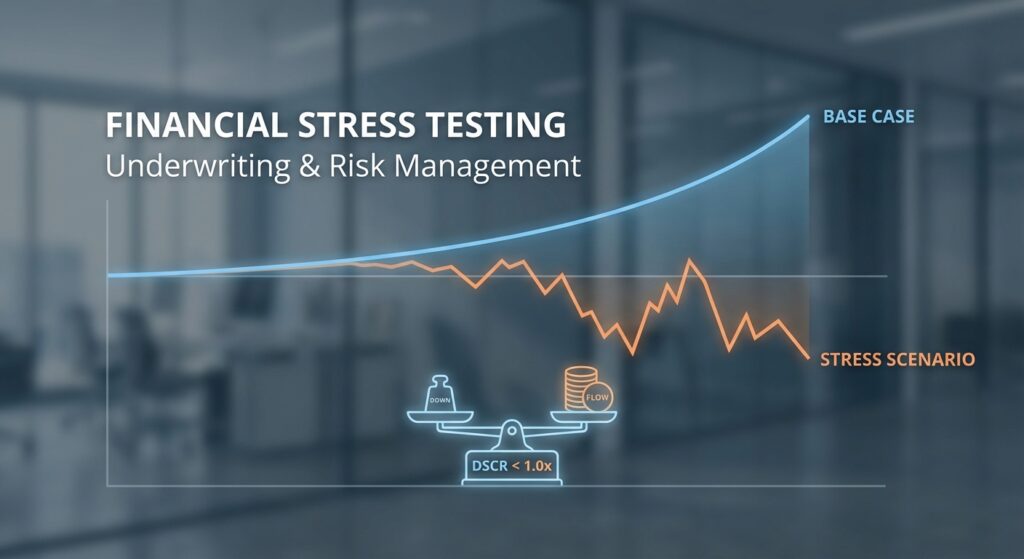
The Underwriting Challenge: Identifying the Breaking Point
In credit underwriting, the “Base Case” model provided by a borrower or sponsor rarely tells the full story. Deal memorandums often present a “sunny day” forecast where margins expand, revenue grows linearly, and synergies are fully realized. However, the primary job of a credit risk officer is not to validate the upside, but to quantify the downside. The rigorous underwriter asks: How much can this business bend before it breaks?
Stress testing cash flows is the analytical backbone of defensive lending. It moves beyond high-level leverage multiples (e.g., Debt/EBITDA) to examine the actual liquidity available to service debt under adverse conditions. As recent economic cycles have demonstrated, companies with identical leverage profiles can have vastly different default probabilities depending on their cost structures and capital intensity.
The Framework: Operating Leverage and Fixed Costs
Effective stress testing requires a granular understanding of a clear methodology: distinguishing between fixed and variable costs to determine operating leverage. A high degree of operating leverage means a company has high fixed costs; consequently, a small decline in revenue can lead to a disproportionately large decline in EBITDA and cash flow.
Key Metrics to Analyze
- Contribution Margin: Developing a view on variable profit per unit vs. fixed overhead absorption.
- Maintenance Capex vs. Growth Capex: Determining the absolute minimum reinvestment required to keep the lights on.
- Working Capital Intensity: Analyzing how changes in the cash conversion cycle impact liquidity during a downturn.
According to the 2025 Principles for the Management of Credit Risk released by the Basel Committee, sound credit measurement must include “forward-looking” assessments that account for potential changes in economic conditions, rather than relying solely on historical performance or static projections [bis.org].
The Analysis: Determining the Breakeven Point
Let us apply this framework to a hypothetical manufacturing borrower, “Alpha Corp,” to illustrate the impact of operating leverage during a stress test.
Base Case Scenario
- Revenue: $100 million
- COGS (60% Variable): $60 million
- Gross Profit: $40 million
- SG&A (90% Fixed): $30 million
- EBITDA: $10 million (10% Margin)
- Debt Service: $5 million
- DSCR: 2.0x
On the surface, a 2.0x Debt Service Coverage Ratio (DSCR) appears healthy. However, an underwriter must stress the top line to see how quickly that cushion evaporates.
Stress Scenario: 10% Revenue Decline
If revenue drops 10% to $90 million, and we assume COGS remains 60% of revenue but SG&A is fixed:
- Revenue: $90 million
- COGS: $54 million
- Gross Profit: $36 million
- SG&A: $30 million (Fixed)
- EBITDA: $6 million
- Impact: A 10% drop in revenue caused a 40% drop in EBITDA.
- New DSCR: 1.2x
In this analysis, the company is dangerously close to a 1.0x coverage ratio despite only a modest revenue contraction. If the stress test includes a simultaneous increase in interest rates or input costs, the borrower would likely default.
Industry Standards and Regulatory Expectations
Institutional lenders and rating agencies have formalized the requirement for multi-scenario analysis. Fitch Ratings’ Corporate Rating Criteria emphasizes that projections should cover a three-to-five-year horizon to capture a “typical economic cycle,” rather than just a single year of performance [assets.fitchratings.com]. This ensures that the rating—and by extension, the underwriting decision—reflects the issuer’s financial profile through troughs, not just peaks.
Furthermore, regulators like the OCC expect banks and lenders to evaluate “repayment sources” under adverse conditions. Their guidance on rating credit risk expressly notes that financial statement analysis must assess the “quantity of existing and potential credit risk” relative to capital resilience [occ.gov].
Common Red Flags
- EBITDA Add-backs: Relying on “Adjusted EBITDA” that excludes recurring restructuring costs, which deceptively inflates the starting point for cash flow analysis.
- Inflexible Cost Structures: Companies unable to cut SG&A quickly during a downturn (e.g., extensive union contracts or long-term leases).
- Customer Concentration: Assessing if a 10% revenue drop relates to the loss of a single key client, which often triggers secondary effects like inventory obsolescence.
Underwriting Checklist: The Stress Test Toolkit
To ensure rigorous diligence, underwriters should utilize the following checklist when building their internal credit memos:
- Fixed vs. Variable Audit: Have you verified which line items usually move with revenue? Do not assume all COGS are variable (e.g., factory rent is COGS but fixed).
- Breakeven Calculation: At what exact revenue level does DSCR hit 1.0x? Is this level within a standard deviation of historical volatility?
- Capex Flexibility: Can the borrower actually turn off growth capex in a downside scenario, or represent committed projects that cannot be stopped without penalty?
- Working Capital Drag: In a scenario where payment terms stretch (receivables age) and suppliers demand faster payment (payables shrink), what is the cash burn?
- Covenant Compliance: Does the stress scenario trigger a technical default (leverage covenant breach) before a payment default?
Key Takeaways by Bond Capital Risk Management
- Operating Leverage is a Double-Edged Sword: High operating leverage boosts returns in growth phases but accelerates distress in contractions.
- Cash is King, EBITDA is Opinion: Always stress test “Free Cash Flow” available for debt service, not just accounting EBITDA.
- Correlations Matter: Real-world stress often involves correlated variables (e.g., revenue falls AND margins compress simultaneously).
- Look Forward, Not Backward: Relying solely on TTM (Trailing Twelve Months) financials ignores impending cyclical shifts.
- Structure for the Downside: Use the results of stress testing to set appropriate covenant cushion levels (typically 20-25% off base case projections).


