
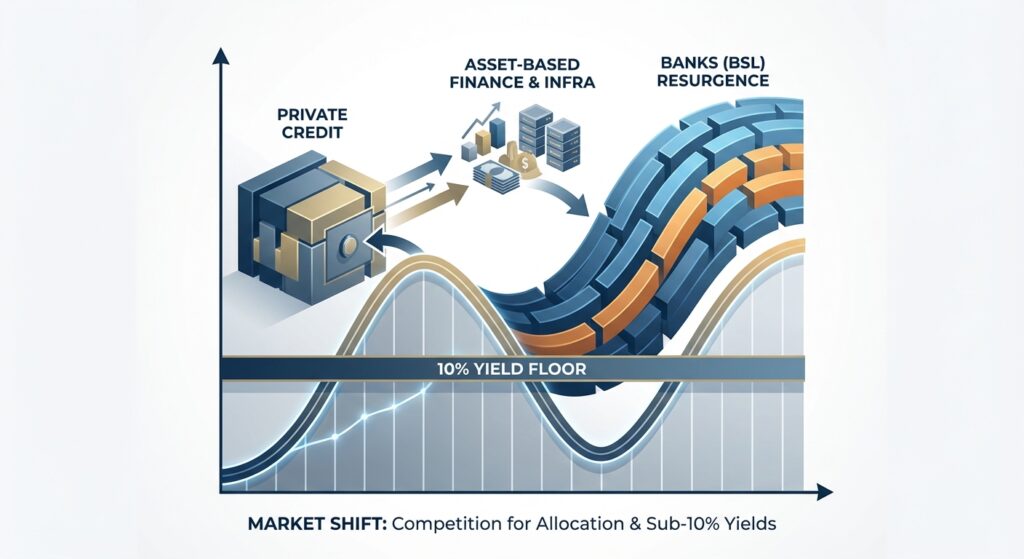
Market Headline: The Great Convergence & The Sub-10% Yield Environment
As we navigate Q1 2026, the private credit market is defined by a fierce resurgence of competition from Broadly Syndicated Loans (BSL) and a decisive shift in pricing power back to borrowers. Following the Federal Reserve’s rate cuts in Q4 2025—bringing the top rate to 3.75%—direct lending all-in yields have breached the psychological floor of 10% for the first time in three years. The “golden era” of easy double-digit returns for lenders has transitioned into a complex battle for allocation.
The defining narrative of early 2026 is the unshackling of traditional banks. With the withdrawal of leveraged lending guidelines in December 2025, banks are aggressively re-entering the market, offering higher leverage multiples to compete with private funds. This has triggered a wave of refinancings, with public markets recapturing significant volumes from private lenders. Despite this pressure, liquidity remains abundant; private credit assets under management (AUM) are projected to surpass $2 trillion this year, driven by a structural pivot toward Asset-Based Finance (ABF) and data infrastructure to offset compressing corporate spreads.
Quantitative Snapshot: Q1 2026
| Metric | Current Level / Data | Context / Trend | Source |
|---|---|---|---|
| Direct Lending Yields | < 10% | Fell below double-digits for the first time in 3 years due to spread compression and rate cuts. | CreditSights |
| Fed Policy Rate | 3.75% | Down from 2024 highs following two cuts in Q4 2025. | Mondaq |
| BSL “Takeout” Volume | $48 Billion (2025) | Public markets actively refinancing private deals; trend accelerating in Q1 2026. | CreditSights |
| Private Credit AUM | > $2 Trillion | Projected 2026 milestone; approaching $4T by 2030. | Moody’s |
| Deal Flow | ~$140 Bn (2025) | Robust volume sustained despite BSL competition. | CreditSights |
Sector Analysis: The Pivot to Asset-Based Finance
Heating Up: Asset-Based Finance (ABF) & Infrastructure
With corporate lending spreads compressing, capital is increasingly rotating into Asset-Based Finance. Moody’s reports that investment focus is shifting significantly from pure corporate cash-flow lending to ABF, specifically consumer loans and data infrastructure credit. This diversification allows lenders to maintain yield targets via complexity premiums rather than credit risk alone.
Heating Up: M&A and LBOs
Dealmaking accelerated at the end of 2025 and has carried momentum into Q1 2026. The stabilized rate environment is thawing the M&A freeze, driving demand for new LBO financing. However, lenders face heightened execution risk as aggressive terms return to the market.
Cooling/Watchlist: Idiosyncratic Distress
While systemic default rates remain managed, specific sectors are seeing “idiosyncratic credit events.” Recent bankruptcies in the auto parts (First Brands) and subprime auto lending (Tricolor) sectors highlight the fragility of borrowers unable to absorb prolonged high rates, even as those rates begin to fall. State Street notes that while these are not yet systemic validation of widespread distress, they expose opacity issues in private portfolios.
Implications for Market Participants
For Borrowers:
Conditions are arguably the most favorable they have been since 2021. The “BSL vs. Private Credit” war is driving down cost of capital. Furthermore, the withdrawal of bank leveraged lending guidelines means borrowers can once again pit banks against direct lenders to secure higher leverage multiples and looser documentation.
For Lenders & Investors:
The “easy beta” trade is over. With yields compressing and public markets retaking $48 billion in loans, managers must differentiate through origination. Expect a bifurcation: large caps will be served by BSL/Mega-funds fighting over thin spreads, while alpha will be generated in complex ABF, NAV lending, and hybrid capital solutions.
Forward Outlook (3-6 Months):
Expect continued volatility in spreads as the market digests the Fed’s “data-dependent” path amidst a soft labor market. The primary risk is no longer just rates, but “Liability Management Transactions” (LMT)—where distressed borrowers aggressively restructure covenants at the expense of existing lenders—becoming a standard feature in private credit documentation.
Key Market Insights
- Yield Compression: Direct lending yields dropping below 10% signals a new, leaner return environment.
- Bank Aggression: Regulatory relief (end of leveraged lending guidelines) empowers banks to compete on leverage, not just price.
- Asset Class Rotation: Growth is pivoting from corporate cash flow lending to Asset-Based Finance (ABF) and data infra.
- Covenant Risks: Documentation is converging with BSL standards; watch for leakage in “Liability Management” protections.
- Refinancing Wave: Expect continued BSL “takeouts” of private credit deals as public market liquidity deepening.


