
The Story: A Billion Dollars That Bought Everyone Nothing
January 2025. A headline crosses the wire that would have looked triumphant to any casual reader: Divvy Homes acquired by Brookfield Properties for $1 billion. In a proptech sector littered with shutdowns and haircuts, a ten-figure acquisition sounded like vindication.
It was not vindication. It was a capital structure autopsy.
Divvy Homes launched in 2017 with a genuinely innovative mission: help renters become homeowners through a structured rent-to-own model. The product worked. The company scaled. At its 2021 peak, Divvy was valued at $2.3 billion and had raised more than $700 million in combined debt and equity from some of the most respected names in venture — Andreessen Horowitz, Tiger Global, GGV Capital, and others. Its property portfolio stretched across 20 cities and included roughly 7,000 homes.
Then came 2022. Interest rates surged. The model — which depended on purchasing homes at cheap financing costs and leasing them back to aspiring buyers — fractured under the weight of a rate environment it was never designed to survive. Three rounds of layoffs followed in a single year. New home acquisitions were paused entirely in 2023. By early 2025, the company that had helped over 15,000 residents begin their homeownership journey had no choice but to sell.
The $1 billion price tag covered the home portfolio and the brand. What it did not cover — not even close — was the full weight of obligations stacked in front of the founders, employees, and most equity investors in the payout waterfall.
The Decision: When Structure Becomes Destiny
The details of Divvy’s capital collapse were laid bare in a letter from CEO and co-founder Adena Hefets to shareholders, which was later reviewed and reported by TechCrunch. The letter confirmed what the liquidation math had already made inevitable: after repaying outstanding indebtedness, covering transaction costs, and fulfilling liquidation preferences owed to preferred shareholders, neither common shareholders nor holders of the Series FF preferred stock — the class typically issued to founders — would receive any consideration from the sale.
Zero. From a billion-dollar exit.
Understanding why requires a clear look at how the capital had been structured. Divvy had layered roughly $735 million in debt financing onto its balance sheet in October 2021, at the apex of the zero-interest-rate era. The logic seemed airtight in that moment: the business model required purchasing real property at scale, debt was cheap, and leverage was the natural mechanism to build a large portfolio fast. The equity story — a $2.3 billion valuation — sat on top of that debt, buoyed by abundant venture capital and a belief that rates would stay accommodative indefinitely.
That belief was the structural error. The debt was not inherently wrong as an instrument. The debt was catastrophically mismatched to the underlying business model’s rate sensitivity. When rates moved, the cost of carrying the portfolio became unsustainable — and the debt, sitting senior in the waterfall, never moved. It simply waited to be repaid first, in full, regardless of what happened to everyone else.
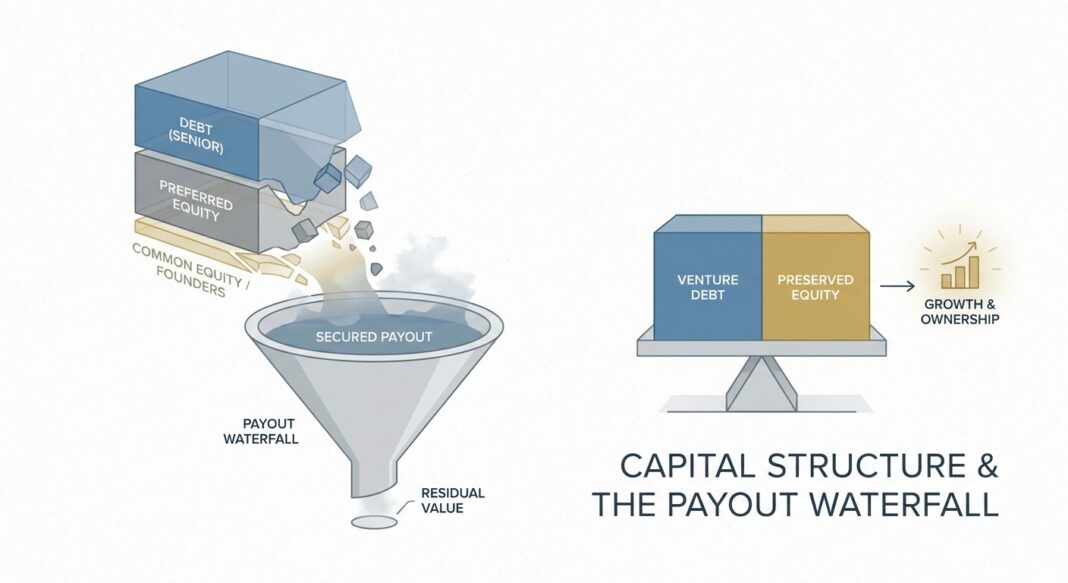
This is the payout waterfall in its most brutal, undeniable form. Debt holders occupy the first position. Preferred equity holders follow. Common equity — founders, employees, early believers — stands last in line. When the exit price barely covers the debt, the line ends before it reaches them.
“This isn’t just a failure story. This is a capital structure story.” — SaaStr, analyzing the Divvy Homes acquisition
The Contrast: A Hypothetical That Mirrors Hundreds of Real Decisions
Hypothetical Case Study — Illustrative Example Only. The following scenario is a composite designed to illustrate the decision framework faced by founder-operators with recurring-revenue businesses. It does not represent a specific company.
Now consider a different founder — call her Maya. She runs a B2B SaaS company generating $8 million in ARR, growing at 40% year-over-year, with 88% gross margins and strong net revenue retention. In 2022, she faces a familiar inflection point: she needs $6 million to accelerate her go-to-market team and expand into two new verticals.
Her options are in sharp contrast:
- Option A — Series A Equity: A top-tier VC will lead at a $40 million pre-money valuation, writing a $10 million check. Maya gives up 20% of her company, accepts two board seats (one for the lead, one independent), and takes on liquidation preferences with a 1x non-participating structure. Her ownership drops from 78% to approximately 62%.
- Option B — Venture Debt: A non-dilutive lender will advance $6 million against her ARR at an interest rate of 11.5%, structured as a 36-month term loan with a 6-month interest-only period and a small warrant coverage of 1% — negligible dilution. Maya repays from cash flow. Her ownership stays at 78%. No board seats change. No liquidation preferences are added to the stack.
Maya chooses Option B. She deploys the capital, hits her milestones, and grows ARR to $18 million over the next 24 months. By the time she raises a Series A, she does so from a position of strength — with a higher valuation, more leverage in negotiating terms, and nearly 16 percentage points more ownership than the 2022 path would have left her with.
When she exits three years later at a 10x ARR multiple — $180 million — those 16 percentage points of preserved ownership represent approximately $28.8 million in additional proceeds. The cost of the venture debt, including all interest and the minimal warrant coverage? Roughly $2.6 million all-in.
The ROI on the equity preservation decision: over 10x.
The Outcome: The Market Has Already Voted
Maya’s hypothetical reflects a shift that is now plainly visible in real transaction data. According to PitchBook’s NVCA Venture Monitor, U.S. venture debt reached a record $53.3 billion in 2024 — up 94% from 2023 — as founders increasingly turned to non-dilutive financing amid declining venture capital availability and rising equity costs. By 2025, the number climbed further still: the 2025-2026 Venture Debt Review, released by Runway Growth Capital and PitchBook, confirmed that U.S. venture debt hit a new record of $68.8 billion in 2025, with annual deal volume holding steady at roughly 1,000 transactions.
The stability of deal count alongside the surge in deal size is significant. Founders are not reaching for debt out of desperation. They are using it with precision. As David Spreng, Founder and CEO of Runway Growth Capital, observed in the 2025-2026 report: “High-quality companies are using debt as a strategic tool to extend flexibility, preserve ownership, maintain control and scale with discipline.”
The market has also produced its own real-world analogues to Maya’s decision. The 2025-2026 Venture Debt Review highlighted Cohesity’s $3.1 billion debt financing — executed following a $1 billion-plus equity round — as a marquee example of how venture debt can power ambitious growth without forcing founders to surrender equity at scale.
The Divvy outcome, meanwhile, stands as the counterpoint that sharpens every lesson. It was not a story about bad founders, a bad product, or a bad market. It was a story about capital structure mismatch — debt applied at scale to a model acutely sensitive to the very variable (interest rates) that debt amplifies. The $1 billion exit price was not the failure. The failure was the $735 million debt load stacked against a rate-sensitive asset base in a rising-rate environment, sitting senior to every other claim on the payout waterfall.
The Lessons: A Framework for Capital Decisions That Actually Hold at Exit
The comparison between Divvy and Maya’s hypothetical is not a lesson against debt. It is a lesson about structural fit — and about understanding, before you sign, exactly where your capital sits in the waterfall and what happens to it when conditions change.
1. Match the Instrument to the Business Model
Venture debt and non-dilutive facilities work best when the business generates recurring, predictable revenue that can service debt obligations without relying on the continued availability of cheap external capital. SaaS and subscription businesses, for instance, have built-in debt serviceability — their cash flows are contractual, not cyclical. Divvy’s model, by contrast, required purchasing and holding rate-sensitive real assets at a scale that made rising rates existentially dangerous.
2. Understand the Waterfall Before You Build the Stack
Every layer of capital you add — whether equity with liquidation preferences, venture debt with senior security, or mezzanine instruments — occupies a specific position in the exit distribution. The fatal mistake is building a capital stack in the present without modeling its behavior in a distressed exit scenario. Founders need to run the waterfall at 0.5x, 1x, and 2x of current valuation before they sign any term sheet.
3. Equity Dilution Is Permanent; Debt Is Temporary
This asymmetry is the core insight of strategic leverage. When a venture debt facility is repaid, the lender exits the picture entirely. The cap table is unchanged. There are no liquidation preferences stacked on top of founder equity. The borrowed capital cost is finite and knowable in advance — unlike the compounding dilution from multiple equity rounds, each adding new preferences, governance rights, and claims that subordinate common equity further.
4. Non-Dilutive Capital Is Now Institutional
The private credit market has matured dramatically. Non-sponsor direct lending went mainstream in 2025, with founder-owned companies gaining access to bespoke structures — delayed-draw term loans, hybrid overlays, and asset-based facilities — that were once exclusively available to PE-backed platforms. The market is no longer forcing founders to choose between a bank credit line and institutional equity. A third path — disciplined, structured, non-dilutive debt — is fully available for businesses with the unit economics to support it.
5. Rate Risk Is Not Theoretical
The Divvy story is also a reminder that macro conditions change, and that capital structures need to be stress-tested against the thing they are most sensitive to. For asset-heavy models, that sensitivity is the cost of financing. For SaaS businesses using venture debt, the risk is different — it is the repayment timeline relative to the path to cash-flow positivity. Either way, modeling the downside before you sign the term sheet is not pessimism. It is the job.
Key Insights
- The waterfall is non-negotiable. At exit, debt is paid first, preferred equity second, and common equity last. Build your capital stack as if a compressed exit is always possible — because it is.
- Strategic debt is growing because it works. U.S. venture debt hit a record $68.8 billion in 2025, driven by founders using debt deliberately to preserve ownership, extend runway, and avoid premature dilution.
- Structural mismatch kills more companies than bad products. Divvy Homes served 15,000 customers and built a $1 billion asset base. The company did not fail because of its mission. It was destroyed by rate-sensitive debt stacked against a rate-sensitive model.
- Preserved equity compounds at exit. Every percentage point of ownership a founder keeps through non-dilutive financing translates directly into exit proceeds. In a $180 million exit, 16 percentage points of preserved ownership is worth $28.8 million — far exceeding the cost of the debt that protected it.
- Debt is not distress — it is discipline. The old narrative that venture debt signals a company that could not raise equity is dead. Today’s data shows that the most sophisticated, capital-efficient operators are choosing debt as a first-principle strategy, not a last resort.


