
Market Headline
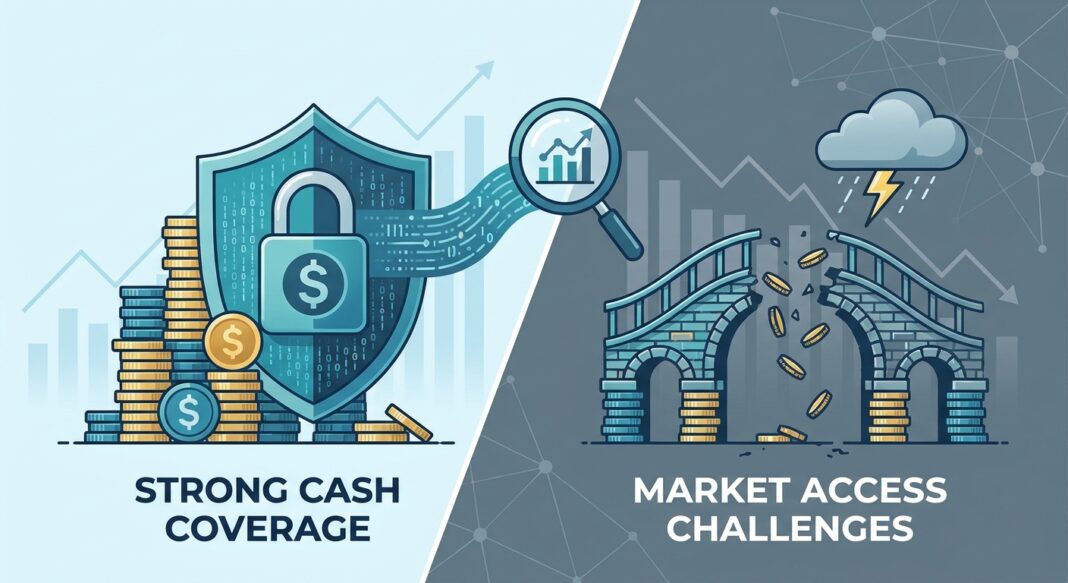
U.S. credit is not facing a uniform lending retreat. Access is increasingly determined by whether a borrower can absorb floating-rate debt service without relying on add-backs, payment-in-kind interest or a refinancing window. The Federal Reserve’s October 2026 Senior Loan Officer Opinion Survey found bank standards for large and middle-market commercial borrowers broadly unchanged in the third quarter, while banks tightened standards for small firms and became more restrictive on riskier-loan premiums. At the same time, new private-credit data show weaker coverage and rising defaults concentrated among smaller borrowers.
Public-market spreads widened in October, while direct-lending yields rose quarter over quarter. That is not a simple contradiction: the measures cover different periods and borrower cohorts. It does show that headline market access can coexist with a tougher underwriting test at company level. For sponsors and operators, debt capacity now turns more on durable cash conversion and coverage under stress than on a single market spread or leverage convention. For lenders, the data support selective deployment, not a broad pullback from lending.
Quantitative Snapshot
| Metric | Latest reading and comparison |
|---|---|
| Middle-market direct-lending yield | 9.61% in Q3 2026, up from 9.25% in Q2, according to NEPC’s Q3 private-markets report. |
| First-lien middle-market spread | 515.75 bps in Q3 2026, slightly wider quarter over quarter; BSL spread was 347 bps and modestly tighter, per NEPC. |
| Public loan spread | 510 bps three-year discount margin at October 31, 2026, 28 bps wider than September, per UBS’s November credit review. |
| High-yield bond spread | 344 bps OAS at October 31, 2026, 32 bps wider month over month, per UBS. |
| Direct-lending fundraising | $185 billion through Q3 2026, equal to 95% of full-year 2025 fundraising despite substantially fewer fund closes, per Preqin’s November 8 update. |
| Sponsor-backed direct-lending volume | $27.4 billion in Q3, up 31% quarter over quarter; year-to-date activity remained 23% below 2025, per NEPC’s report. |
The private and public spread figures are not identical instruments or sampling windows. NEPC’s Q3 yield includes first-lien and unitranche direct loans; UBS’s October spread measures are index-based public-market readings. Together, they indicate that public risk premia reset higher during October while direct lending still carried a higher reported yield. In the latest borrower-level data, median interest coverage fell to 1.68x in September from 1.73x in June, and 15.1% of borrowers were below 1.0x, up from 13.9%, according to Houlihan Lokey’s November 19 release.
Sector Analysis
Borrower size is a clearer stress divider than the broad private-credit label. Houlihan Lokey reported Q3 defaults of 3.9% by loan principal for borrowers below $100 million of EBITDA, compared with 3.0% in Q2. For borrowers under $20 million of EBITDA, 11% of loans were marked below 90% of par, versus roughly 1% in 2023. Median leverage for small-borrower deals declined to 3.8x in the 2026 vintage from 4.3x in 2025 and 4.6x for 2021 and earlier vintages. Lower leverage is evidence of lender adjustment, but not proof that cash-flow risk has been resolved.
Healthcare is attracting deal flow and producing elevated credit stress at the same time. NEPC puts healthcare at 20% of 2026 new-issue direct-lending deals, up from 18% in 2025. Yet Houlihan Lokey measured Q3 healthcare defaults at 7.1% by count and 4.6% by outstanding principal, with stress concentrated in provider platforms built through acquisitions. The sector’s volume therefore signals financing demand, not uniform credit quality. Lenders are likely to distinguish diversified operators with predictable reimbursement and integration results from roll-ups dependent on acquisition-adjusted EBITDA.
Software is a split signal rather than a blanket exclusion. Its share of private-equity-backed direct-lending deals fell to 12% year to date from 16% in 2025, according to NEPC. But Houlihan Lokey’s Q3 data show software defaults at 1.0% on a size-weighted basis, with median revenue 24% and EBITDA 10% above origination levels. Fitch’s October private-credit dataset recorded a 0.6% trailing-year default rate for Technology Software, while industrial and manufacturing reached 9.8%, and retail 9.7%, up from 6.1% in September. The distinction is between demonstrated operating performance and uncertainty over future competitive position, not sector labels alone.
Bank availability also varies by borrower. The Fed’s October SLOOS found C&I standards for large and middle-market firms basically unchanged in Q3, but small-firm standards tightened. Banks also tightened standards for loans to nondepository financial institutions, including business-credit intermediaries and private-equity funds. The survey points to a narrower bank channel for smaller companies and some finance platforms, rather than a wholesale bank exit. Federal Reserve, October 2026 SLOOS.
Implications
What This Means for Borrowers
Borrowers should prepare financing materials around recurring cash flow, not headline adjusted EBITDA alone. Reconcile add-backs to realized savings, separate maintenance capex from growth spending, and show interest coverage under a higher base-rate case and an operating downside. For provider groups, lender diligence is likely to test acquisition integration, labor costs, reimbursement exposure and same-site performance. Smaller borrowers should expect leverage and documentation to reflect earnings volatility: 2026 small-borrower deals in Houlihan Lokey’s dataset had a 3.8x median leverage ratio, and lender attention is shifting toward cash interest capacity and covenant headroom.
What This Means for Lenders and Investors
Strong fundraising does not equal strong deployment. Preqin reported $185 billion raised through Q3, while NEPC’s deal data show year-to-date activity below 2025. PitchBook’s October monitor likewise says direct-lending volume edged higher on fewer, larger deals, but the year-to-date pace trailed last year and syndicated lenders won more large transactions. Investors should distinguish dry powder from deployable capital at target risk-adjusted terms, and track amendments, PIK usage and coverage migration alongside reported defaults. Fitch reported that interest deferrals and PIK accounted for 49% of trailing-year private-credit default events through October; maturity extensions under stress accounted for another 38%.
Over the next three to six months, public spread volatility and competition for larger, stronger borrowers are likely to keep private-credit underwriting uneven. Fundraising may sustain lender capacity, but the combination of widened public spreads and selective private-loan demand leaves room for repricing in both directions. The more durable signal will be whether borrower coverage stabilizes and smaller-company defaults ease, not whether aggregate issuance or capital raised rebounds. Watch bank standards for small firms and nonbank finance companies, as well as lender treatment of EBITDA adjustments and covenant relief.
Key Market Insights
- Assess cash interest coverage and downside EBITDA sensitivity alongside leverage; median borrower coverage slipped to 1.68x in September.
- Separate Q3 private-loan yields from October public index spreads; their periods and borrower profiles differ.
- Healthcare deal share is rising, but provider-platform defaults require acquisition-level and reimbursement diligence.
- Software performance is bifurcated: current operating metrics remain sound in HL’s dataset, while origination share has declined.
- Measure fundraising against closed deals and realized deployment. Capital raised is not evidence of easing borrower access.


