
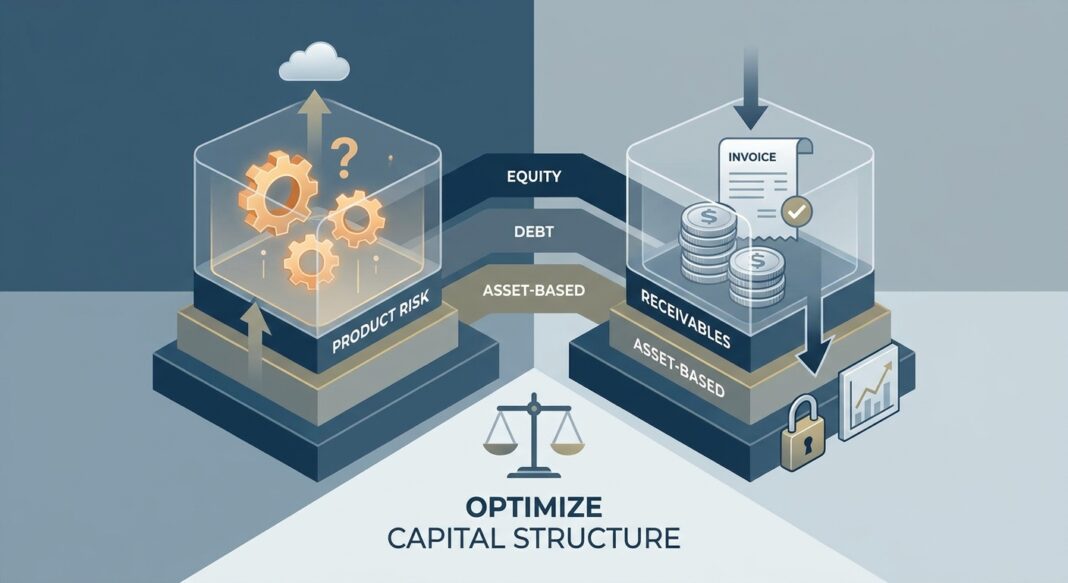
Commercialization Capital: Separate Product Risk from Receivables
1. The early-revenue financing problem
An early-revenue manufacturer can have a validated product, signed customer orders and a cash deficit at the same time. Cash leaves for tooling, certification, hiring and inventory before customer invoices are collected. Treating all of that as one financing need can lead to expensive debt funding uncertain product development, or equity funding receivables that could support a borrowing base.
The first structuring question is therefore not simply how much capital the company needs. It is which spending has a repayment source, when that source arrives, and what uncertainty remains before it does. Product development and market entry carry execution risk. Accepted invoices and eligible inventory may support asset-based credit. Recurring, proven cash flow can support amortizing debt. The capital stack should reflect those differences rather than forcing every use into one instrument.
This is also a stage question. Seed businesses generally fund research and runway with founder capital, grants where available, and equity. Early-revenue companies add customer deposits, equipment finance and selective venture debt when a credible repayment path exists. Growth companies can add bank revolvers, receivables or inventory-backed facilities, cash-flow loans, mezzanine and preferred equity. Mature companies may access broader bank and public-credit markets. Succession transactions can combine senior debt with seller financing, preferred capital and buyer equity. Each step depends on evidence of repayment, not just the company’s label.
2. Build the stack around the use
Start with separate funding buckets: product and regulatory work; equipment and tooling; inventory; payroll and operating runway; receivables; and any acquisition or ownership proceeds. For each bucket, identify timing, collateral, uncertainty and the expected repayment source. Keep long-lived assets on a tenor that matches their useful life. Do not assume a short revolver can safely fund a multi-year product build.
In an illustrative term-sheet design for a company moving from pilot orders to repeat shipments, a bank or nonbank lender could provide a revolving borrowing-base facility against eligible receivables and inventory. Availability would be determined by agreed collateral definitions, advance rates, reserves, reporting and concentration limits. Separate equipment financing could fund identified machinery. A term loan or venture-debt facility, if available, could fund a defined runway or milestone, with scheduled payments, security, covenants and any equity-linked feature stated explicitly. Equity would cover the residual risk that cannot prudently be repaid from contracted cash flows.
The documents should state permitted uses, draw conditions, maturity, amortization, interest and fees, collateral, guarantees, covenants, cure rights, prepayment terms and any warrants or conversion rights. For conditional tranches, specify objective milestones, evidence required, testing dates and whether the lender can refuse a draw for reasons beyond a missed milestone. This is a structural illustration, not a report of a specific transaction.
3. Compare access, cost and repayment
Bank debt is usually the lower-cost debt layer when a borrower meets underwriting standards and has dependable cash flow or collateral. It brings repayment obligations, lien priority and often financial covenants. An asset-based revolver can fit a seasonal or growing working-capital cycle, but availability moves with eligible collateral and lender reserves.
Private credit and venture debt can offer more tailored structures or access where a bank will not lend, but the borrower must test total cash cost, amortization, fees, security and refinancing risk. Venture debt is not a substitute for equity when the core use is uncertain research or a business has no credible repayment source. Mezzanine debt can fill a financing gap when senior debt capacity is insufficient, usually at a higher return requirement and with possible PIK interest or equity participation. Preferred equity avoids scheduled debt service but adds economic and governance rights. Common equity has no contractual repayment schedule, but dilutes ownership and allocates more upside to new investors.
Use customer deposits or milestone payments where commercial terms permit; they can reduce the funded gap without adding a new lender claim. At growth, acquisitions and expansion may justify a blended stack. At maturity or succession, prioritize durable cash generation and a repayment profile that can withstand weaker performance, rather than using a financing instrument simply because it is available.
4. Market evidence, not a universal price quote
Current data point to a selective market, not one standard term sheet. The Federal Reserve’s October 2026 Senior Loan Officer Opinion Survey found that, during Q3 2026, banks tightened premiums on riskier commercial and industrial loans across company sizes. It also reported tighter collateral requirements and more use of interest-rate floors for small firms. The same survey said C&I standards for large and middle-market firms were broadly unchanged. Those findings describe bank responses, not an approval promise for an individual borrower. Federal Reserve, October 2026 SLOOS.
Cooley’s Q3 2026 venture-financing report covered 162 reported financings and $10.7 billion of invested capital in its own deal sample; AI-related deals were 41% of financings and 62% of that capital, for the quarter ended September 30, 2026. The concentration is a reminder that aggregate venture dollars do not describe access for every sector or stage. Cooley GO, Q3 2026 Venture Financing Report.
Undiluted tracked 64 venture-debt and growth-credit deals announced or identified during October 2026, with $2.48 billion disclosed across 46 deals. Thirty-one of those 46 disclosed deals were below $50 million. The tracker notes that it is a record of identifiable deals, not an estimate of total market lending. These figures show transaction diversity, not market pricing. Undiluted, October 2026 Deal Tracker, published November 2, 2026.
5. The gap-capital playbook
Quantify. Build a monthly sources-and-uses schedule through the next operating milestone and show the cash low point. Separate committed spending from optional spending. Stress slower collections, delayed customer acceptance, lower gross margin and a longer ramp. Calculate the residual gap after deposits, internal cash and available collateral-based borrowing.
Prepare. Assemble a quality-of-earnings bridge where relevant, monthly cash forecast, accounts-receivable aging, inventory detail, customer concentration, backlog and cancellation terms, capex schedule, debt schedule and covenant forecast. Reconcile management reporting to bank statements and accounting records. Present a base case and downside case with explicit assumptions.
Run the process. Match lender type to each capital bucket. Give banks a borrowing-base case; give cash-flow lenders a repayment and leverage case; give equity investors a milestone and ownership case. Compare proposals on net cash delivered, total cash interest and fees, amortization, collateral scope, covenants, draw certainty, prepayment, dilution and time to close. A headline spread alone cannot compare a revolver, delayed-draw loan and equity round.
6. Negotiation points and takeaways
Operators can negotiate eligible collateral definitions, reserves, reporting frequency, covenant headroom, cure mechanics, milestone tests, permitted debt and liens, acquisition baskets, prepayment premiums and flexibility to move unused proceeds between approved uses. Ask lenders to distinguish objective draw conditions from broad discretion. For warrants or preferred securities, model ownership dilution and exit proceeds across several outcomes, not only the target case.
Investors should focus on repayment priority, collateral coverage, intercreditor arrangements, cash-versus-PIK burden, covenant triggers and the capital needed to reach the next financing or cash-flow milestone. Confirm that the plan does not depend on refinancing a bullet maturity under optimistic assumptions.
- Separate uncertain product investment from collateral-backed working capital.
- Match debt tenor and amortization to the asset or cash flow that repays it.
- Use equity for residual risk that cannot support contractual repayment.
- Compare total economics and control rights, not headline pricing alone.
- Size the gap to a measurable milestone, with a downside case and a defined draw plan.


