
Case basis: an anonymized company case disclosed by Bain Capital Credit in November 2026. Bain reports operating and capital-structure figures as of September 2025. The borrower is not named, and the reported pro forma outcomes are estimates, not verified realized results.
The Story
The company had already shown that it could grow. With an experienced private equity sponsor, it expanded through acquisitions and opened more than 60 new stores. EBITDA exceeded $50 million. The constraint was not demand or a stalled operating plan. It was the financing structure beneath the plan.
Growth had been funded mainly with senior debt. As base rates rose, cash interest consumed more of the company’s available cash. The business still had substantial enterprise value, but little free cash flow remained for another acquisition or another store-opening push. On the lender’s existing terms, borrowing more at the senior level risked increasing the cash burden that was already restricting expansion.
The owners faced a familiar middle-market choice. They could accept equity capital and share future value, or add debt and carry more repayment risk. But “debt” was not one uniform option. A further first-lien loan would have been senior and cash-pay. The eventual structure placed new capital at the holding-company level, behind operating-company senior debt, with interest paid in kind rather than in current cash.
That distinction shaped the decision. The objective was not to make leverage disappear. It was to move part of the capital burden away from near-term cash flow, lower the first-lien balance, and create room for investment. Bain Capital Credit’s November 2026 case study does not identify the company, so the analysis is limited to the figures it published.
The Decision
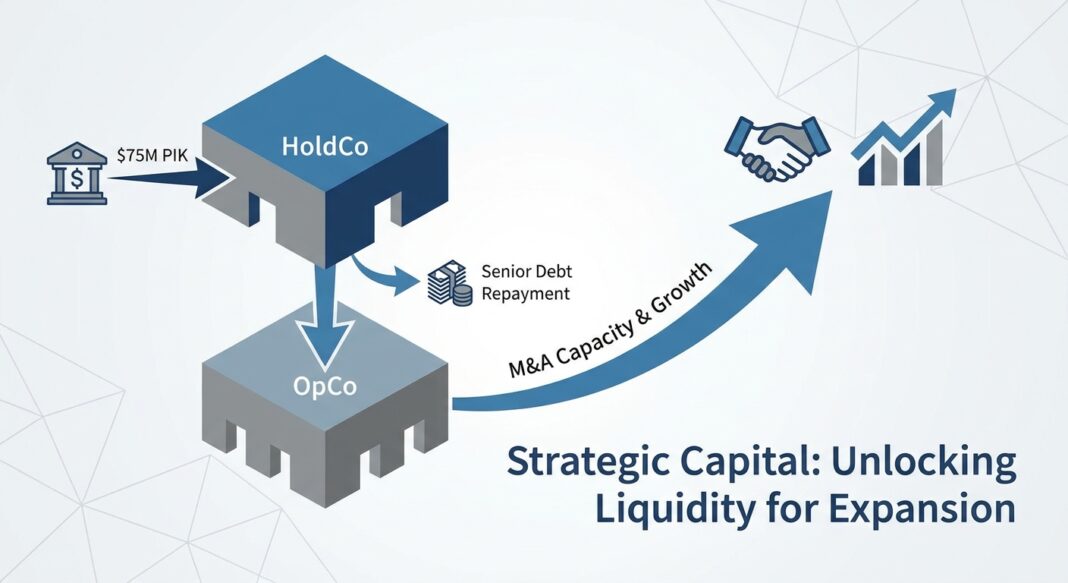
Bain’s disclosed transaction was a $75 million HoldCo PIK investment. Approximately $50 million went to repay senior debt. The remaining approximately $25 million funded continued greenfield expansion. Because the new notes were issued at the holding-company level and paid 14% interest in kind, they did not add an immediate cash-interest bill at the operating company.
The pro forma comparison shows a first-lien position moving from 6.0x EBITDA at SOFR plus 575 basis points to 5.0x at SOFR plus 525 basis points. The new HoldCo notes added 1.5x of leverage at 14% PIK. These figures are as of September 2025, per Bain’s case exhibit. The structure therefore reduced senior leverage and its associated cash cost, but it did not simply reduce total debt. It introduced a junior claim that would accrue over time.
The alternative described in the case was unattractive at either end of the conventional menu. More senior borrowing would have added cash interest, while equity would have diluted the sponsor’s stake. The chosen structure traded dilution and immediate cash-pay burden for a high-cost, subordinated obligation. That trade can preserve ownership percentage, but it cannot preserve the same equity value if the PIK balance compounds faster than enterprise value grows.
The deal’s logic depended on placement and use of proceeds: repay expensive or restrictive senior debt first, then fund growth with the remainder. The company was not using the entire facility to distribute cash to its owners. It was using most of it to relieve the bottleneck in its operating capital stack.
The Outcome
Bain’s pro forma case estimated cash rising from $4 million to $28 million and fixed-charge coverage rising from 1.0x to 1.4x. Estimated EBITDA growth increased from approximately 6% to 10%. The exhibit also moved the business from no free cash flow available for incremental debt and no M&A capacity to a position with a new acquisition facility and renewed capacity for expansion. These are projected transaction effects in Bain’s analysis, not reported subsequent results.
The counterfactual was a company with strong operations but a financing structure that left it short of cash and unable to pursue additional acquisitions. Equity could have supplied capital without another debt payment, but would have reduced the sponsor’s ownership share. The PIK solution preserved that percentage at closing, while adding a 14% claim that could materially reduce residual equity value if growth disappointed or the eventual exit took longer than expected.
The case does not provide an exit valuation, realized EBITDA growth, repayment schedule, or eventual proceeds to the sponsor. It therefore cannot establish that the recapitalization created value in the end. What it does show is a measurable change in the forecast: $24 million more cash, 0.4x higher fixed-charge coverage, and an estimated four-percentage-point increase in EBITDA growth, alongside a larger junior debt claim. That is a financing reset with a real operating thesis, not proof of a successful exit.
The Lessons
First, identify what is actually binding. If the business is performing but senior cash interest is absorbing its investment capacity, a financing structure with lower near-term cash service may be more useful than a larger first-lien loan. If the true problem is weak demand, low margins, or unreliable cash conversion, PIK interest only postpones the reckoning.
Second, model the whole stack, not just the first-lien leverage multiple. Here, first-lien debt fell from 6.0x to 5.0x, but the new 1.5x HoldCo layer put total debt claims higher. At 14% PIK, accrued interest compounds the amount due. The borrower should test that balance against conservative EBITDA, exit timing, refinancing availability, and recovery value.
Third, trace every dollar of proceeds. The disclosed $50 million senior repayment directly addressed the cash-interest constraint; the roughly $25 million growth allocation depended on store-level returns and execution. Those uses should have separate budgets, milestones, and downside tests.
A practical screen is to ask: Does the business have durable cash generation? Does the financing improve operating-company liquidity after fees and interest? Is the use of proceeds tied to measurable returns? Can the company still service senior debt under a downside case? And does the projected increase in enterprise value plausibly exceed the compounded PIK claim? If those answers are weak, equity or slower growth may carry less risk than expensive deferred-pay debt.
This case is a useful reminder that preserving ownership percentage and preserving owner value are different outcomes. The structure bought time and capacity on Bain’s pro forma assumptions. Its eventual value depended on whether the company converted that capacity into cash flow faster than the HoldCo obligation grew.
Key Insights
- HoldCo PIK can reduce immediate cash interest without eliminating debt or its compounding cost.
- The disclosed $75 million facility directed about $50 million to senior repayment and about $25 million to expansion.
- First-lien leverage declined from 6.0x to 5.0x, while the new notes added 1.5x of HoldCo debt.
- Bain’s cash, coverage, and EBITDA-growth figures were pro forma estimates, not confirmed realized outcomes.
- Ownership dilution avoided is not the same as equity value preserved; repayment capacity and PIK accrual determine the difference.


