
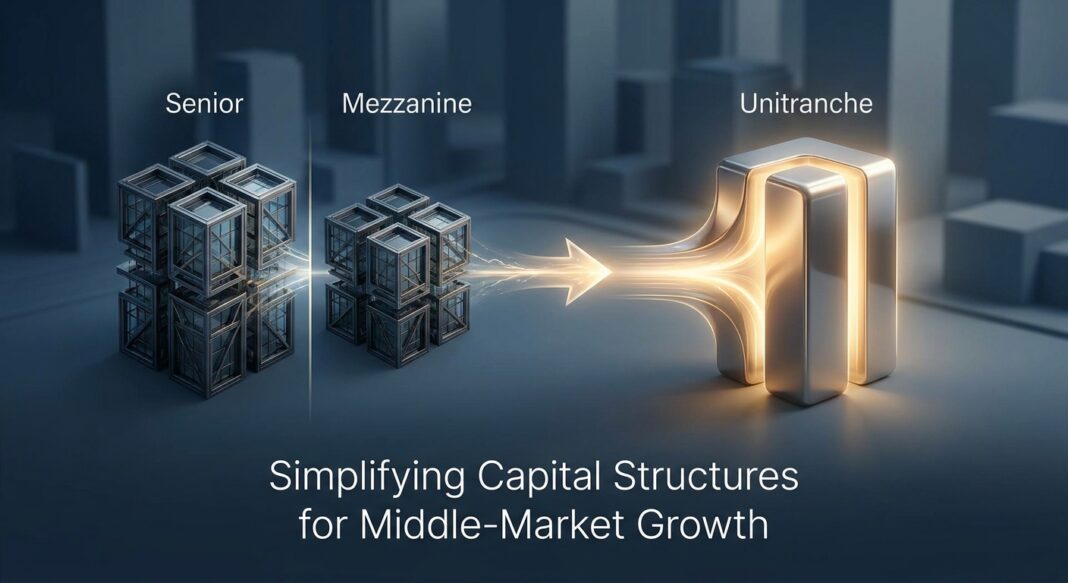
The Deal That Almost Didn’t Close
Picture a lower-middle-market business owner trying to finance a $50 million acquisition. In 2008, that meant assembling two separate credit agreements, two lender syndicates, an intercreditor agreement, and months of negotiation — only for the deal to collapse when the mezzanine tranche couldn’t agree on enforcement rights with the senior lender. Today, that same deal closes in 60 to 90 days with a single loan document, one lender relationship, and one phone call when something goes wrong.
That shift — from bifurcated capital structures to a single, streamlined instrument — is the story of the unitranche loan, arguably the most consequential structural innovation in private credit over the past decade. Understanding how unitranche works, what it costs, and when it makes sense is foundational knowledge for both investors evaluating private credit funds and business operators seeking growth capital.
What Is a Unitranche Loan?
A unitranche is a single debt instrument that combines what would otherwise be a senior secured loan and a subordinated or mezzanine loan into one facility with one blended interest rate. The borrower signs a single credit agreement, makes payments to a single agent, and negotiates covenants with a unified lender group.
Behind the scenes, the lending economics are more complex. When multiple direct lenders participate, they privately allocate risk and return through an Agreement Among Lenders (AAL) — a document the borrower never sees. The unitranche structure combines senior and subordinated debt into a single facility, with the economic allocation between tranches governed by an AAL that is not disclosed to the borrower. Within the AAL, the lender group is divided into a first-out tranche (lower risk, lower yield, senior in the payment waterfall) and a last-out tranche (higher risk, higher yield, absorbs first losses).
From the borrower’s perspective, this internal architecture is invisible. What they experience is structural simplicity: the lender, or a small club of lenders, provides the entire debt package and privately allocates first-out and last-out economic pieces. The borrower sees one loan, one covenant package, and one lender group.
How It Works: A Side-by-Side Example
To understand the real-world value proposition, compare how a $100 million acquisition might be financed under two different structures — traditional senior-plus-mezzanine vs. a unitranche.
Scenario: Company with $15 million EBITDA seeks $100 million in total financing. Equity sponsor contributes $50 million; the remaining $50 million comes from debt.
Traditional Senior + Mezzanine Structure:
- Senior secured loan: $35 million at SOFR + 375 bps (~7.1% all-in at current rates)
- Mezzanine tranche: $15 million at 13% cash + 1% PIK (14% all-in)
- Two credit agreements, two lender syndicates, one intercreditor agreement
- Estimated legal cost: $450,000–$650,000
- Time to close: 100–130 days
Unitranche Structure:
- Single term loan: $50 million at SOFR + 575 bps (~9.0–9.5% all-in at current rates)
- One credit agreement, one lender lead, single covenant package
- Estimated legal cost: $200,000–$300,000
- Time to close: 60–90 days
The blended pricing looks higher in isolation — but when operators account for reduced legal fees, faster execution, lower intercreditor friction, and the option value of a single lender relationship during stress, the total economic picture is often more competitive. A direct comparison shows unitranche deals typically close in 60 to 90 days versus 100 to 130 days for senior-plus-mezzanine structures, with legal costs roughly half those of bifurcated deals.
Current Market Reality: Unitranche Pricing and Positioning in 2026
Unitranche has moved from a niche middle-market innovation to the dominant financing structure for sponsor-backed acquisitions under $500 million in enterprise value. Unitranche has become the financing standard for acquisitions valued between $25 million and $200 million in enterprise value, with roughly 70 to 80 percent of deals in that range using at least partial unitranche funding.
On pricing, the market has stabilized after a volatile 2025-to-early-2026 period:
| Metric | Reading | Source |
|---|---|---|
| Traditional middle-market unitranche spread (Q3 2026) | SOFR + 500–575 bps | VRC Q3 2026 |
| Unitranche all-in yield range (spot, Q3 2026) | 9.33%–10.08% | VRC Q3 2026 |
| Upper middle market unitranche spread (July 2026) | S+522 bps (12-month high) | Houlihan Lokey Summer 2026 |
| Private credit premium over broadly syndicated loans | 178 bps (July 2026) | Houlihan Lokey Summer 2026 |
| Average new issuance total leverage (July 2026) | 4.5x EBITDA | Houlihan Lokey Summer 2026 |
| Global private credit AUM (2026) | ~$1.7 trillion | CTA / Preqin 2026 |
An important structural trend: unitranche spreads widened to S+522 in July 2026, the widest level in more than a year and approximately 30 basis points above the February trough, while total leverage on new issuance declined to 4.5x — the lowest reading in the trailing 12 months. Lenders, in other words, are simultaneously tightening leverage while widening spreads — a cautious posture that reflects macro uncertainty rather than credit distress.
Meanwhile, the July 2026 SLOOS found bank lending standards at the tighter end of the historical range for most loan categories, except C&I loans, for which standards are generally easier than their midpoints — a nuanced environment where the largest corporate borrowers find banks competitive, but lower-middle-market companies remain underserved and heavily reliant on private credit.
The Covenant Advantage: Why Unitranche Lenders Sleep Better
One of the most misunderstood features of unitranche lending is its covenant structure — and it matters enormously to both lenders and borrowers.
Unlike the broadly syndicated loan market, where covenant-lite (cov-lite) has become nearly universal, traditional unitranche deals retain financial maintenance covenants. Unitranche facilities typically include maintenance covenants — a meaningful advantage for lenders compared to the broadly syndicated loan market where covenant-lite has become standard. Common covenants include a maximum total leverage ratio and a minimum fixed charge coverage ratio, giving the lender an early seat at the table if the borrower’s financial performance deteriorates.
In practical terms, the financial covenant is typically a single net first-lien or total net leverage covenant with an initial cushion of 25 to 35 percent over the base case plan, stepping down as cash flow grows. This cushion means a borrower doesn’t immediately default if EBITDA dips — but the lender gets notified early and has leverage to renegotiate before a payment crisis develops.
However, competitive pressure is eroding this advantage at the top of the market. Larger unitranche deals above $200 million in enterprise value are increasingly closing covenant-lite, with cov-lite appearing in 30 to 40 percent of those larger transactions. This is a risk worth monitoring for investors in larger private credit funds.
Decision Framework
For Investors Evaluating Private Credit Funds
- Examine covenant density: Funds focused on the lower-middle-market (below $50M EBITDA) generally retain stronger maintenance covenants than large-cap direct lending strategies. Investors may consider this when assessing downside protection.
- Understand the AAL waterfall: In club deals, confirm whether your fund holds first-out or last-out positions — the economic difference in a stress scenario can be significant.
- Evaluate spread vs. leverage: Unitranche yields ranging between approximately 9.00% and 9.75% represent a decline of roughly 250 basis points from late 2023 peak levels — investors should assess whether current spreads adequately compensate for credit risk at prevailing leverage levels.
- Monitor the public-private premium: Broadly syndicated loan spreads tightened as sponsors increasingly tested the syndicated market to refinance existing private credit loans; the private vs. public premium currently sits at 178 basis points, above the 2025 average of 166 basis points. A shrinking premium is a signal worth tracking.
For Business Owners and Operators
- Right-size the structure to your deal: Unitranche is most efficient for deals between $25 million and $200 million in enterprise value. Below that range, community bank or SBA structures may be cheaper; above it, the syndicated market may offer tighter pricing.
- Model the full cost of capital: Add 50 to 100 basis points of original issue discount on first-lien unitranche and 25 to 50 basis points of annual undrawn revolver commitment fee to reach a true all-in cost. The headline spread understates the total economic cost.
- Leverage the single-lender relationship: Unitranche lenders often provide delayed-draw facilities, accordion features, and incremental debt capacity for bolt-on acquisitions within the same document — a flexibility that bifurcated structures rarely match.
- Understand your covenant headroom: Know your EBITDA-to-leverage covenant cushion from day one. Operators who run monthly compliance calculations are far better positioned to proactively renegotiate terms before a technical breach triggers lender remedies.
Key Takeaways
- One loan, layered economics: A unitranche presents as a single instrument to the borrower, but the AAL privately allocates first-out and last-out risk — investors and operators should understand the structure behind the simplicity.
- Pricing in 2026: Traditional middle-market unitranche spreads range from SOFR + 500 to 575 basis points, with all-in yields of approximately 9.33% to 10.08% as of Q3 2026, according to Valuation Research Corporation.
- Speed and certainty have real value: Unitranche deals close 40 to 70 days faster than bifurcated structures and cost roughly half as much in legal fees — a meaningful advantage in competitive auction processes.
- Maintenance covenants are a differentiator: Unlike cov-lite syndicated loans, middle-market unitranche deals typically retain a leverage covenant with a 25–35% cushion, giving lenders early warning and borrowers early dialogue.
- Market scale signals permanence: Preqin projects private credit reaching $4.5 trillion in AUM by 2030 — unitranche, as the dominant deal structure, is not a transitional product but a permanent feature of the middle-market financing landscape.


