
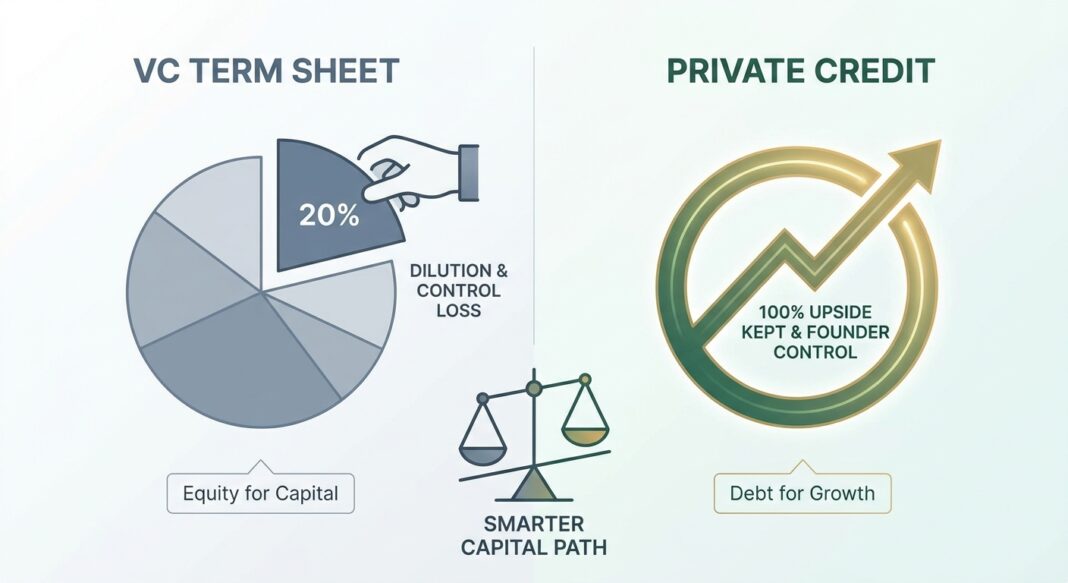
The Story: A Profitable Founder, a VC Term Sheet, and a Better Question
Note: The following is a hypothetical case study constructed to illustrate real capital structure principles. The company, founder, and deal terms are illustrative. All market data cited is sourced from real public sources and linked accordingly.
In the spring of 2023, imagine a founder — call her Sarah Kimani — sitting across from a partner at a well-regarded growth equity fund in San Francisco. Her company, OperaBase, a vertical SaaS platform serving mid-market logistics operators, had just crossed $8M in ARR with 82% gross margins and sub-10% annual churn. She was profitable. Not venture-profitable. Actually profitable.
The term sheet on the table: $20M for 20% of the company, implying a $100M pre-money valuation. The pitch was simple: take the capital, hire a sales team, accelerate growth, and aim for a Series C in 18 months.
Sarah had seen this movie before. A co-founder friend had taken a Series A in 2019, then a Series B, then a down round in 2022. By the time his company sold for $60M — a respectable outcome — he owned 9%. His check was smaller than his first year’s salary.
So Sarah asked a different question: “What if the $20M didn’t cost me any equity at all?”
Her CFO had been quietly watching the rise of non-dilutive private credit. The answer, it turned out, was more available than either of them had imagined.
The Decision: Two Paths, One Company, Very Different Futures
Sarah and her CFO mapped out two scenarios side by side.
Path A — The VC Route
- Raise: $20M Series B at $100M pre-money (20% dilution)
- Founder ownership post-round: ~52% (accounting for prior seed and Series A dilution)
- Board control: Ceded — new investor receives two board seats and protective provisions
- Exit timeline: Driven by fund cycle, likely forced to market within 4–5 years
- Cost of capital: 20% of every future dollar of value creation, in perpetuity
Path B — Private Credit
- Structure: $18M unitranche direct loan from a mid-market private credit lender, at SOFR + 575bps (approximately 10.75% all-in at the time), with a 5-year term and modest equity warrant coverage of 2%
- Founder ownership post-close: ~71% (warrant dilution only, no primary equity issuance)
- Board control: Retained — lender receives one observer seat, no voting rights
- Exit timeline: Sarah’s choice, not the fund’s
- Annual debt service: ~$1.94M in interest (manageable against $6.5M EBITDA)
The math was not subtle. On a $250M exit — a 2.5x outcome on current valuation — Path A delivered Sarah approximately $130M. Path B, with the same exit, delivered her approximately $177M. A $47M swing, for the cost of a few years of debt service totaling roughly $9.7M in interest.
She chose Path B.
This kind of structure is increasingly common. Platforms like Vista Credit Partners’ FounderDirect have been purpose-built for exactly this founder profile — later-stage, founder-driven businesses seeking what the firm describes as “less-dilutive strategic financing solutions.” George Alifragis of Metropolitan, a $1.8B private investment firm, explains that flexible non-controlling capital from $10M–$100M can be structured as debt but behave like growth equity — preserving founder ownership while fueling scale.
The Outcome: Growth Without Governance Conflict
Eighteen months after closing the private credit facility, OperaBase had deployed capital into a 14-person enterprise sales team and two bolt-on acquisitions of smaller logistics software vendors. ARR climbed from $8M to $19M. EBITDA expanded from $6.5M to $11.2M as the acquired revenue was integrated onto the existing infrastructure.
During that same period, three of Sarah’s founder peers who had taken VC rounds at similar points found themselves in difficult board conversations about burn rates, hiring freezes, and whether to pursue strategic options earlier than planned. Their investors — operating on fund timelines — needed liquidity. Sarah had no such pressure.
In Year 3, she initiated a dividend recapitalization: she refinanced the original $18M facility into a $32M term loan at improved terms, using $14M in incremental proceeds to pay herself a personal distribution while leaving the business fully capitalized. No dilution. No control transfer. No board approval required beyond what was written in her original loan covenants.
This is precisely what a dividend recapitalization is designed to do. As one advisory firm notes, “the owner receives cash without selling the business outright, while retaining operational control and a continuing equity stake.” For Sarah, the recap functioned as a mid-journey liquidity event — she took risk off the table personally, without changing anything about how OperaBase operated.
By October 2026, with ARR approaching $28M and EBITDA margins above 40%, OperaBase was running a formal process — on Sarah’s timeline, to buyers she selected, with 71% of the equity still hers.
The Lessons: When Private Credit Beats the VC Term Sheet
Sarah’s story is hypothetical, but the mechanics it illustrates are not. The private credit market that enabled her decision has grown from $970 billion in 2019 to approximately $1.7 trillion globally by 2026, according to Preqin’s 2026 Global Alternatives Report. In the U.S. alone, roughly 80% of lower-middle-market leveraged buyouts in 2025 used a private credit unitranche rather than a syndicated bank loan, per S&P Global Market Intelligence data. This is not a niche instrument. It is the market.
But the right instrument depends entirely on the right profile. Here is the framework for thinking about it:
Private Credit Works When:
- The business generates real cash flow. Debt requires servicing. A company with negative EBITDA cannot credibly borrow for growth — it needs equity risk capital. But a company with 35%+ EBITDA margins and predictable recurring revenue is a lender’s ideal borrower.
- The founder values control more than the option of high-velocity VC scaling. VC is not wrong — it is a tool calibrated for winner-take-all markets where speed and scale outweigh ownership math. Not every business is that business.
- The exit is founder-controlled, not fund-driven. One of the underappreciated risks of taking PE or VC capital is what a 2026 advisory guide calls “misaligned exit timing” — where “drag-along provisions force the founder’s rollover into the PE firm’s exit” and the founder’s liquidity is no longer self-controlled.
- There is a clear use of proceeds. Private credit lenders underwrite to specific deployment plans — acquisitions, salesforce expansion, geographic rollout. Vague growth capital stories don’t get funded; specific capital allocation plans do.
Where This Breaks Down:
- Pre-revenue or early-stage companies cannot service debt. Private credit is a growth tool, not a startup tool.
- Highly cyclical businesses face covenant risk during downturns. Lenders can accelerate or demand restructuring when revenue dips — a reality reflected in Proskauer’s Private Credit Default Index, which registered 2.73% in Q1 2026, up from 1.84% in Q3 2025.
- Businesses that need strategic partnership, not just capital. Sometimes a VC or PE partner brings distribution, talent networks, or market access that justifiably warrants the dilution. Not every equity check is purely financial.
Key Insights
- Ownership math is outcome math. On a $250M exit, the difference between 71% ownership and 52% ownership is $47M in founder proceeds — more than the total interest cost of the debt over its full term. Every point of equity is a real dollar at exit.
- Private credit has matured into a mainstream growth tool. The global market sits near $1.7 trillion in AUM and is projected to reach $3.48 trillion by 2031. Non-dilutive capital is no longer a workaround — it is a competitive financing market with liquidity, sophistication, and product breadth to match most founder needs.
- A dividend recap is a mid-journey liquidity event, not just an exit tool. Founders don’t have to wait for a sale to take risk off the table. A well-structured recap can return personal capital while leaving the business fully intact, governed, and scaling.
- Control is structural, not cultural. VC investors are often genuinely founder-friendly — until their fund cycle creates pressure to exit. The structural reality of fund timelines, drag-along rights, and board composition means that equity capital comes with governance strings that private debt does not. Founders who understand this negotiate differently from the start.
- The right capital question is not “how much?” but “at what cost, and to whom?” The VC term sheet implied a $100M valuation. The private credit facility implied a $0 ownership cost beyond interest. Understanding the true long-term cost of each option — in equity, governance, and timing autonomy — is the most important financial skill a founder can develop.


