
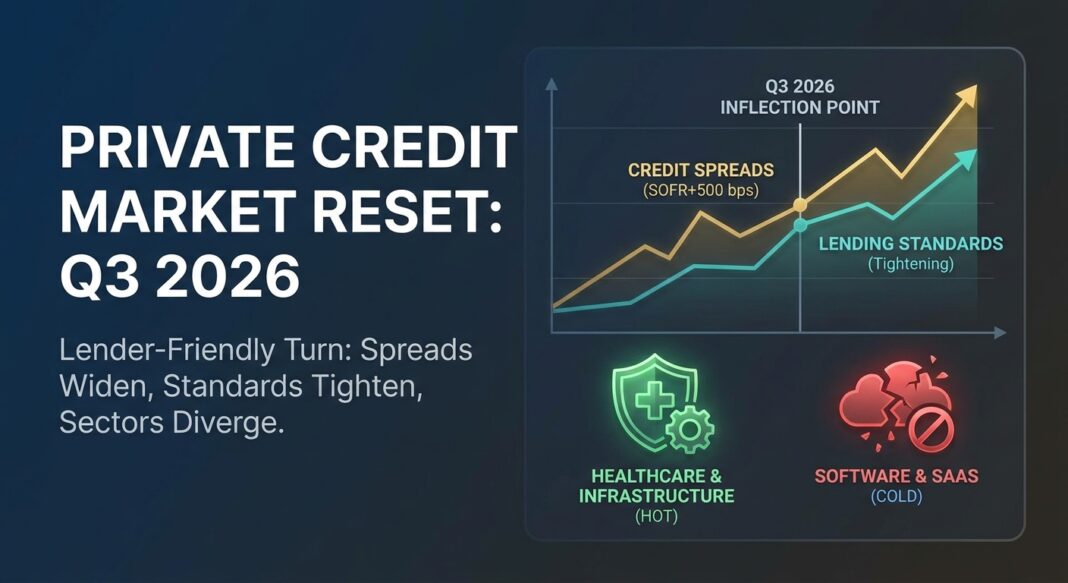
Macro Headline: A Decisive Credit Cycle Inflection Point
For institutional investors and operating executives who rely on credit markets to finance acquisitions, recapitalizations, and growth, Q3 2026 marks a decisive inflection point. The multi-year era of aggressive spread compression in private credit is reversing at a measured but unmistakable pace, driven by three converging forces: persistently elevated base rates, AI-driven disruption shock in the technology sector, and an accumulating maturity wall from 2021-vintage loans now coming due.
While U.S. base rates remained relatively flat in Q1 2026, the forward SOFR curve has shifted upward due to elevated inflationary pressures — and credit spreads, while still tight relative to long-term averages, are beginning to price in higher risk. The Federal Reserve’s policy stance reinforces this dynamic: the Federal Open Market Committee held the target range at 3.50%–3.75% on July 29, with three members preferring an increase — signaling that meaningful rate relief is not imminent.
Wider spreads, higher-for-longer rates, and bank retrenchment are improving pricing and terms for disciplined lenders, with private credit spreads returning to the SOFR+500 context — up from the mid-400 bps level prior to the geopolitical escalation involving Iran. Meanwhile, private debt issuance totaled approximately $87.2 billion through May 2026, representing a decline of approximately 24.6% compared to the same period in 2025, with May issuance of $6.88 billion reflecting a significant quarter-over-quarter contraction. Volume compression combined with wider spreads tells a market in the early stages of a lender-friendly reset — one where underwriting discipline, sector selection, and covenant quality separate winning platforms from those facing mark-to-market exposure.
Quantitative Market Snapshot
The table below consolidates the most current available market data as of Q2/Q3 2026 across key credit market metrics. All figures are sourced directly from institutional data providers and regulatory filings.
| Metric | Current Value (Q2/Q3 2026) | Prior Period | Source |
|---|---|---|---|
| MM Direct Lending Spread (avg., 1st lien) | SOFR + 502 bps (Q2 2026) | SOFR + ~450 bps (Q1 2026) | NEPC / PitchBook LCD, Q2 2026 |
| Unitranche All-In Yield (traditional MM) | 9.00%–9.75% spot; 9.47%–10.22% swap-adjusted | ~11.5%–12.5% peak (late 2023) | Valuation Research Corp (VRC), Q2 2026 |
| LMM Unitranche Spread (sub-$10M EBITDA) | SOFR + 550–750 bps | vs. SOFR + 425–575 bps (>$25M EBITDA) | SPP Capital Partners via Kaden Wood Group, July 2026 |
| DL Yield Premium vs. BSL Market | 259 bps (Q2 2026) | Narrower in prior quarters as BSL spreads compressed | NEPC / PitchBook LCD, Q2 2026 |
| HY Composite OAS (public markets) | ~324 bps (current) | 259 bps low (Jan. 2025); 461 bps high (Apr. 2025) | ICE / InvestmentGrade.com, Oct. 2026 |
| Private Credit Default Rate (narrow / broad) | 2.51% (Proskauer, Q2 2026) / 6.0% (Fitch, Q2 2026) | 2.73% Proskauer Q1 2026 / 5.7% Fitch Q1 2026 | Proskauer / Fitch via Kaden Wood Group, Aug. 2026 |
| Fund-Level Debt/Equity (BDC median) | 1.0x (current); flagged if trends to 1.2x | Stable; no material upward drift in borrower D/EBITDA | Heron Finance, Q2 2026 Private Credit Benchmark Report |
Key interpretive notes: Average middle market direct lending spreads moved from approximately 450 basis points in Q1 2026 to approximately 500 basis points in Q2 2026, though PitchBook LCD’s investor survey suggests that consensus expects spreads to stabilize or tighten modestly quarter-over-quarter. On leverage, borrower debt-to-EBITDA ratios have been broadly stable with no material upward drift, suggesting lenders have maintained underwriting discipline on borrower leverage over the last three years. However, fund-level debt-to-equity has increased to approximately 1.0x and warrants continued monitoring, particularly if leverage trends toward 1.2x, as higher levels can amplify losses during periods of market stress.
Sector Analysis: Where Capital Is Flowing — and Where It Is Retreating
🟢 Hot Sectors: Healthcare, Infrastructure, AI Hard Assets
Healthcare has definitively displaced technology as the top destination for direct lending deployment. Healthcare displaced Technology as the sector receiving the largest share of direct lending deployment in Q1 2026, according to PitchBook LCD data, with direct lending deal volume rising 26% year-over-year — propelled primarily by larger transactions even as deal count trailed 2025’s pace. Healthcare deals made up 22% of direct lending issuance year-to-date through March, up from 18% in 2025, while Tech’s share slipped to 14% from 18% in 2025. Importantly, healthcare led private credit last year, accounting for 19% of all 2025 direct lending deals — and was also the only industry to not see significant year-over-year price tightening, with spreads landing at an average of approximately SOFR+500 bps in Q4 2025, according to Octus data.
Infrastructure and AI-adjacent hard assets are also attracting institutional capital at scale. Morgan Stanley estimates private credit could supply more than half the $1.5 trillion needed for global data center buildouts through 2028, and UBS reports that AI-related private credit loans nearly doubled in the 12 months through early 2025. Priority sectors for 2026 include energy infrastructure, digital infrastructure, defense and national security, and next-generation manufacturing — all requiring patient institutional capital.
🔴 Cold Sectors: Software/SaaS, Office CRE
Software and SaaS credits face acute repricing risk. Heightened volatility in early 2026, driven by AI-related disruption concerns and geopolitical developments, pushed credit markets into price discovery mode — stalling primary market activity late in Q1 while secondary spreads widened, particularly for technology and software-exposed credits, even as lender demand remains strong for high-quality borrowers. Market participants broadly expect new software-related direct lending transactions to price at premiums of approximately 75–100 basis points above year-end levels, though many lenders remain risk-off, already overexposed to software and technology, and limiting incremental exposure amid ongoing uncertainty in borrower performance.
Within commercial real estate, the picture is divergent: banks eased CRE lending standards most since early 2022 in Q2 2026 — a sign that some appetite for risk is returning. However, a significant net share of banks reported that construction and land development (CLD) standards remain at the tighter end of the range they have used since 2005.
Structural Shift: The Lower Middle Market Premium
A persistent bifurcation has emerged between large-cap and lower-middle-market (LMM) credits. Over half of large-cap direct lending deals now price below 500 bps, but in the lower middle market, the spread premium has actually widened — reaching 232 basis points over large-cap in Q3 2025. This structural gap persists because the capital flooding the upper market simply cannot deploy at the lower end with the same efficiency.
Strategic & Operational Implications
For Borrowers & Operating Executives
The all-in cost of floating-rate debt has materially risen for leveraged borrowers. With lower-middle-market unitranche deals pricing at 500–700 basis points over SOFR and a further 25–50 basis points of widening expected over the coming two quarters, the all-in cost of floating-rate debt stays in the low-to-mid teens once spreads are layered on at current base rates. Fixed charge coverage ratios (FCCR) are under direct pressure as a result. Lenders are now underwriting to a forward-looking FCCR that incorporates expectations for interest rates — and a stress test adding 100 bps to floating-rate debt that yields a ratio below 1.1x is increasingly viewed as insufficient early-warning protection in the current environment.
Operators should also note that the July 2026 SLOOS special questions found that bank lending standards are currently at the tighter end of the historical range for all loan categories except C&I loans, for which standards are generally easier than their midpoints. This asymmetry means that high-quality, sponsor-backed C&I borrowers still have relative access to capital — while asset-heavy, real estate, and consumer-facing operators face structurally constrained bank channels.
For Institutional Investors & Lenders
The rising default environment demands sharper discrimination. Proskauer’s Private Credit Default Index printed 2.51% for Q2 2026 (covering 716 loans representing $195.6 billion in original principal), while Fitch’s U.S. private credit default rate printed 6.0% on a trailing-twelve-month basis — a record — with the difference largely attributable to whether maturity extensions count as defaults. For institutional allocators, the current environment favors active, experienced private credit managers where the most durable advantage may come from better documentation, more conservative leverage, and the time to conduct stress analysis before capital is deployed.
On the positive side of the ledger, combining current base rates and spreads, direct lending continues to generate high single-digit unlevered asset returns — an attractive premium relative to public credit markets — and the combination of elevated interest rates and potentially widening spreads presents an attractive gross yield outlook. Four in five portfolio managers expect allocations to private credit to increase over the next 12 months, with 44% expecting an increase of more than 20%.
Forward-Looking View: Liquidity & Lending Dynamics (Next 3–6 Months)
Three dynamics will shape credit market conditions into Q1 2027:
1. Maturity Wall Pressure: As 2021-vintage loans approach maturity, refinancing risk has increased, raising the likelihood of liability management exercises, restructurings, defaults, or forced asset sales — with exposure most acute in software and technology loans where AI-related disruption continues to pressure operating fundamentals.
2. Bank Re-Entry vs. Private Credit Incumbency: In December 2025, the OCC, Fed, and FDIC issued a joint statement rescinding the 2013 Leveraged Lending Guidance — potentially allowing banks greater flexibility to underwrite risk and compete more directly with private credit across leverage levels. However, the structural retreat of bank lending in middle-market loans and certain asset types shows no signs of fully reversing despite regulatory relief.
3. Selective Default Risk in Software: While broad-based defaults are not the base case, credits that do experience stress are more likely to do so because of structural issues such as leverage, heavy PIK usage, and AI disruption — with one bank recently forecasting that draconian-case defaults in software could reach as high as 14–15% in a disruption scenario. Managers with limited software exposure and strong covenant packages are best positioned.
For investors keen to navigate the divergence, niche areas of private credit such as core middle-market direct lending may sidestep concerns now percolating in broader markets. The structural opportunity in the lower middle market — wider spreads, real covenants, and deal flow from succession transactions — makes the $5M–$25M EBITDA segment a favorable setup for disciplined allocators heading deeper into the cycle.
Key Market Insights
- Spreads Have Repriced: Middle market direct lending spreads averaged SOFR+502 bps in Q2 2026, up ~50 bps from Q1, and lower-middle-market unitranche deals price at SOFR+550–750 bps — creating genuine yield opportunities for new deployers. (NEPC / PitchBook LCD)
- FCCR & Leverage Discipline Are Non-Negotiable: Lenders are stress-testing FCCR below 1.1x as a hard floor, and borrower debt/EBITDA has remained stable — meaning sponsors who over-levered in 2021–2022 face material headwinds at refinancing. (Heron Finance Q2 2026)
- Healthcare > Technology in Deal Flow: Healthcare now commands 22% of direct lending issuance (up from 18%), while Tech has declined to 14% — a structural rotation driven by AI disruption risk in SaaS and recurring-revenue models under pressure. (PitchBook LCD Q1 2026)
- Default Divergence Demands Methodology Scrutiny: The gap between Proskauer’s 2.51% narrow default rate and Fitch’s 6.0% record broad default rate is entirely explained by the treatment of maturity extensions — investors must understand which methodology their fund managers use. (Kaden Wood Group / Fitch / Proskauer, Aug. 2026)
- Bank SLOOS Signals Mixed Opportunity: The July 2026 SLOOS found C&I standards easier than historical midpoints and significant net shares of banks reporting narrower spreads on C&I loans — creating selective refinancing windows for quality borrowers, while CLD and consumer standards remain at the tighter end of the 20-year range. (Federal Reserve SLOOS, July 2026)


