
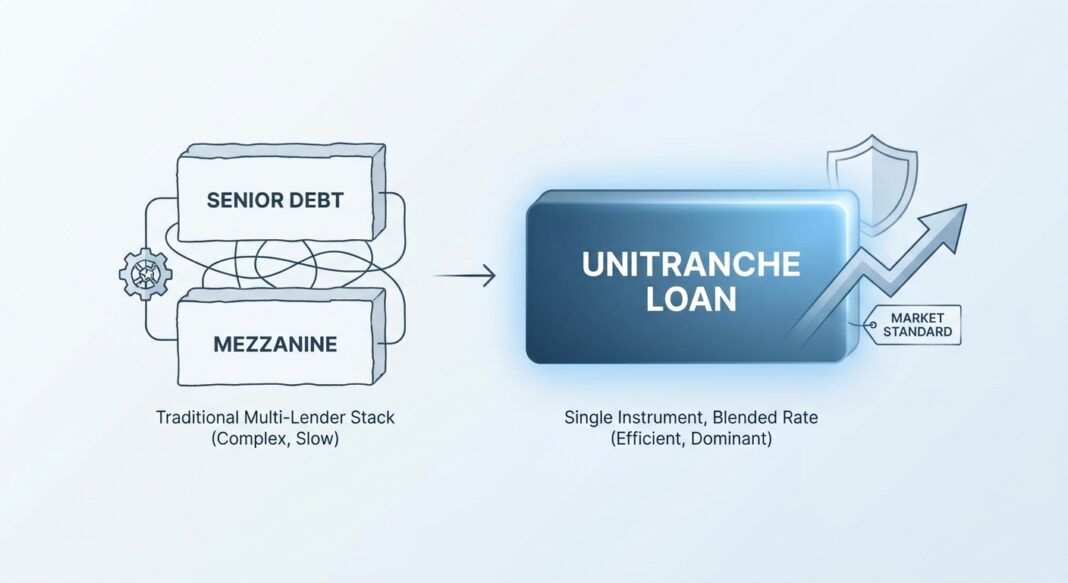
The Deal Structure That Changed Everything
Not long ago, financing a middle-market acquisition meant calling two different lenders, negotiating two separate credit agreements, and waiting for a senior bank and a mezzanine fund to agree on an intercreditor arrangement before your deal could close. That process took 90 to 120 days — and it could fall apart at any step. Today, a single instrument has rendered much of that complexity obsolete.
Unitranche debt is now the dominant financing structure for middle-market acquisitions. Understanding how it works — and why it has captured the market so decisively — is essential for both investors evaluating private credit funds and business owners or sponsors seeking acquisition capital. This article breaks down the mechanics, the economics, and the current market reality behind unitranche lending.
What Unitranche Debt Actually Is
Unitranche debt is a single-tranche term loan that combines what would otherwise be a senior secured loan and a subordinated or mezzanine loan into one instrument, governed by one credit agreement, with one direct lender — or one lead lender managing a small club. As Taft Law explains, the structure provides borrowers with one-stop financing for both senior and subordinate debt needs under a single agreement.
The interest rate on a unitranche loan is blended: it sits between what pure senior debt would cost and what pure mezzanine or subordinated debt would cost. The borrower pays more than bank senior rate, but meaningfully less than stacking a bank loan plus a mezzanine tranche would cost in aggregate. The direct lender captures the yield spread that previously flowed to two separate lender groups.
Behind the scenes, many unitranche facilities are internally bifurcated between a first-out tranche (lower-risk, lower-yield, often sold to a co-lender) and a last-out tranche (higher-risk, higher-yield, retained by the lead lender). The borrower sees only one loan. The Willow Wealth unitranche guide notes that this first-out / last-out bifurcation is one of two common unitranche types, with the other being a straight senior-stretch structure delivering five or six turns of leverage without a subordinated split.
Maturity terms typically run five to seven years with minimal mandatory amortization — a feature that preserves borrower cash flow during the hold period while delivering predictable, coupon-heavy returns to the lender.
How It Works: A Concrete Example
Consider a private equity sponsor acquiring a manufacturing business with $10 million in EBITDA at a 5.0x purchase multiple — a $50 million enterprise value. The sponsor contributes $14 million in equity (28% of EV) and needs to finance the remaining $36 million in debt.
Traditional Two-Tranche Structure:
- Senior bank term loan: $20 million at 2.0x EBITDA — pricing at SOFR + 300 bps (~6.7% all-in)
- Mezzanine loan: $16 million at 1.6x EBITDA — pricing at 13–15% (cash + PIK)
- Blended cost of debt: approximately 10.5–11%
- Two lenders. Two credit agreements. Two closing processes. 90–120 days. Intercreditor agreement required.
Unitranche Structure:
- Single unitranche facility: $36 million at 3.6x EBITDA — pricing at SOFR + 500–525 bps (~9.1–9.4% all-in, per current market)
- One lender. One credit agreement. One set of covenants. 45–60 days to close.
- No intercreditor negotiation. No syndication risk.
The borrower’s all-in cost is modestly lower, execution is dramatically faster, and ongoing administration is simpler. The lender captures the full yield spread rather than sharing economics with a bank. For sponsors running platform acquisition strategies, CT Acquisitions’ 2026 unitranche guide points out that this simplicity is especially valuable when completing add-on acquisitions under the same credit agreement — no need to re-open intercreditor arrangements each time.
Current Market Relevance: Where Unitranche Stands in 2026
Unitranche is no longer an emerging innovation — it is the established standard for private middle-market lending. The data from mid-2026 tells a clear story:
According to Valuation Research Corporation’s Q2 2026 Private Markets Update, unitranche structures continue to dominate new issuance, with coupon spreads generally ranging from 4.75% to 5.50% for standard middle-market transactions — approximately 25 basis points higher than year-end 2025 levels, reflecting modest spread widening driven by market volatility.
According to CRISIL Integral IQ’s May 2026 analysis, average first-lien middle-market direct-lending spreads were approximately 500 basis points in Q4 2025, with unitranche spreads at 508 bps and average first-lien all-in yields at 9.16%.
According to VRC’s Q2 2026 update, overall unitranche all-in yields range between approximately 9.00% and 9.75%, representing a decline of roughly 250 basis points from late 2023 peak levels — a meaningful normalization even as spreads have nudged wider in 2026.
According to Northleaf Capital’s Q2 2026 Private Credit Market Update, new issue pricing for U.S. sponsor-backed middle-market transactions widened by approximately 25 basis points through Q2 2026, as elevated market volatility and a pullback in supply gave well-capitalized lenders improved negotiating dynamics.
The broader private credit market context explains why unitranche has thrived: according to Angel Investors Network, citing Preqin’s 2026 Global Private Debt Report, global private credit AUM has reached approximately $1.7 trillion in 2026, up from $250 billion in 2012 — a 15%+ annualized growth rate sustained for over a decade. The BDC market alone has grown from $110 billion in 2019 to $475 billion in Q1 2026.
Meanwhile, the banking backdrop continues to support private credit’s market share. According to the Federal Reserve’s July 2026 SLOOS, bank lending standards for C&I loans remain broadly unchanged but are at the tighter end of their historical range for most non-C&I loan categories — a dynamic that leaves a structural gap private credit lenders are well-positioned to fill, particularly for smaller and sponsor-backed borrowers that banks view as less attractive credits.
| Metric | Data Point | Source |
|---|---|---|
| Unitranche coupon spread (mid-market, Q2 2026) | SOFR + 475–550 bps | Morgan Stanley Private Credit Monitor, Q2 2026 |
| Average first-lien all-in yield (Q4 2025) | ~9.16% | CRISIL Integral IQ, May 2026 |
| Unitranche all-in yield range (Q2 2026) | ~9.00%–9.75% | Valuation Research Corporation, Q2 2026 |
| Global private credit AUM (2026) | ~$1.7 trillion | Preqin, via Angel Investors Network 2026 |
| Bank C&I lending standards vs. historical range (Q2 2026) | Easier than historical midpoint for C&I; tighter end for most other categories | Federal Reserve SLOOS, July 2026 |
Decision Framework: Investors and Operators
For Investors Evaluating Private Credit Funds with Unitranche Exposure:
- Yield vs. risk positioning: Unitranche lenders occupy the full debt stack, meaning they absorb both senior and junior credit risk. Investors consider whether the blended spread — currently approximately SOFR + 475–550 bps — adequately compensates for that combined exposure, particularly in a higher-default-rate environment. According to CRISIL Integral IQ, Fitch reported a U.S. private credit default rate of 5.4% for the trailing 12 months ended February 2026 — a figure worth benchmarking against spread income.
- Covenant quality: Unitranche loans typically carry maintenance covenants (tested quarterly) as opposed to the incurrence-only covenants common in broadly syndicated loans. Tighter covenants give lenders earlier warning and more intervention rights, which matters at this stage of the credit cycle.
- Manager underwriting discipline: With spreads narrower than 2023 peaks, investors evaluate whether their manager is maintaining leverage discipline. Northleaf’s Q2 2026 update notes that well-capitalized lenders are seeing more favorable negotiating dynamics as retail-oriented capital retrenches — a signal that manager selectivity separates outcomes.
For Business Owners and Sponsors Evaluating Unitranche Financing:
- Speed and certainty of execution: When deal timing matters — competitive auction processes, seller deadlines, platform add-ons — unitranche’s single-lender structure can reduce close timelines from 90–120 days to 45–60 days. For many transactions, that speed premium justifies any rate differential over a bank senior-plus-mezzanine structure.
- Covenant flexibility: Direct lenders offer more customized covenant packages than bank credit facilities. Equity cure rights, EBITDA addback flexibility, and covenant-lite structures are negotiable features that bank lenders rarely extend to middle-market borrowers.
- Total cost of capital calculation: Operators consider unitranche pricing holistically — not just the coupon, but also OID, commitment fees, amendment fees, and prepayment premiums. A headline rate of SOFR + 500 bps may cost less in total friction than a senior + mezzanine stack once legal fees, two sets of due diligence, and intercreditor negotiation costs are included.
Key Takeaways
- Unitranche = one loan, one lender, blended rate. It combines senior and subordinated debt into a single instrument, eliminating intercreditor complexity and reducing closing timelines from 90+ days to 45–60 days.
- Current market pricing sits at SOFR + 475–550 bps. All-in yields range approximately 9.00%–9.75% as of mid-2026, down roughly 250 bps from 2023 peaks but nudging wider as market volatility increases.
- Unitranche dominates middle-market deal finance. With global private credit AUM at approximately $1.7 trillion and direct lending representing the majority of that base, unitranche is not a niche product — it is the default capital structure for sponsor-backed acquisitions in the $25M–$200M enterprise value range.
- Investors evaluate the full risk profile, not just the yield. Unitranche lenders hold both senior and junior risk exposure. In a rising-default environment, covenant quality, manager discipline, and portfolio concentration matter as much as the headline spread.
- Bank lending conditions create a durable structural opportunity. The Federal Reserve’s July 2026 SLOOS confirms that bank standards remain at the tighter end of historical ranges across most credit categories. The financing gap private credit filled over the past decade has not closed — and unitranche remains the primary instrument capturing it.


