
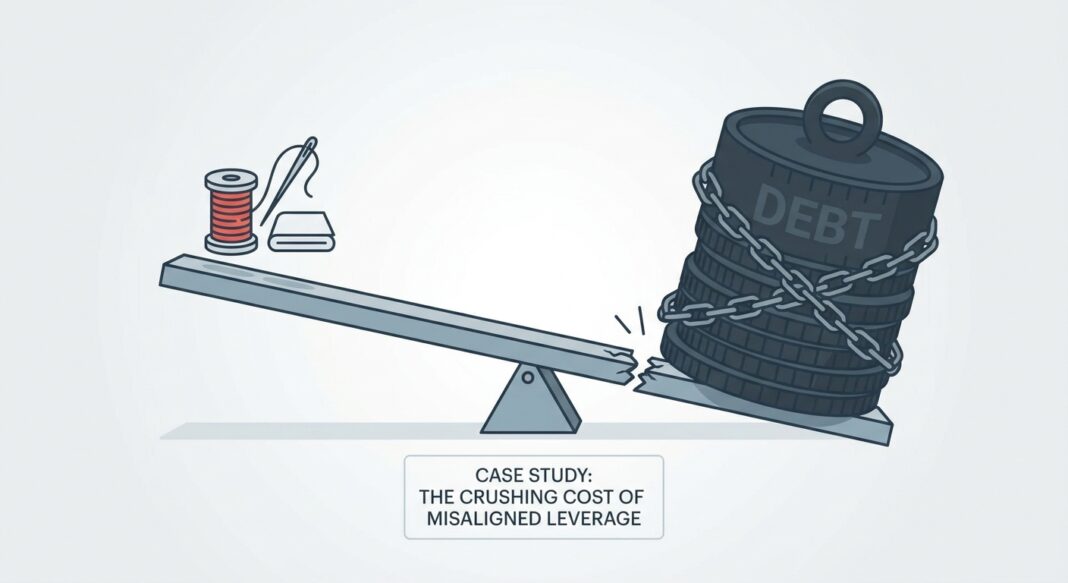
The Story: A Profitable Retailer, A Billion-Dollar Debt Sentence
In 2010, JOANN Fabrics was a quietly thriving American institution. Founded in 1943, the craft and fabric retailer had no debt, a loyal customer base of millions, and a record-high stock price. From the outside, it looked like a stable, cash-generating business with decades of runway ahead of it.
Then private equity arrived.
In 2011, Leonard Green & Partners took JOANN private in a leveraged buyout valued at approximately $1.6 billion. As is standard in such transactions, the deal was financed heavily with borrowed money — not Leonard Green’s own capital, but debt loaded directly onto JOANN’s balance sheet. Of that $1.6 billion acquisition price, roughly $1.15 billion was borrowed. Leonard Green contributed approximately $450 million of its own equity. Overnight, a company with no debt became responsible for servicing over a billion dollars in obligations, plus annual management fees owed to its new owners.
The store still had customers. The products still sold. The brand still had meaning. But from that moment forward, every dollar JOANN generated was spoken for before it could be reinvested in the business.
What followed over the next thirteen years was a slow, structural dismantling — not because the core business failed, but because the capital structure made sustained profitability nearly impossible. By March 2024, JOANN filed for Chapter 11 bankruptcy with over $1 billion in debt. It emerged briefly, then filed again. By early 2025, all stores had closed. Nineteen thousand employees lost their jobs.
The debt had outlasted the business.
The Decision: When the Capital Structure Is the Strategy
To understand how this happens, it helps to strip away the complexity. In a classic leveraged buyout, a private equity sponsor acquires a company using a blend of its own equity (typically a minority of the total purchase price) and third-party debt secured against the acquired company’s assets. The company — not the buyer — becomes responsible for repaying that debt from its own cash flows.
For JOANN, that meant the LBO mechanics imposed a crushing fixed-cost burden from day one. The interest expense alone, on over a billion dollars of debt, consumed cash that could otherwise have funded e-commerce investment, supply chain improvements, or competitive pricing strategies. Instead, those dollars flowed toward debt repayment. Cost-cutting became a survival imperative. Staffing was reduced. Stores became understaffed. The customer experience suffered.
The debt-based ownership structure didn’t just reshape the balance sheet — it reshaped every operating decision the company made, orienting leadership toward short-term financial performance rather than long-term competitive investment.
A profitable pandemic surge in 2020–2021 briefly looked like a lifeline. JOANN went public in 2021, but market concerns about its debt burden meant the IPO raised only $130 million — far too little to meaningfully reduce its obligations. By 2022 and 2023, rising interest rates turned a manageable debt service burden into an existential one. The company reported a $200.6 million net loss on $2.2 billion in sales in fiscal year 2023. By the time it filed for bankruptcy in March 2024, the balance sheet showed $2.44 billion in total debts against $2.26 billion in total assets.
Leonard Green, which had held the asset for thirteen years, forfeited its stake in the first restructuring and exited without being held responsible to creditors. The equity was wiped. The jobs were gone. The brand was liquidated.
The PE firm’s incentives and the company’s long-term health had never been aligned.
The Outcome: What a Different Capital Decision Looks Like
Now run the comparison. What would JOANN’s trajectory have looked like under a founder-controlled, debt-rational capital structure?
Consider the minority recapitalization model — a structure increasingly used by founder-operators who want partial liquidity without surrendering control of the enterprise they built. In a minority recap, an investor acquires a stake of typically 20–49% in a company, providing the selling shareholders with real, immediate liquidity while the founder retains majority ownership and operational authority. The company does not become responsible for acquisition debt. Its cash flows remain intact for reinvestment.
For a business like JOANN in 2010 — profitable, debt-free, with dependable cash flows — a minority recap with a growth-oriented partner would have achieved several things simultaneously: original shareholders could have realized meaningful liquidity, the business could have retained capital for long-overdue digital investment, and leadership would have remained incentivized to build rather than to service.
The contrast with the LBO outcome is stark. JOANN’s operating business generated real revenue through 2023 — over $2.2 billion in net sales that year alone. The stores had customers. The model was viable. What crushed the company wasn’t retail headwinds alone — it was the $100-million-plus annual interest burden that left no margin for error and no capital for adaptation.
PE-backed company bankruptcies in the U.S. reached a record high in 2024, with 110 such filings from private equity and venture capital-backed companies. More than half were concentrated in consumer discretionary and healthcare — the exact sectors where cash flow predictability is most sensitive to operating conditions and where excessive debt leaves the least room for cycle navigation.
The math of misaligned leverage is brutal: when a company’s interest expense exceeds its operating flexibility, the business no longer belongs to its customers or its employees. It belongs to its debt schedule.
The Lessons: A Framework for Founders Facing a Capital Decision
The JOANN story is not primarily a story about private equity. It is a story about what happens when the capital structure serving the investor’s return model diverges from the structure that serves the business’s long-term survival. That misalignment can happen in any form of capital — the vehicle matters less than the incentive design.
Here is the framework that the JOANN case illuminates:
1. Ask Who Bears the Debt
In a leveraged buyout, the company bears the debt used to purchase it. In a minority recapitalization, the company receives capital — or the seller receives liquidity — without the operating business being burdened by acquisition financing. Before any capital event, founders and operators should ask: if this deal closes, whose cash flows are pledged to service the resulting obligations?
2. Distinguish Liquidity from Business Health
PE sponsors in an LBO realize their return primarily through a future exit, not through operational improvement. Their interests are tied to transaction multiples and fund timing, not the company’s decade-long competitive position. A founder who instead structures a minority recap retains control, participates in future upside, and keeps the business’s capital allocation decisions anchored in operational reality rather than exit timeline pressure.
3. Stress-Test Fixed Costs Against Operating Cycles
JOANN’s structure left no buffer for a rising rate environment. The company that had no debt in 2010 was paying over $100 million annually in interest by its peak leverage years. Any business with cyclical revenue sensitivity — retail, healthcare, media — should model its debt service coverage across pessimistic operating scenarios before accepting financing structures that lock in fixed obligations against variable cash flows.
4. Preserved Equity Compounds; Surrendered Equity Does Not
The private credit market has grown to over $3.5 trillion in assets under management, offering founder-operators more tools than at any prior point in history to achieve liquidity, fund growth, or navigate succession without surrendering control of their businesses. The founder who structures a minority recap — retaining 60–70% of their company while taking chips off the table — continues to compound on the majority of the equity they built. The founder who accepts a full LBO receives a check today and a subordinated residual stake in a debt-laden vehicle.
5. The Alignment Test
Before accepting any capital partner, ask one question: Is this partner’s return dependent on the same outcomes I care about? When the answer is yes — when the investor profits from the business growing and generating more free cash flow — incentives align. When the answer is no — when the investor profits primarily from a leveraged entry price and a future multiple regardless of operating decisions made along the way — misalignment is structural, not interpersonal.
JOANN’s core business was not broken when Leonard Green arrived in 2011. The stores were profitable. The brand was loved. What broke the company was a capital structure designed for the investor’s exit, not the company’s endurance. That is the lesson every founder, family business owner, and operator should carry into the next capital conversation they have.
Key Insights
- Acquisition debt loaded onto the target company is the single most common structural cause of PE-backed bankruptcy. JOANN went from zero debt to over $1 billion in obligations overnight — not because the business deteriorated, but because the buyout mechanics required it.
- A minority recapitalization preserves operating flexibility. By selling 20–49% without burdening the company with acquisition financing, founders access liquidity while protecting the cash flows needed for competitive reinvestment and cycle resilience.
- PE-backed bankruptcies hit a record 110 filings in 2024, with more than half in consumer and healthcare — a signal that the LBO model’s debt tolerance assumptions have been systematically mis-calibrated against real-world operating conditions.
- Incentive alignment is the architecture of capital decisions. When an investor’s return is contingent on the same outcomes as the founder’s — sustained growth, cash generation, long-term enterprise value — the capital structure becomes a tool of alignment. When it isn’t, it becomes a tool of extraction.
- The private credit market now offers more founder-friendly structures than at any prior point in history. With the market exceeding $3.5 trillion in AUM and direct lenders competing actively for quality borrowers, founders and operators have genuine alternatives to the classic LBO model — including minority recaps, growth credit, and succession financing that preserves family or operator control.


