
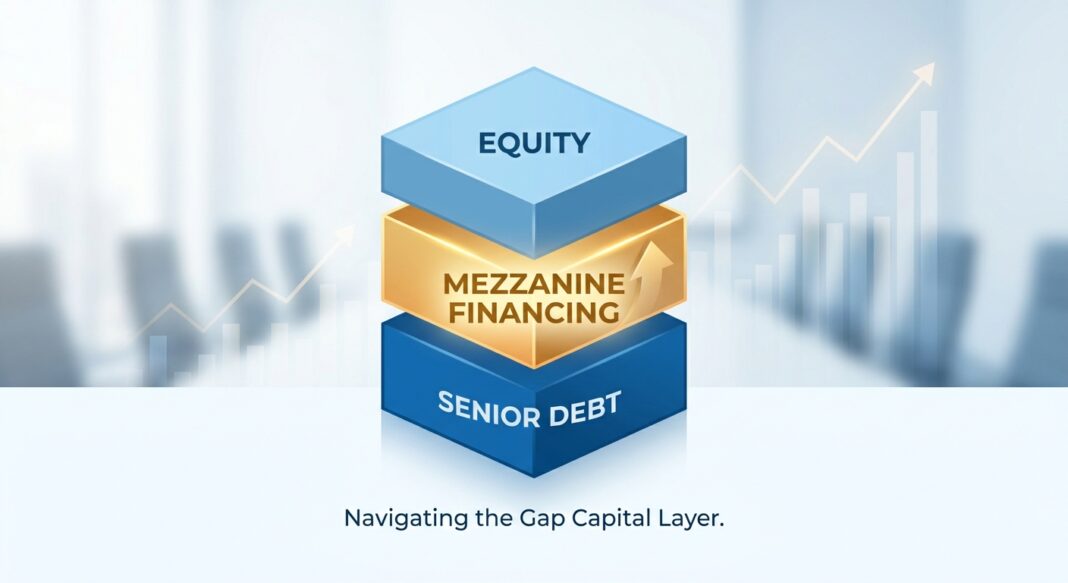
The Financing Challenge: When Senior Debt Runs Out and Equity Costs Too Much
Every growth-stage acquisition eventually confronts the same arithmetic problem. A founder-led business with $5M in EBITDA has identified a bolt-on acquisition at a $30M enterprise value. The senior lender — a regional bank or a direct lender — will stretch to 3.5x EBITDA, delivering roughly $17.5M. The buyer can bring $8M in equity. That leaves a $4.5M gap that senior debt won’t touch and that equity would cover only at a dilution cost the operator refuses to accept.
This is the structural moment where mezzanine financing earns its place in the capital stack. Mezzanine financing bridges the gap between what senior lenders provide and your total capital needs. It is not a last resort. Used with precision, it is a deliberate tool for completing transactions that would otherwise collapse — or close at the wrong price, the wrong dilution, and the wrong control terms.
The challenge is that understanding when to deploy mezzanine debt — and how to structure it correctly — is one of the most consequential decisions in acquisition finance. This playbook exists to make that decision systematic: from quantifying the gap, to structuring the tranche, to running the process, to closing the intercreditor agreement on commercially workable terms.
Structure Breakdown: Anatomy of the Gap Capital Layer
Where Mezzanine Sits
Mezzanine capital is a type of financing that sits between senior debt and equity in a company’s capital structure. In the waterfall, it is subordinated to the senior lender in both payment priority and collateral claims, but it ranks senior to all forms of equity. Mezzanine is usually unsecured, or secured by a third-lien interest behind the first lien and second lien, and it carries an intercreditor agreement that subordinates it to the senior debt, often with a payment block during senior defaults.
The Three Economic Pillars
Mezzanine financing is not a single-rate instrument. Its economics are built from three stacked components:
- Cash Interest Component: Regular interest payments, typically 8–12% per annum.
- Payment-in-Kind (PIK) Toggle: An optional interest accrual mechanism to preserve cash flow, where unpaid interest capitalizes into the outstanding principal balance rather than requiring current cash payment.
- Equity Kicker: Warrants or conversion rights providing equity upside, typically representing 3–8% of the loan amount. A warrant is a security that gives the holder the right to purchase a company’s stock at a set price in the future. In mezzanine financing, warrants act as an equity kicker, letting lenders share in the company’s upside value if it grows.
Worked Example: A $30M Acquisition of a $6M EBITDA Distribution Business
To make this concrete, consider the following illustrative capital stack for a growth-stage operator acquiring a distribution platform:
| Layer | Amount | % of EV | Pricing / Terms | Priority |
|---|---|---|---|---|
| Senior Secured Term Loan | $16M | 53% | SOFR + 400 bps (~9.3% all-in); 5-year amortizing | First lien |
| Mezzanine / Sub Debt | $6M | 20% | 12% cash pay + 3% PIK; 5.5% warrant coverage; 6-year bullet; PIK toggle years 1–2 | Subordinated (unsecured) |
| Buyer Equity | $8M | 27% | Common equity / rollover | Last-out |
In this structure, the mezzanine tranche carries a 15% blended current return (12% cash + 3% PIK accruing into principal) plus a warrant kicker that participates in upside at exit. A worked example for a comparable deal would price the mezzanine tranche at 12% cash pay plus 3% PIK, with 3% warrant coverage on fully diluted equity, a six-year term, interest-only for years one through three, and a PIK toggle right negotiated for years one and two to preserve integration-period cash flow — with incurrence-only covenants on leverage and restricted payments.
How the PIK Toggle Works in Practice
Most mezzanine in 2026 carries a cash coupon plus a PIK toggle — a typical structure is 10% cash plus 2% to 4% PIK, where the PIK can be deferred and capitalized into principal during the early years. The PIK feature is what makes mezzanine attractive to growth-stage borrowers whose free cash flow does not yet support the full coupon. In an integration year, the operator elects PIK on the 3% component; the balance compounds and repays at maturity or refinancing — preserving cash for operations while keeping the lender whole on its targeted IRR.
How It Compares: Mezzanine vs. the Alternatives
Selecting the right financing layer requires mapping the cost of capital spectrum honestly. The table below summarizes the key trade-offs for a growth-stage operator in 2026:
| Capital Source | All-In Cost (2026) | Dilution | Control Impact | Best Fit |
|---|---|---|---|---|
| Senior Bank Term Loan | SOFR + 300–450 bps (~8–10%) | None | Maintenance covenants; financial reporting | 3.0–3.5x EBITDA base leverage |
| Unitranche (Direct Lending) | SOFR + 500–700 bps (~10–12%) | None | Cov-loose; single net leverage test | Speed, single lender, 4–6x leverage |
| Mezzanine / Sub Debt | 12–15% (cash + PIK + warrants) | 1–5% via warrants | Board observer; negative covenants | Gap-filler when senior capacity exhausted |
| Preferred Equity | 10–14% coupon + conversion | 10–20% on conversion | Board seat; protective provisions | Non-cash-flowing or pre-revenue businesses |
| Growth / Minority Equity | 25–40%+ target IRR | 20–40% | Board seat; veto rights; information rights | High-growth; pre-profitability |
The Unitranche Alternative
For many lower-middle-market deals, the natural question is whether a unitranche eliminates the need for a mezzanine tranche entirely. The sweet spot for unitranche is $25M–$200M enterprise value; below that range, SBA plus senior bank wins on cost, and above $300M the broadly syndicated loan market wins on cost. Unitranche compresses the capital structure into one instrument — eliminating intercreditor complexity — but at a blended rate that can exceed the senior-plus-mezz stack on larger deals. When the borrower’s EBITDA is too thin to support 5–6x unitranche leverage at SOFR + 550–700 bps, the two-tranche senior-plus-mezz structure remains the more cost-efficient architecture.
When Mezzanine Is the Right Answer
Companies use mezzanine debt to finance growth, acquisitions, or ownership transitions without diluting existing equity holders excessively. The structural calculus favors mezzanine when: (1) senior debt capacity is exhausted and the acquisition requires 4.5–6x total leverage; (2) the operator wants to preserve majority ownership and reject a growth equity minority stake; and (3) the business generates sufficient free cash flow to service a 10–12% cash coupon while PIK-ing the remainder.
Current Market Terms: What the 2026 Mezzanine Market Looks Like
The following data points reflect current pricing and structural standards as reported by market participants and deal data sources:
- All-In Cost: Mezzanine debt financing sits between senior credit and equity, priced today at roughly 11% to 14% cash coupon plus 1% to 4% PIK plus warrants of 1% to 5% of the fully diluted cap table.
- GF Data Benchmark: All-in cost in 2026 runs 12% to 15%, split among 10% to 12% cash coupon, 1% to 3% PIK, and 1% to 2% warrant coverage per GF Data’s 1H 2026 report.
- Warrant Coverage: Nearly every mezzanine deal includes equity warrants — options to purchase common stock at a nominal strike price, often as low as $0.01 per share. If the company exits at a high multiple, the warrants convert into meaningful equity proceeds, lifting the lender’s blended IRR from the coupon range (10%–16%) into the target range (15%–20%).
- Term and Amortization: The note usually has a five-to-seven-year bullet maturity, a non-call period of one to two years, and step-down call premiums after that. Payment terms typically require quarterly cash interest, with the PIK interest capitalizing into the outstanding balance and paid at maturity or refinance.
- Tranche Size: Typical LMM tranche size runs $5M to $75M, with SBIC-licensed funds like Plexus Capital and Falcon Investment Advisors handling smaller checks down to $2M.
- Target IRR: A blended cost of capital of 15% to 18% is normal for mezz plus warrants; the equity kicker is the reason funds accept a subordinated position without a board vote.
- Covenant Design — The Maintenance vs. Incurrence Divide: Maintenance covenants require the borrower to satisfy defined financial tests on an ongoing basis, typically measured quarterly. Common maintenance covenants include a maximum total leverage ratio, a maximum senior leverage ratio, a minimum interest coverage ratio, and a minimum fixed-charge coverage ratio. By contrast, incurrence tests operate differently — they are tested only when a borrower seeks to undertake a specified action, such as incurring additional indebtedness, making an acquisition, or paying a dividend. In the mezzanine market, covenant design is negotiated: some mezzanine providers accept incurrence-only covenants; others require maintenance tests on leverage and interest coverage. As a benchmark, borrowers with EBITDA of less than $50 million are typically subject to a maintenance covenant requirement.
The Gap Capital Playbook: Four Steps from Identification to Close
Step 1 — Quantify the Gap Precisely
Before approaching any mezzanine fund, the operator must produce a single-page capital sources-and-uses table that defines the gap with precision. Inputs: acquisition price, senior debt capacity (typically 3.0–4.0x EBITDA from a named lender at term sheet stage), available equity, and any seller note component. The residual is the mezzanine quantum. Avoid rounding up — lenders underwrite to the dollar, and oversizing the mezz tranche increases warrant dilution and coupon burden unnecessarily.
Step 2 — Build the Three-Year Integrated Model
Mezzanine providers hold for five to seven years and underwrite the eventual refinancing or sale. They require a three-year integrated model — revenue, EBITDA, debt service, and free cash flow — with sensitivity tables on at least two variables: revenue growth rate and EBITDA margin. The model must demonstrate that the business can service the cash component of the coupon even in the downside case, and that total leverage reaches a refinanceable level (sub-4.0x) within the hold period. If it cannot, the PIK toggle must be sized large enough to cover the shortfall.
Step 3 — Run a Competitive Process Across 8–12 Funds
The right advisor runs a competitive process across 8 to 12 mezz funds, models the debt against a minority equity alternative, and negotiates intercreditor terms in parallel with senior. Active institutional players in the lower-middle market include NewSpring Mezzanine ($5M–$25M, growth-stage LMM), Peninsula Capital Partners ($5M–$50M, industrials and distribution), Northstar Mezzanine ($5M–$35M, family-owned and founder-led), Star Mountain Capital ($5M–$50M, non-sponsored LMM and founder recaps), and Plexus Capital ($2M–$15M SBIC, Southeast US LMM). Process tip: submit simultaneously and set a hard term sheet deadline. Competition compresses pricing by 50–100 bps and reduces warrant coverage by 1–2 percentage points.
Step 4 — Negotiate the Intercreditor Agreement
The intercreditor agreement governs the relationship between the senior lender and the mezzanine fund — defining payment blocks, standstill periods, and enforcement rights. The intercreditor negotiation is often the longest single item in the financing process and where deals stall. Key operator objectives: (a) minimize the payment block period (target 90 days vs. the lender’s ask of 180 days); (b) secure a purchase option allowing the mezzanine fund to buy out the senior at par in a senior default scenario; and (c) ensure the mezz fund’s board observer rights do not create fiduciary complications.
Negotiation Guidance: What to Push On, What to Concede
For Operators and Borrowers
The mezzanine term sheet has four economic variables that move together: cash coupon, PIK rate, warrant coverage, and call protection. Operators should prioritize negotiating in this sequence:
- Warrant Coverage First: Warrants are permanent dilution. A 1% reduction in warrant coverage at a 5x exit multiple is worth more than a 50 bps reduction in coupon. Push hard here — especially if the business is growing EBITDA faster than 15% per annum.
- PIK Toggle Scope: Negotiate the toggle as a right, not a borrower-elected feature subject to lender consent. Lender-consent PIK introduces renegotiation risk at the worst moment in the business cycle.
- Call Protection Window: Mezzanine funds typically require a 1–2 year non-call period followed by step-down prepayment premiums. If the business is on a 3-year path to refinancing, negotiate the step-down schedule aggressively — a 103/102/101/par structure is achievable in competitive processes.
- Covenant Package: Target incurrence-only covenants with generous baskets. Incurrence tests are triggered only when a borrower seeks to undertake a specified action, such as incurring additional indebtedness, making an acquisition, or paying a dividend — not by passive performance deterioration. This preserves operational flexibility during integration.
For Investors and Capital Allocators
When evaluating a mezzanine tranche from the lender side, the critical underwriting question is not the coupon but the coverage ratio at the downside case. Mezzanine debt is typically structured with a five-to-seven-year term, with interest-only periods at the front and a balloon at maturity — meaning the borrower needs a credible plan for either refinancing the mezzanine at maturity or selling the company before the balloon comes due. Lenders should stress the model to a 20% revenue decline and verify that EBITDA still covers the cash coupon at 1.1x before approving a PIK structure with limited lender remedies.
Key Takeaways
- Mezzanine fills a precise gap. It is the capital layer between senior debt capacity (typically 3.0–4.0x EBITDA) and the equity quantum the operator is willing to contribute — used when dilution from growth equity is unacceptable and senior leverage is exhausted.
- The three-pillar return structure defines the economics. Cash coupon (10–12%), PIK toggle (1–3%), and warrant coverage (1–5% of fully diluted equity) combine to target a 15–18% blended IRR for the mezzanine fund — a cost the borrower must underwrite against the acquisition’s projected returns.
- PIK toggles are a cash flow management tool, not a distress feature. Negotiating a right (not a consent-based permission) to PIK the interest component during integration-period years is a legitimate structural ask that protects free cash flow without triggering a technical default.
- Covenant design is negotiable — and consequential. Incurrence-only covenants provide maximum operational flexibility but give lenders limited early-warning protection; maintenance covenants trigger quarterly engagement but constrain management actions. The negotiation outcome depends on deal size, EBITDA track record, and competitive process dynamics.
- The intercreditor agreement is where deals die. Running the senior and mezzanine processes in parallel — and pre-aligning on intercreditor terms before exclusivity — is the single most reliable way to compress the timeline and avoid a late-stage deal collapse.


