
The Underwriting Challenge: What Is the Business Actually Earning?
Every private credit underwriting starts with the same adversarial question: Is the EBITDA presented in this CIM the real EBITDA? The answer, almost universally, is no — or at least, not yet. A borrower or sponsor will present an “Adjusted EBITDA” figure that reflects the earnings potential of the business under idealized, post-transaction conditions. The lender’s job is to independently reconstruct the earnings base from the ground up.
This tension sits at the heart of modern private credit underwriting. Adjusted EBITDA is where deal economics are set, covenants are calibrated, and leverage multiples are calculated. If the EBITDA base is overstated — even by 10% to 15% — every downstream metric becomes unreliable: debt-to-EBITDA ratios are understated, debt service coverage ratios are inflated, and the lender is effectively underwriting a phantom business.
In a market where Moody’s estimates the private credit default rate in 2025 ranged between 1.6% and 4.7% depending on the inclusion of distressed exchanges, and where Fitch reported the U.S. private credit default rate hit a record 6.0% in April 2026, the stakes of flawed EBITDA underwriting have never been higher. Getting the earnings base right is not a procedural step — it is the entire game.
The Analytical Framework: Borrower EBITDA vs. Lender EBITDA
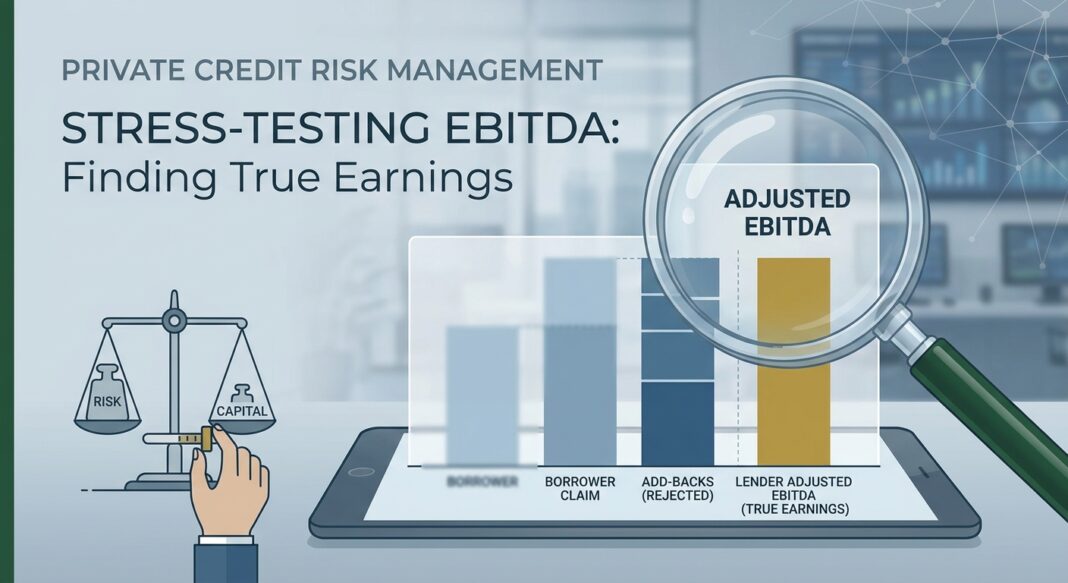
The practitioner’s starting point is a structural distinction that surprisingly few credit memos formalize: the difference between what the borrower claims and what the lender independently derives. The cleanest credit memo shows both borrower-adjusted EBITDA and lender-adjusted EBITDA, with a clear, documented bridge between them. Each line item in that bridge either survives lender scrutiny or it does not. There is no middle ground.
The Four Acceptable Add-Back Categories
Experienced underwriters limit acceptable add-backs to a narrow set of defensible categories:
- Excess Owner Compensation: The delta between actual owner W-2 compensation and a documented market-rate replacement salary for the same role. A working owner earning $625,000 as CEO where a market-rate replacement costs $240,000 generates a legitimate $385,000 add-back — but only with a third-party compensation benchmark such as the Robert Half or Korn Ferry industry guides.
- Related-Party Rent Normalization: When a borrower leases its facility from an owner-controlled LLC, the rent may be above or below market. The adjustment normalizes to a documented third-party comparable using CoStar, LoopNet, or a local broker opinion. Lender pushback is minimal when the comparable is documented and the adjustment flows through to the capitalized lease liability.
- Documented One-Time, Non-Recurring Expenses: Litigation settlements, one-time restructuring severance, or sale-process advisory fees can be added back — but only when supported by invoices, court orders, or board resolutions confirming non-recurrence. If the category has appeared in two of the last three years, it is not non-recurring.
- Non-Cash Charges: Stock-based compensation, goodwill impairment, and write-downs of non-operating assets. Even here, lenders should confirm whether equity grants recur annually, which makes them an ongoing compensation cost rather than a one-time charge.
The CARVE Test: A Decision Framework for Every Line Item
A practical framework for evaluating any proposed add-back is the CARVE test. If the cost is needed to Continue generating revenue, serve Accounts, meet Regulatory requirements, or maintain the Value of the asset Estate, it belongs in EBITDA. A proposed adjustment that fails more than two of those five checks should be haircut or excluded entirely, regardless of how the borrower characterizes it. As one practitioner framework notes, “a $200,000 add-back that passes only 2 of 5 CARVE checks should be haircut or excluded.”
The Normalization ≠ Pro Forma Distinction
A critical discipline: normalized EBITDA reflects what the business did earn on a representative historical basis. Pro forma EBITDA incorporates forward-looking assumptions about what the business could earn post-transaction. These must be evaluated separately. When a sponsor’s schedule blends historical normalization with forward-looking pro forma items — cost synergies not yet realized, new customer contracts not yet signed, headcount reductions not yet executed — the lender must separate and independently stress-test each layer. The price is set on history. The loan must be serviceable on history.
The Analysis: Walking Through a $10M EBITDA Manufacturing Company
Consider a hypothetical middle-market manufacturing borrower presenting the following CIM summary:
| Line Item | Borrower Claim | Lender Treatment | Lender Adjustment |
|---|---|---|---|
| Reported EBITDA (TTM) | $8,200,000 | Accepted | $0 |
| Owner Compensation Excess | +$500,000 | Haircut to +$350,000 | -$150,000 |
| Related-Party Rent Normalization | +$200,000 | Accepted with CoStar support | $0 |
| One-Time Legal Settlement | +$300,000 | Accepted with court order | $0 |
| Strategic Marketing (“Growth Spend”) | +$400,000 | Rejected — needed to sustain revenue | -$400,000 |
| Non-Recurring Revenue (One Customer Windfall) | $0 adjustment | Lender deduction | -$250,000 |
| Lender-Adjusted EBITDA | $9,600,000 | $7,700,000 |
The variance is significant: the borrower presents $9.6M; the lender derives $7.7M — a 20% gap. On a 4.5x leverage deal, that difference translates to a $8.5M reduction in supportable debt, from $43.2M to $34.7M. This is the EBITDA credibility gap in practice.
Downstream Ratio Impact
With a $35M term loan at a blended rate of SOFR + 550bps (approximately 9.8% all-in), annual interest expense is approximately $3.4M. Using borrower EBITDA, the interest coverage ratio (ICR) is a comfortable 2.82x. Using lender-adjusted EBITDA, it compresses to 2.26x — dangerously close to a typical 2.0x covenant floor. The underwriting must always be built on the lender’s number, not the borrower’s.
Industry Standards: What Institutional Lenders Require
Covenant Architecture
Standard private credit covenant packages for sponsor-backed middle-market loans are built around two primary financial maintenance tests, both tied directly to lender-adjusted EBITDA. A maximum total net leverage ratio (typically 4.0x–5.0x at close, with step-downs) and a minimum fixed charge coverage ratio (FCCR) of 1.15x–1.25x are the market standard. Lenders writing deals above 4.5x leverage must underwrite a credible deleveraging path — typically driven by EBITDA growth, mandatory amortization, or both.
The leverage ratio is not purely a credit metric; it is also a market comparability tool. Because sponsors use EBITDA multiples to value and exit companies, the leverage ratio allows lenders to compare risk profiles across the portfolio with precision. Covenant definitions may permit adjustments that a credit officer still haircuts for underwriting conservatism — the covenant definition and the underwriting definition of EBITDA need not be the same number, and experienced lenders keep a margin of safety between the two.
Red Flags That Should Stop or Re-Price a Deal
- Add-back stack exceeding 25%–30% of reported EBITDA: When the bridge from reported to adjusted EBITDA requires a long list of adjustments, each individually arguable, the cumulative effect masks real earnings volatility.
- Growth-spend add-backs: Borrowers who propose adding back marketing, R&D, or sales headcount expenses as “strategic” or “non-recurring” are asking the lender to fund the business’s customer acquisition engine. Reject unless the revenue generated is independently contractually secured.
- Deferred maintenance: A business that has suppressed capital expenditures to inflate near-term EBITDA will require catch-up spend post-close. Lenders should normalize maintenance capex to a percentage of revenue benchmarked against industry peers and deduct it from free cash flow before sizing the loan.
- Customer concentration without contractual protection: If a single customer represents more than 20%–25% of revenue and that revenue is not under a long-term take-or-pay contract, the lender faces binary risk that no EBITDA adjustment can solve.
- Pro forma synergies without implementation evidence: Cost savings from planned headcount reductions, facility consolidations, or vendor renegotiations that have not yet occurred should be excluded from the EBITDA base used to size the loan.
📊 Credit Performance Data Box
- Private Credit Default Rate (2025, incl. distressed exchanges): 1.6%–4.7% — Moody’s estimate via Moody’s, April 2026
- U.S. Private Credit Default Rate Record High (April 2026): 6.0% — Fitch Ratings, reported via Forbes, May 2026
- Distressed Restructurings as % of All Private Credit Defaults (2025): ~65% — Moody’s Ratings
- Senior Direct Lending Annualized Loss Rate (2017–2024): 0.4% vs. 1.1% for leveraged loans and 2.4% for high-yield bonds — Morgan Stanley / Cliffwater Direct Lending Index
- First-Lien Senior Secured Loan Recovery Rate (historical): 60%–80% in default scenarios — Moody’s long-term data; bank loans average 82% on a discounted basis — Moody’s Ultimate Recovery Database
- S&P U.S. Spec-Grade Default Rate Forecast: Falling to ~4.0% by September 2026 from 4.6% — S&P Global / Investing.com
- KBRA DLD Direct Lending Index Default Rate (TTM, Sept. 2025): 1.8% — Valuation Research Corporation citing KBRA DLD
The data tells an important structural story: senior direct lending with strong covenants and senior secured positioning has historically delivered far lower loss rates than the broader leveraged finance market. But that advantage is not unconditional. It depends entirely on the quality of the underlying EBITDA underwriting that sized the loan in the first place. Aggressive add-backs, covenant-lite structures, and pro forma EBITDA inflation are precisely the practices that erode that structural advantage — and the current default cycle is beginning to reveal which vintages got it wrong.
Underwriting Checklist: EBITDA Normalization Diligence
The following step-by-step framework should be executed for every credit before EBITDA is finalized for sizing, covenant-setting, or credit approval:
- Start with the Trial Balance, Not the CIM. Request company-prepared financial statements, the general ledger, and bank statements for the trailing 36 months. The CIM EBITDA is a starting hypothesis, not a fact.
- Build a Three-Year EBITDA Bridge. Map reported EBITDA for each of the last three fiscal years. Look for trend direction — is EBITDA growing, stable, or declining? A single LTM period with a high add-back stack may be masking a deteriorating business.
- Categorize Every Proposed Add-Back. For each item: (a) identify the source document, (b) apply the CARVE test, (c) decide to accept, haircut, or reject, and (d) document the rationale in the credit file. Do not approve an add-back that lacks a corresponding invoice, payroll record, legal document, or third-party benchmark.
- Separate Normalization from Pro Forma Adjustments. Historical normalization items and forward-looking pro forma assumptions must appear in separate schedules. Pro forma items require independent implementation evidence before they can be included in the sizing base.
- Normalize Maintenance Capex. Calculate average annual maintenance capital expenditure over the trailing three years. If capex has been suppressed below industry norms, apply a normalized capex charge against EBITDA before calculating free cash flow and DSCR.
- Reconcile Lender EBITDA to All Key Ratios. Confirm that the lender-adjusted EBITDA base flows consistently into leverage ratio, interest coverage ratio, FCCR, and all covenant definitions. A mismatch between the underwriting EBITDA and the covenant EBITDA creates monitoring blind spots.
- Run a Downside Case. Apply a 15%–25% EBITDA haircut to the lender-adjusted base and recalculate leverage and coverage ratios. If the downside scenario breaches covenants or produces DSCR below 1.0x, the loan is undersized for the risk or the structure requires additional protections (equity cure rights, cash sweeps, or tighter covenants).
- Confirm the QoE Report Scope. For transactions above $5M in deal size, require a third-party Quality of Earnings report from a nationally recognized accounting firm. The QoE is the mechanism through which the normalization negotiation is resolved with evidence rather than assertion, and it protects the lender’s credit memo from later challenge.
Key Takeaways
- ✅ Never accept the borrower’s EBITDA at face value. Build a lender-adjusted EBITDA independently, document the bridge, and use only the lender’s number to size the loan and set covenants.
- ✅ The CARVE test filters out the most common aggressive add-backs: if a cost is needed to generate revenue, serve customers, meet compliance, or maintain assets, it belongs in EBITDA regardless of how it is characterized.
- ✅ Normalized EBITDA and pro forma EBITDA are fundamentally different instruments. Pro forma adjustments require implementation evidence; absent that evidence, they must be excluded from the sizing base.
- ✅ The EBITDA credibility gap has direct default consequences. With Fitch recording a record 6.0% private credit default rate in April 2026, and Moody’s noting that ~65% of 2025 defaults were distressed restructurings rather than hard events, much of the current stress traces to EBITDA inflation in prior vintages.
- ✅ Senior secured positioning and strong covenants are only as good as the EBITDA base they are tied to. Historical data shows senior direct lending loss rates of just 0.4% annually — but that advantage disappears when leverage ratios are calculated against inflated earnings. Rigorous normalization is the foundation of every other underwriting discipline.


