
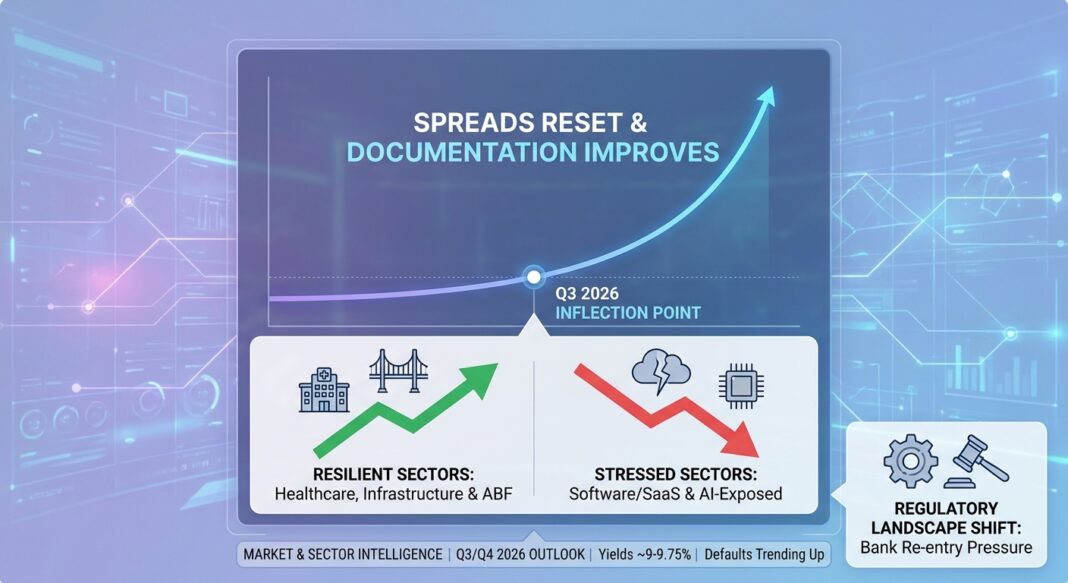
Private Credit at the Inflection Point: Spreads Reset, Sectors Bifurcate, and the Regulatory Landscape Shifts
Market Headline: The Lender-Friendly Reset Takes Hold
Private credit markets have crossed a meaningful threshold entering Q4 2026. After a prolonged period of spread compression that favored borrowers, the first half of this year delivered a visible reset — and the data now confirms it is structural, not cyclical. According to Lord Abbett’s mid-year outlook, spreads have widened by roughly 50 to 100 basis points since late 2025, while defensive documentation terms have simultaneously improved — a rare combination that signals genuine lender leverage rather than a temporary volatility spike.
Three macro forces are converging to define the current credit environment:
- The software/SaaS dislocation. AI disruption concerns triggered a near-30% equity selloff in software stocks between October 2025 and February 2026 and rippled directly into private credit loan valuations. The BIS documented that SaaS loans grew to over $500 billion — approximately 19% of total direct loan portfolios — by end-2025, making sector repricing systemic rather than idiosyncratic.
- Bank re-entry via regulatory deregulation. On December 5, 2025, the OCC and FDIC rescinded the 2013 Interagency Guidance on Leveraged Lending, effective immediately, allowing banks to apply enterprise-wide risk management to leveraged lending and creating direct competitive pressure on private credit at the upper end of the market.
- Volume contraction with quality bifurcation. Valuation Research Corporation (VRC) data shows private debt issuance totaled approximately $87.2 billion through May 2026, a decline of roughly 24.6% compared to the same period in 2025, while deal quality stratification is accelerating — high-quality borrowers continue to attract competitive capital while stressed credits face meaningful premium widening.
The net result: lenders who maintained underwriting discipline through the 2023–2025 compression cycle are now positioned to capture better risk-adjusted terms; borrowers relying on market momentum to support weak fundamentals face a materially changed landscape.
Quantitative Market Snapshot — Key Metrics as of Q3/Early Q4 2026
| Metric | Current Level (Q3 2026) | Prior Period (Q4 2025) | Change | Source |
|---|---|---|---|---|
| Middle Market Unitranche All-In Yield (USD) | ~9.00% – 9.75% | ~8.50% – 9.25% | +~50 bps (swap-adjusted) | VRC Q2 2026 Update |
| Unitranche Coupon Spread (USD, Middle Market) | SOFR + 475 – 550 bps | SOFR + 450 – 525 bps | +~25 bps vs. year-end | VRC Q2 2026 Update |
| Large-Cap Direct Lending Spread | ~SOFR + 480 bps | ~SOFR + 455 bps | +~25 bps (Q1 2026 widening) | Octus FY 2025 Direct Lending Analytics |
| Lower Middle Market Spread Premium over Large-Cap | ~+232 bps (widened from 2024) | ~+180 bps | +~52 bps | Avante Capital / Muzinich & Co. Analysis |
| High Yield Composite OAS | ~324 bps (early Oct 2026) | ~259 bps (Jan 2026 low) | +~65 bps (from 2026 lows) | InvestmentGrade.com / ICE BofA Index |
| HY All-In Yield | ~7.3% – 8.2% | ~6.8% – 7.5% | Widened from 2026 lows | BNY Investments, Sept. 25, 2026 |
| Software Sector Secondary Spread (vs. B-Index) | ~+229 bps above B-rated loan index | Broadly in-line | +245 bps wider than year-end | VRC / PitchBook LCD (Jun. 2026) |
| C&I Bank Lending Standards (Large/Mid Firms) — Fed SLOOS | Net 0.0% tightening (Q3 2026) | Net +8.1% tightening (Q2 2026) | Eased materially | FRED / Fed SLOOS, Aug. 3, 2026 |
| Private Credit Default Rate Range (Q2 2026) | 2.51% (Proskauer) to 6.0% (Fitch) | ~1.6% – 5.7% | Trending higher on broader measures | Kadenwood Group / Proskauer; Fitch, Jul. 2026 |
| Private Debt Issuance (Jan–May 2026) | ~$87.2 billion | ~$115.6 billion (same period 2025) | –24.6% YoY | VRC Q2 2026 Update |
| Fund-Level Debt-to-Equity (BDC Median) | ~1.0x | ~0.95x | Modest uptick; monitoring warranted at 1.2x | Heron Finance Q2 2026 Benchmark Report |
Note: Spreads quoted over 90-day Term SOFR (3.73% as of June 30, 2026 per Golub Capital 10-Q filings). All-in yields incorporate OID effects. LMM = Lower Middle Market. Sources linked in table.
Regulatory Force Multiplier: The Leveraged Lending Guidance Rescission
A critical but underappreciated data point: on December 5, 2025, the OCC and FDIC rescinded the 2013 Interagency Guidance on Leveraged Lending — the framework that had, for over a decade, constrained banks to 6x Debt/EBITDA thresholds on broadly syndicated loans and pushed deal flow toward private credit. The agencies stated the guidance had been “overly restrictive” and had directly contributed to the growth of nonbank lending outside the regulatory perimeter. The Federal Reserve has been widely expected to follow. This withdrawal may bring more leveraged lending back into the traditional banking system, intensifying competition with private credit lenders — particularly at the upper end of the market where bank re-entry is already measurable.
Sector Analysis: Capital Is Rotating — Follow the FCCR
🟢 High Lender Appetite: Healthcare, Infrastructure & Asset-Backed Finance
Healthcare is the standout sector for private credit conviction in 2026. Octus data shows healthcare led all sectors in private credit in 2025, accounting for 19% of all direct lending deals — and was the only major industry to resist meaningful spread tightening, with pricing holding at approximately SOFR+500 bps through Q4 2025. The sector’s appeal is structural: demographic shifts and non-cyclical service models continue to attract lenders seeking stable, predictable cash flows — the precise FCCR profile that disciplined underwriters currently demand. Healthcare M&A activity remains robust heading into year-end, providing a consistent pipeline of underwriting opportunities for direct lenders.
Infrastructure and Asset-Backed Finance (ABF) represent the most significant structural rotation underway. By Q1 2026, direct lending’s share of private credit fundraising had fallen to 31% — down from a peak — as allocators expanded into infrastructure debt, real estate credit, special situations, and ABF strategies. Specialty finance raised $37 billion in 2025 — more than the prior two years combined — after representing only 5% of private credit fundraising as recently as 2023. Traditional banks have been systematically pushed out of long-duration infrastructure lending by post-GFC regulatory capital requirements, and private credit funds are filling this gap with financing that typically costs 100–300 basis points more than conventional bank loans but offers speed and structural flexibility. Morgan Stanley estimates private credit could supply more than half of the $1.5 trillion needed for global data center buildouts through 2028.
🔴 Constrained Lender Appetite: Software/SaaS and AI-Disruption-Exposed Credits
Software is 2026’s defining credit stress story. Software companies have accounted for only 12% of all PE-backed direct lending deals by count in 2026 — down from 16% last year, and the volume decline is even steeper. Based on LCD estimates, software deals accounted for 15% of PE-backed direct lending volume year-to-date, down from 22% last year and a peak of 27% in 2020–2022.
The structural concern is concentration: a third of private credit funds have extended loans to the SaaS sector, with outstanding SaaS loans growing from $8 billion in 2015 to over $500 billion — 19% of total direct loans — by end-2025. Secondary spreads in software are approximately 245 basis points wider than year-end levels, and new software-related direct lending transactions are expected to price at 75–100 basis points above standard yield matrix ranges. Software represents approximately 20% of private market exposure versus roughly 13% in the liquid leveraged loan market, making manager underwriting discipline and vintage-year exposure the critical differentiating variables heading into year-end.
KPI Underwriting Shift: FCCR and Leverage Multiples Under Active Revision
The FCCR is no longer a passive covenant — it is an active underwriting filter. Heron Finance’s Q2 2026 benchmark report (covering 69 private credit funds with over $1 trillion in aggregate AUM) confirms borrower Debt/EBITDA ratios have been broadly stable with no material upward drift, suggesting lenders have maintained discipline on headline leverage. However, the forward-looking FCCR calculus has tightened materially: with 90-day Term SOFR at 3.73% as of June 30, 2026, borrowers carrying 5.0–5.5x Debt/EBITDA at floating rates face meaningful fixed charge pressure at even modest revenue underperformance. Fund-level debt-to-equity ratios have crept to approximately 1.0x, with the Heron report flagging that trends toward 1.2x would warrant heightened loss-amplification risk in a stress scenario. Covenant packages in the core middle market continue to offer more protection than the large-cap market: quality middle market lending, particularly sponsor-backed deals with robust covenant packages, continue to offer attractive yield pick-up relative to the broadly syndicated loan market.
Strategic & Operational Implications
For Borrowers & Operating Executives
- Cost of capital has reset upward. Middle market unitranche yields of 9.00%–9.75% — roughly 250 basis points below late-2023 peaks but 50 basis points above year-end 2025 — represent a structurally higher financing floor. Operating plans built on sub-9% all-in costs require revision. FCCR stress-testing at current SOFR levels, not forward curves, is the operationally prudent baseline.
- Sector identity matters for access. Healthcare and infrastructure-linked businesses command tighter spreads and deeper lender appetite; software and SaaS-exposed operators — particularly those with pre-profitability ARR structures — now face a materially narrower lender universe. Financing is still available for software businesses providing lower leverage, higher pricing, or compelling AI-adjacency narratives, but incumbency is now a prerequisite, not a preference.
- Bank re-entry is real but selective. As banks begin to reenter the lending market, upward pressure on credit spreads has moderated — particularly for upper middle market and large-cap credits. Borrowers in the $100M+ EBITDA range should actively run bank/private credit processes in parallel; those below $50M EBITDA will continue to find private credit as the primary and often sole institutional option.
For Institutional Investors & Lenders
- The lender-friendly window is open but time-limited. More deal flow and wider spreads are constructive, but the most durable advantage may come from better documentation, more conservative leverage, and the time to conduct stress analysis before capital is deployed. Funds deploying in Q3–Q4 2026 have a structural documentation and pricing advantage over 2024–2025 vintages.
- Institutional capital is stable; wealth channel is not. Institutional capital has remained stable and in some cases increased as market dislocations created more attractive entry points, while retail-oriented BDC vehicles experienced Q1 2026 redemption requests nearly five times above the prior four-quarter average. Manager selection and capital base composition are now meaningful performance variables.
- ABF and infrastructure require new origination infrastructure. PwC’s 2026 private credit survey identifies senior direct lending, asset-based finance, and specialty finance as the most attractive segments, but notes that these strategies require structuring expertise beyond traditional cash-flow lending. Managers without established origination platforms in these verticals face meaningful ramp risk.
- Default rate measurement demands precision. Five major data providers report private credit default rates ranging from 2.51% (Proskauer, payment defaults only) to 6.0% (Fitch, including distressed exchanges and maturity extensions) as of Q2 2026. Portfolio reporting that excludes maturity extensions and distressed exchanges is materially understating credit stress. Institutional due diligence must demand the broader definition.
Forward-Looking View: Next 3–6 Months
Rates and liquidity: With 90-day Term SOFR at approximately 3.73% as of June 30, 2026, and forward curves pricing limited additional Fed cuts, floating-rate private credit borrowers face a “higher-for-longer” base rate through at least Q1 2027. With SOFR near 3.6% and further 2026 Fed cuts largely priced out, pressure remains on over-levered borrowers, particularly those facing 2028–2029 refinancing walls.
Deal flow recovery is gradual: Middle market PE activity has shown improvement, with deal value increasing approximately 10.7% year-over-year and exit activity rising 14%, per PitchBook data, but issuance remains below 2025 pace. Buyout volume is expected to improve but not set records, with refinancing activity likely having peaked as the majority of 2021-vintage loans have already been addressed.
Structural shifts accelerate: The drivers of return appear to be shifting away from broad asset-class growth toward specialization, dispersion, and cross-market investment judgment. Moody’s projects private credit AUM exceeding $2 trillion in 2026 and approaching $4 trillion by 2030, with ABF — lending against pools of receivables, infrastructure assets, and real assets — becoming the primary growth engine. Managers that built origination infrastructure in these verticals ahead of the rotation are positioned to lead the next deployment cycle.
Software resolution timeline: Direct lenders remain better positioned than syndicated markets to manage stress, given their ability to avoid liability-management dynamics — but the 2020–2022 software vintage workouts are likely to extend through 2027–2028. Funds with high-quality covenant packages and senior-secured structures will have the workout tools; covenant-lite large-cap portfolios will not.
📌 Key Market Insights: 5 Actionable Takeaways
- Spreads have reset +50–100 bps since late 2025, but the reset is uneven. Large-cap and upper middle market credits benefited most from bank re-entry pressure moderating spreads in Q2; lower middle market lenders are capturing a 232 bps structural premium that is widening, not compressing. Allocators should distinguish between these sub-markets rather than treating “private credit” as a monolithic asset class.
- Software is a sector-specific credit cycle, not a systemic one — yet. With software representing 19–20% of direct loan portfolios, deterioration is material but manageable for diversified lenders. The risk inflection point is 2027–2028 refinancings for the 2020–2022 vintage; monitor non-accrual rates and distressed exchange activity — not just headline default rates — as leading indicators.
- The December 2025 leveraged lending guidance rescission is a competitive game-changer for upper-market deals. Banks now have the regulatory latitude to compete at leverage levels previously ceded to private credit. Sponsors running processes for credits above $75M EBITDA should run dual-track bank/private credit processes to capture the emerging pricing competition. Private lenders in this segment must offer speed and structural flexibility — not just availability.
- FCCR stress-testing must use current SOFR, not peak-cycle assumptions. With Term SOFR at ~3.73% and spreads at 475–550 bps, an EBITDA-backed borrower at 5.0x leverage is paying 8.5%–9.25% in annual debt service before amortization. A 20% EBITDA miss from underperformance or AI disruption can move FCCR below 1.0x rapidly. Lenders accepting documentation that allows aggressive EBITDA add-backs are creating an underpriced future impairment.
- Asset-backed finance and infrastructure debt are the allocation destination for H2 2026 and 2027. The capital rotation is confirmed: direct lending fell to 31% of private credit fundraising by Q1 2026 as ABF and specialty finance captured inflows. This is not a tactical trade — it reflects a structural shift in where private credit adds differentiated value relative to banks. Institutional investors building or expanding private credit allocations should weight ABF, infrastructure debt, and specialty finance over plain-vanilla direct lending at current relative valuations.


