
One Loan, Two Realities: The Unitranche Innovation
Walk into most middle-market leveraged buyouts today, and you will find a capital structure that looks deceptively simple: one lender, one credit agreement, one interest rate. What you will not see is the sophisticated architecture operating behind the scenes — a private contract between lenders that quietly divides risk, return, and control in ways the borrower may never fully know.
This is the unitranche loan, and it has become the dominant financing instrument in private credit. Understanding how it works is foundational for any investor evaluating direct lending funds or any business owner considering a private credit facility. The structure solves a genuine problem: how do you access the combined debt capacity of senior and subordinated capital without the cost, complexity, and negotiation friction of managing two separate lender groups?
In a market where Preqin’s 2026 Global Alternatives Report estimates global private credit AUM has reached roughly $1.7 trillion — up from $970 billion in 2019 — the unitranche structure sits at the center of how that capital is deployed. Grasping it is not optional. It is the starting point for understanding modern private credit.
What a Unitranche Loan Actually Is
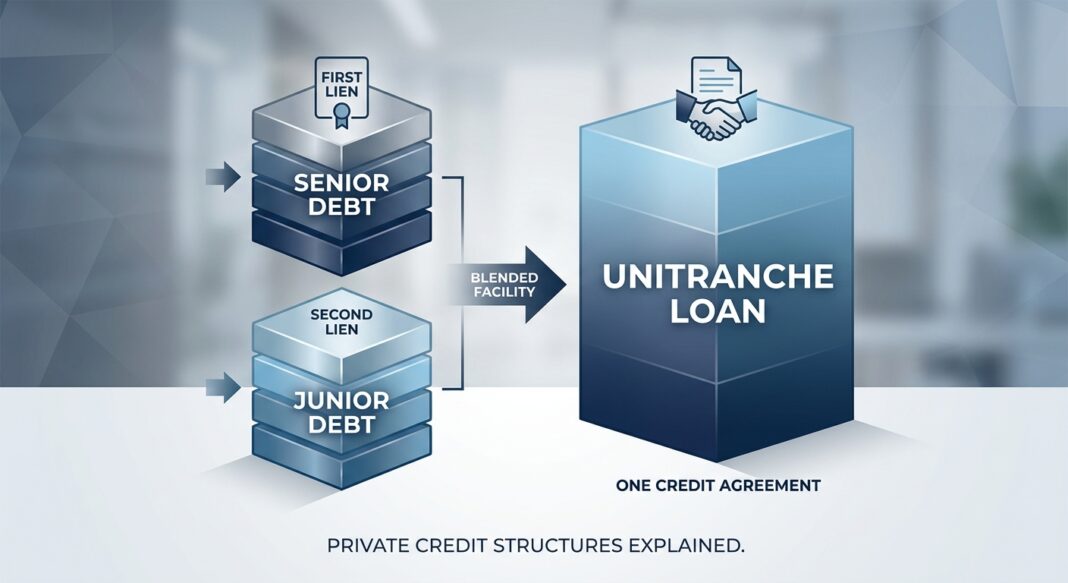
A unitranche loan is a single secured term loan that blends senior and junior debt into one instrument under one credit agreement. As Private Credit Hub explains, the structure delivers one lien package, one covenant set, one amortization schedule, and one administrative agent — all presented to the borrower as a single, clean financing.
The complexity does not disappear; it relocates. Behind the scenes, lenders in larger facilities typically execute an Agreement Among Lenders (AAL) — a private inter-lender contract the borrower is not party to. Mayer Brown (July 2026) describes this architecture precisely: in a unitranche arrangement, there is only one lien on collateral, and payment priority is governed by the AAL rather than by separate competing security interests, as would occur in a traditional first-lien/second-lien deal.
The AAL carves the single facility into two internal sleeves: a first-out piece and a last-out piece. First-out lenders receive scheduled interest, amortization, and prepayments before last-out lenders, and in exchange they accept a lower margin. Last-out lenders absorb loss first in a distressed scenario and are compensated with a higher yield. According to Alternative Fortune, the structure became dominant not because it is cheaper or necessarily safer, but because it gives private equity sponsors speed, certainty of close, and confidentiality.
How It Works: A Concrete Example with Numbers
Consider a private equity sponsor acquiring a healthcare services platform with $20 million in EBITDA at a 7x multiple — a $140 million enterprise value. The sponsor contributes $56 million in equity (40% of enterprise value), and needs $84 million in debt financing.
Under a traditional two-tranche structure, the borrower would negotiate two separate credit agreements:
- Senior loan: $60 million at SOFR + 450 bps (all-in ~8.5%), with first-lien collateral
- Mezzanine loan: $24 million at a fixed 13–14%, with second-lien or subordinated position
- Two lender groups, two sets of covenants, two intercreditor negotiations
Under a unitranche structure, the same borrower signs a single $84 million credit agreement at a blended rate of approximately SOFR + 525 bps (roughly 9.5% all-in at current base rates). The borrower deals with one administrative agent, one covenant package, and closes faster. The lenders divide the $84 million internally: perhaps $54 million in a first-out sleeve earning SOFR + 400 bps, and $30 million in a last-out sleeve earning SOFR + 700 bps. The borrower sees none of this split.
The math works for all parties: CTA Acquisitions (2026) notes that unitranche deals typically carry total leverage of 4–6x EBITDA, with blended all-in rates ranging from 8–11% (SOFR + 500–700 bps in 2026). For investors, the blended yield on the full facility compensates for the structural complexity absorbed. For operators, one negotiation replaces two.
Current Market Relevance: Data Points Anchoring the Concept
The unitranche structure is not a theoretical construct — it is the workhorse of today’s private credit market, and current data tells that story clearly.
| Metric | Value | Source |
|---|---|---|
| Global Private Credit AUM (2026 est.) | ~$1.7 trillion | Preqin via CTA Acquisitions, 2026 |
| New-issue unitranche spread (Q1 2026) | ~525 bps over SOFR | PitchBook LCD via CTA Acquisitions, 2026 |
| All-in unitranche coupon range (2026) | ~9.5%–10.5% | CTA Acquisitions, 2026 |
| Blackstone BCRED avg. yield on new private debt (Q2 2026) | 9.0% (3.9% base + 5.1% spread/fees) | Blackstone BCRED Form 8-K, SEC, Q2 2026 |
| Ares Capital weighted-avg. yield on debt investments (Q1 2026) | ~10.4% | Ares Capital Q1 2026 Shareholder Report via CTA Acquisitions |
| C&I bank lending standards (Q2 2026) | Basically unchanged; easier than historical midpoints | Federal Reserve SLOOS, July 2026 |
| Private credit AUM growth forecast to 2030 | ~$4.0–4.5 trillion | Moody’s Private Credit Outlook 2026 |
The bank lending backdrop matters here. The Federal Reserve’s July 2026 SLOOS found that C&I lending standards are currently at the easier end of their historical ranges — a meaningful shift from the tighter conditions of 2023 and early 2025. Even as banks ease slightly for larger corporate borrowers, GM Insights (2026) identifies ongoing Basel III/IV capital regulation as a structural driver pushing middle-market lending away from banks and toward private credit — reinforcing the structural role unitranche facilities occupy.
Spread compression is also a live story. VGlobal Holdings (2026) reports that direct lending spreads, while narrowing, remain approximately 300 basis points above comparable public loan yields — a meaningful premium that continues to attract institutional allocators even as pricing tightens. Historically, unitranche loans ran 50–150 bps above the weighted average of the senior and sub components they replaced, but that premium has compressed to roughly 25 bps in the current environment as competition among lenders intensifies.
Decision Framework: Investors and Operators
For Investors Evaluating Private Credit Funds
When analyzing a direct lending fund with significant unitranche exposure, investors consider several structural questions:
- First-out vs. last-out positioning: Does the fund primarily hold first-out sleeves (lower yield, lower risk) or last-out sleeves (higher yield, higher loss-absorption)? The fund’s average position within the AAL waterfall materially affects its risk/return profile.
- Spread adequacy: With new-issue unitranche spreads at approximately 525 bps over SOFR in Q1 2026 — down from 650–700 bps in 2023 — investors evaluate whether current pricing adequately compensates for credit and liquidity risk at current leverage levels.
- Covenant quality: Unitranche structures carry a single covenant package. Investors examine whether that package includes a meaningful financial maintenance covenant (typically a leverage or interest coverage test) rather than only incurrence-based covenants, which provide less early-warning protection.
- Distressed scenario mechanics: In a workout, who controls enforcement under the AAL? Understanding voting thresholds and cure rights in the agreement among lenders is essential for assessing downside recovery.
For Business Owners Considering a Unitranche Facility
Operators and finance teams evaluate the unitranche against alternatives along several dimensions:
- Speed and certainty: Unitranche eliminates intercreditor negotiations between separate senior and subordinated lenders — a meaningful advantage in time-sensitive M&A processes.
- All-in cost vs. a two-tranche alternative: The blended unitranche rate is typically slightly higher than a comparable senior/sub stack, but operators consider total transaction costs, management bandwidth, and execution risk in that comparison.
- Leverage capacity: CTA Acquisitions (2026) notes unitranche lenders can extend total leverage up to 7x EBITDA for high-quality recurring-revenue businesses (SaaS, healthcare services), providing access to debt capacity that banks typically will not underwrite.
- AAL opacity: Operators should be aware that while they are not party to the AAL, its terms directly shape how a distressed scenario unfolds — including who controls enforcement timing and whether management has any seat at the table.
Key Takeaways
- A unitranche is one loan with hidden layers: The borrower sees a single credit agreement; the lenders may privately divide the facility into first-out and last-out sleeves via an Agreement Among Lenders (AAL), each with different yields and loss exposure.
- Execution simplicity is the core value proposition: By eliminating intercreditor negotiations between separate lender groups, unitranche structures offer sponsors speed and certainty of close — a premium that has made this format the dominant deal structure in private credit M&A financing.
- Pricing has compressed but remains structurally attractive: New-issue unitranche spreads averaged approximately 525 bps over SOFR in Q1 2026, generating all-in coupons of roughly 9.5%–10.5% — down from peaks near 12.5% in mid-2023 but still ~300 bps above comparable public loan yields.
- Bank standards are stabilizing, not collapsing: The Federal Reserve’s July 2026 SLOOS shows C&I lending standards at easier-than-historical-midpoint levels, but structural regulatory pressure (Basel III/IV) continues to limit banks’ appetite for middle-market unitranche-sized facilities — sustaining the addressable market for private credit lenders.
- The AAL is the hidden risk document: For investors, understanding a fund’s positioning within the AAL waterfall (first-out vs. last-out) and the distressed control rights embedded in those agreements is as important as analyzing the loan-level yield or leverage multiple.


