
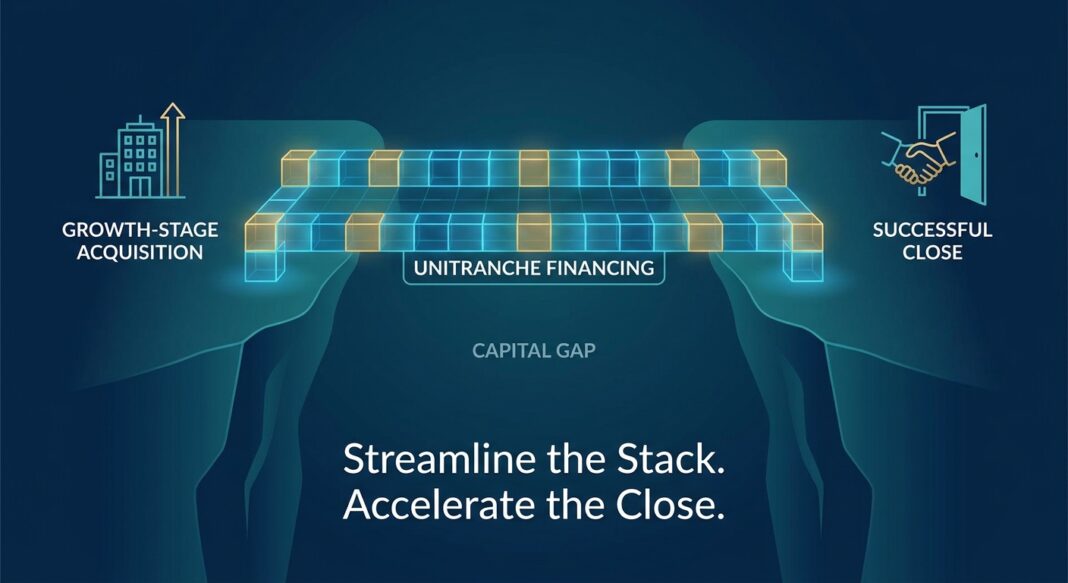
The Financing Challenge: One Acquisition, Two Lenders, One Problem
A software business with $8M in EBITDA and a clean recurring-revenue profile wants to buy a $25M bolt-on. The founders have never run a leveraged capital process. Their bank — a regional commercial lender — will go to 2.5x EBITDA on a senior term loan and stop. That leaves a $5M hole between the bank, the equity check, and the purchase price. The traditional answer is to add a mezzanine tranche: bring in a subordinated lender, negotiate two credit agreements, execute an intercreditor arrangement, and close in 130 days. The modern answer — and the one most lower-middle-market operators are choosing in 2026 — is a unitranche.
The financing gap in growth-stage acquisitions is structural, not accidental. Banks are constrained by regulatory capital treatment on leveraged exposures. Banks remain constrained by Basel III endgame capital treatment on leveraged exposures, which shows up in tightened bank balance-sheet capacity for the exact borrower class private credit funds are now chasing. Private credit has stepped into that gap at scale: the private credit market reached roughly $1.7 trillion in global assets under management at the start of 2026, up from $970 billion in 2019, according to Preqin’s 2026 Global Alternatives Report. The instrument at the center of that growth is the unitranche loan.
Structure Breakdown: What a Unitranche Actually Is
The Mechanics
Unitranche debt is a single-tranche term loan that combines what would otherwise be senior secured debt and subordinated/mezzanine debt into one instrument with one lender, one credit agreement, and one covenant package. The unitranche structure, which combines senior and subordinated debt into a single facility with a blended interest rate, has become the dominant form in the direct lending market. Roughly 80% of lower-middle-market leveraged buyouts closed in 2025 used a private credit unitranche rather than a syndicated bank loan, per S&P Global Market Intelligence.
The blended rate is the defining economics. The interest rate is a "blended" rate which is often higher than, or about the same as, the interest rate of traditional senior debt, but lower than the interest rate for traditional second lien or subordinated debt. In first-out/last-out (FOLO) structures, the AAL — Agreement Among Lenders — governs the payment waterfall, fee and interest allocation, voting, lien priority and enforcement between first-out and last-out lenders.
Worked Example: A $50M Unitranche for a $100M Enterprise Value Software Company
Consider a private equity-sponsored acquisition of a B2B SaaS platform at $100M enterprise value with $10M EBITDA (10x multiple). The capital stack:
| Layer | Amount | % of EV | Instrument | Pricing (2026) | Term |
|---|---|---|---|---|---|
| Unitranche Term Loan | $50M | 50% | First-lien unitranche + $7.5M DDTL | SOFR + 550 bps (~9.5–10% all-in) | 6 years |
| Revolving Credit Facility | $7.5M | 7.5% | Super-senior revolver (bank) | SOFR + 275 bps | 5 years |
| Sponsor Equity | $42.5M | 42.5% | Common equity | Target 20%+ IRR | 5-year hold |
Key term sheet features: 2% OID at close; 102/101/par prepayment premium (soft call protection in years 1–2); delayed-draw term loan (DDTL) sized for one bolt-on acquisition; single financial covenant — maximum total leverage at 5.5x in year one, stepping down 0.5x annually; four equity cure rights over the loan life, no more than two in any consecutive four-quarter window; accordion feature permitting up to $15M in incremental term debt subject to pro-forma leverage compliance.
Unitranche agreements often include leverage ratios ranging from 4–6 times a company's EBITDA, with blended interest rates typically falling in the range of SOFR + 500–700 basis points. For this company's deal, the 5x initial leverage and SOFR + 550 bps pricing sit squarely in the market.
2026 Pricing Reference Points
- Private credit spreads averaged approximately 525 basis points on new-issue unitranche loans in Q1 2026, down from the 650–700 basis point range that prevailed through 2023, per PitchBook LCD private credit data.
- All-in coupons on new-issue unitranche loans have compressed to roughly 9.5% to 10.5%, from a peak near 12.5% in mid-2023.
- Current middle-market spreads run approximately SOFR + 4.75% to SOFR + 5.50% for deals in the $40M–$100M EBITDA range, according to Lincoln International's Q1 2026 private market data.
- In March 2026, PitchBook reported that WWEX (Worldwide Express) and Auctane, in a Thoma Bravo-backed transaction, secured a $4.815 billion unitranche loan plus a $275 million revolver, priced at 575 basis points over the benchmark rate, with Ares Capital serving as administrative agent for a 33-lender club that included Blackstone, Blue Owl, Apollo, and Oaktree. This large-cap transaction confirms that unitranche execution has scaled well beyond its middle-market origins.
Unitranche vs. Alternatives: The Real Trade-Offs
Unitranche vs. Traditional Senior + Mezzanine Split
The traditional senior/mezzanine split was the standard LBO structure for decades. It offers more leverage headroom — total leverage in a senior plus mezzanine structure typically reaches 5–7x EBITDA versus 4–6x for a unitranche — but at the cost of deal complexity and timeline. A two-lender structure requires a separate intercreditor agreement, two sets of covenants, two administrative agents, and often $200,000–$300,000 more in legal cost. Time to close for a unitranche runs 60–90 days versus 100–130 days for a senior plus mezzanine structure.
Mezzanine financing carries its own distinct pricing logic: mezzanine debt financing sits between senior credit and equity, priced today at roughly 11% to 14% cash coupon plus 1% to 4% PIK plus warrants of 1% to 5% of the fully diluted cap table. Because mezzanine lenders seek a return of 14% to 20%, this return must be achieved through means other than simple cash interest payments — by using equity ownership and PIK interest, the mezzanine lender effectively defers its compensation until the due date of the security or a change of control. When warrant dilution is a concern for founders or sponsors retaining meaningful equity, the unitranche eliminates the equity kicker entirely.
Unitranche vs. Broadly Syndicated Loans (BSLs)
Pricing on BSLs in 2026 runs SOFR + 350–500 bps for B2/BB- credits (approximately 7.5–9.5% all-in), versus 9.5–11% for unitranche. For very large deals ($500M+ EV), BSLs typically win by 100–200 bps. But for the sub-$200M EV market — where the growth-stage acquisition deal almost always lives — BSL execution requires minimum deal size, ratings, and roadshow logistics that most operators cannot support. The unitranche facility is now the default structure for LBOs under $500 million in enterprise value.
When Each Option Makes Sense
| Scenario | Optimal Structure | Why |
|---|---|---|
| $10M–$200M EV acquisition, PE-backed | Unitranche | Speed, certainty, single lender relationship |
| Maximum leverage needed (>6x EBITDA) | Senior + Mezzanine | Sub layer pushes leverage ceiling higher |
| Owner retaining >80% equity, no warrants | Unitranche | No equity kicker dilution |
| $500M+ EV, rated credit, public markets access | BSL / TLB | 100–200 bps cheaper at scale |
| Growth-stage, limited cash flow, deferral needed | Mezz with PIK toggle | PIK preserves near-term cash flow |
Current Market Terms: What the 2026 Unitranche Looks Like
Covenant Architecture
The covenant package is where the real negotiation happens in 2026. The standard 2026 unitranche package features a single financial covenant — typically a maximum leverage ratio that steps down annually (e.g., 6.0x in year 1, 5.5x in year 2, 5.0x in year 3, 4.5x thereafter). Some lenders push for additional covenants such as minimum interest coverage or minimum fixed charge coverage; aggressive sponsors negotiate these out.
The covenant-lite migration is accelerating. Incurrence-based covenant packages are replacing maintenance tests in roughly two of every three growth-stage unitranche facilities currently evaluated in the market. Covenant-lite loans are only tested and can only be breached following an affirmative action of the borrower, rather than by a deterioration in the borrower’s financial condition. For growth-stage operators with lumpy revenue or acquisition pipelines, incurrence covenants offer the operating flexibility that maintenance covenants structurally cannot provide. Larger unitranche deals above $200M EV are increasingly closing covenant-lite; this was historically reserved for BSLs but now appears in 30–40% of $200M+ unitranche deals.
Structural Features Standard in 2026
- Accordion / Incremental: Facilities commonly incorporate accordion features allowing borrowers to upsize commitments for acquisitions and delayed-draw mechanisms for capital expenditure programmes.
- Delayed-Draw Term Loan (DDTL): Sized for future bolt-on acquisitions, typically drawable within 18–24 months of close at the same spread as the original term loan.
- Equity Cure Rights: Standard 2026 terms provide 4 cures over the life of the loan, no more than 2 in any consecutive 4 quarters, with cure proceeds added to EBITDA for covenant purposes.
- Call Protection: Typically 102/101/par — a 2% premium in year one, 1% in year two, then open prepayment. Soft call only; no hard no-call period in most LMM deals.
- PIK Toggle: Available in a minority of unitranche deals where lender accepts it; more common in mezzanine and second-lien structures. PIK interest accrues to principal instead of being paid in cash, preserving cash flow; ABF Journal puts typical PIK rates at 2% to 4%.
Market Depth
Ares Capital, Blue Owl Capital, Antares Capital, Twin Brook Capital Partners, Apollo Global Management direct lending, Carlyle Direct Lending, KKR Capital Markets, Golub Capital, and Monroe Capital lead the unitranche market for $25M–$200M EV deals. Total BDC gross assets under management reached $575 billion in the first quarter of 2026, up 21% year over year, according to LSTA's quarterly tracking. Lender competition in the core $50M–$200M EV band is intense: direct lenders aggressively compete for deals in this band, with pricing tightest, terms most flexible, and leverage most generous.
The Gap Capital Playbook: From Quantifying Need to Closing the Structure
Understanding unitranche mechanics is necessary but insufficient. The operator or sponsor who secures the best terms runs a deliberate process. Here is the four-step playbook.
Step 1 — Quantify the Gap
Build a leverage capacity model before approaching lenders. Start with your EBITDA — adjusted for add-backs lenders will accept, not management's preferred figure. Map the acquisition price against three leverage scenarios: 4x, 5x, and 6x EBITDA. The gap between your maximum acceptable equity contribution and the purchase price is the debt you need to fill. Model the debt service coverage ratio (DSCR) at each leverage point: lenders will require 1.15–1.30x minimum coverage. If cash flow is tight, flag the PIK toggle conversation early — but expect to pay 50–75 bps more for that option.
Growth remains the primary reason middle market companies pursue private capital, with funding growth initiatives ranked first at 28%, followed by investments in technology, automation, and AI at 26%, acquisitions at 18%, and recapitalization at 16%. Know which bucket your capital need falls into — lenders price and structure differently for each use of proceeds.
Step 2 — Prepare the Materials
Unitranche lenders underwrite management, not just the model. Your confidential information memorandum (CIM) must answer four questions immediately: What does the business do and who are its customers? What is the quality of EBITDA (recurring vs. project vs. one-time)? What does leverage look like at 5x trailing EBITDA and 4.5x forward? What is the exit path and timeline? Append a detailed EBITDA bridge, a three-year financial model with downside case, an aged receivables schedule, and — for the target acquisition — a standalone and pro-forma integration model. Lenders who see clean diligence materials move faster and price tighter.
Step 3 — Run the Process
In the $25M–$200M EV range, unitranche wins on speed — a 45–90 day close versus 90–150 days for broadly syndicated loans. To realize that speed advantage, approach three to five lenders simultaneously. Send a teaser, NDAs, and CIM on the same day. Set a term sheet deadline 15 business days out. Competitive tension in this market is real: buy-side competition for these deals creates favorable financing dynamics because lenders chase relationships. Do not accept the first term sheet before the process closes — even a second term sheet in hand compresses spreads by 25–50 bps and improves covenant headroom.
Covenant-lite structures represent 62% of new unitranche originations in the sub-$100M ticket band, up from 34% in Q2 2024, according to Bloomberg DCM Q2 2026. Use this data point in lender conversations: it is a factual market reference, not a bluff.
Step 4 — Negotiate the Structure
Negotiation priority order matters. Operators frequently win the rate negotiation and lose on structure. Founders who negotiate hard on the coupon and soft on the covenants will lose money on the deal even if the headline rate looks like a win. Structure your negotiation in this sequence:
- Covenant headroom first: Push for 25–30% EBITDA headroom on the leverage covenant. A 6.0x covenant on a 5.0x drawn structure is materially better than a 5.5x covenant on the same drawing.
- Accordion sizing second: Size the accordion to cover at least one bolt-on at today's target multiples without returning to the market for consent.
- Cure mechanics third: Negotiate hard for the ability to use cure proceeds for working capital (not just paydown), no cap on cure size, and cure proceeds counted for covenant calculation in the breach quarter.
- Spread and OID fourth: With competitive tension established from the process, the lender will compress spread 25–50 bps rather than lose the deal relationship.
Key Takeaways
- Unitranche is the default lower-middle-market structure in 2026. It closes faster (45–90 days), costs less to document, and eliminates intercreditor risk — critical advantages when acquiring a seller with a hard timeline.
- All-in cost has compressed materially since 2023. New-issue unitranche pricing of SOFR + 475–550 bps translates to approximately 9.5–10.5% all-in, down from a 2023 peak near 12.5%.
- Covenant architecture matters more than spread. Incurrence-based packages replace maintenance tests in a growing majority of growth-stage unitranche deals. Negotiate leverage headroom and cure mechanics before rate.
- The DDTL is your acquisition currency. Sizing a delayed-draw tranche at close locks in your spread and avoids a return to market for bolt-on financing — the most underused structural feature in growth-stage deals.
- Run a competitive process even for a single facility. Lender competition in the $50M–$200M EV band is at a cyclical high; three parallel term sheets routinely compress spreads by 25–75 bps and meaningfully improve covenant terms before a line of credit is drawn.


