
The Gap Capital Playbook: How Growth-Stage Companies Should Navigate the Full Acquisition Financing Stack
The Financing Challenge No One Warns You About
You have a thesis. You have a signed letter of intent. What you do not have is a clean financing path.
Imagine a vertical-market software company generating $8M in recurring annual revenue with 72% gross margins and a proven customer acquisition model. The founders want to acquire a smaller competitor at a $15M purchase price — a bolt-on that will add $3M in ARR and meaningful operating synergies. The bank offers $5M. The equity investor wants 30% of the company in exchange for the shortfall. Neither option is structurally right.
This is the defining tension of growth-stage acquisition financing: the gap between what senior lenders will extend and the total capital required to close the deal. Fill it with too much dilutive equity and the founders surrender the very upside the acquisition was designed to capture. Fill it with too much high-coupon debt and cash flow constraints strangle the combined business before synergies can materialize.
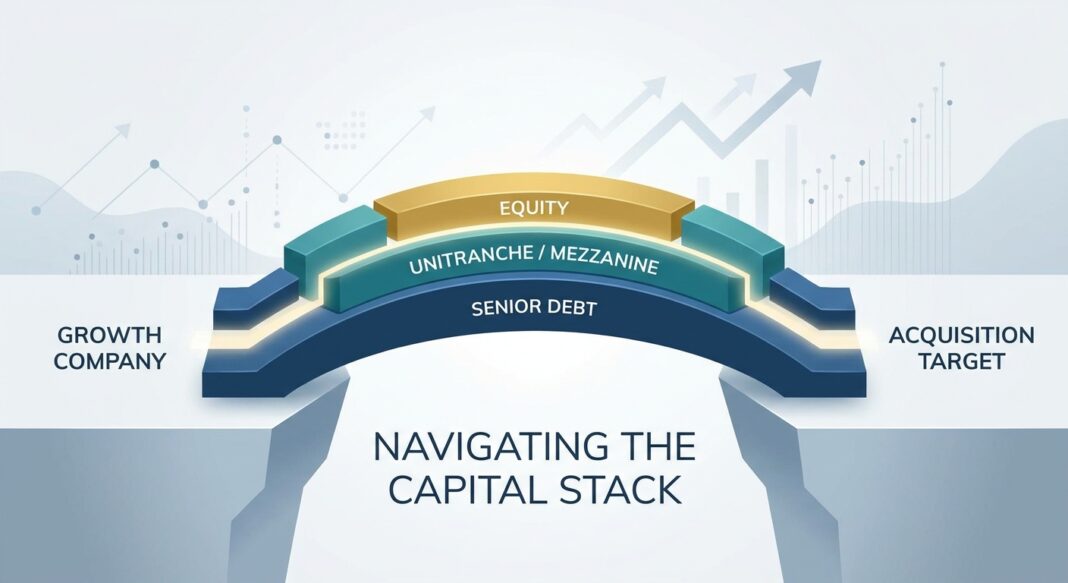
The correct answer is rarely one instrument. It is a layered capital stack — assembled in a specific order, priced against a specific use of proceeds, and negotiated with the lender hierarchy in mind from the first conversation. What follows is the practitioner’s guide to building that stack.
Mapping the Capital Stack: From Banks to Equity
Before approaching a single lender, the operator must build a clear map of every layer available — ordered by cost of capital from cheapest to most expensive — and understand what each layer requires in exchange for its check.
Layer 1 — Senior Secured Debt (Banks & Direct Lenders)
Senior debt is the foundation of any acquisition stack: first lien on all assets, the most restrictive covenant package, and the lowest all-in cost. In the current environment, senior bank debt prices at approximately SOFR + 275–450 bps (roughly 8%–10% all-in), typically sized to 3.0x–4.0x normalized EBITDA for established cash flows. Senior leverage multiples on middle-market deals averaged 3.7x in Q1 2026 per GF Data, with total leverage across the lower middle market averaging 4.6x.
The constraint is well-understood: banks reach a ceiling before the deal is funded. That ceiling creates the gap.
Layer 2 — Unitranche (Direct Lending / BDCs)
The unitranche — a single secured term loan that blends senior and junior debt into one instrument under one credit agreement — now dominates acquisition financing in the $25M–$200M enterprise value band. A unitranche can extend total leverage to 4.5x–5.0x EBITDA, bridging the gap that a standalone senior facility cannot reach.
Pricing in 2026 sits at SOFR + 500–700 bps for the lower middle market, with a 2%–3% original issue discount (OID) and a 2%–3% prepayment fee declining over the first 24 months — an all-in cost of 9.5%–11% for a typical 5x leverage transaction. The premium over a standalone senior loan buys a single lender, faster execution (45–90 days to close versus 90–150 days for a syndicated senior-plus-mezz structure), and the elimination of intercreditor complexity.
Unitranche agreements often include leverage ratios of 4x–6x EBITDA and typically carry a single financial maintenance covenant — a maximum leverage test stepping down annually — rather than a full maintenance package.
Layer 3 — Mezzanine / Subordinated Debt
Mezzanine financing is the gap capital layer — subordinated to all senior lenders but senior to every equity holder. It is the instrument that makes otherwise impossible transactions structurally executable. All-in pricing typically ranges from 13%–18%, structured as a cash-pay coupon plus a PIK (payment-in-kind) component and warrant coverage of 1%–5% of fully diluted equity. A typical structure runs a five-to-seven year bullet maturity, with interest paid partially in cash and partially accrued as additional principal.
PIK mechanics matter. Under a PIK arrangement, the borrower pays part or all of interest by issuing additional debt notes rather than cash. The outstanding principal balance compounds each period; the investor receives cash only when the PIK portion is repaid at bullet maturity or exit. Most mezzanine structures use a partial PIK: the lender still receives some cash-pay interest each period while the PIK portion accrues, preserving the borrower's near-term cash flow for operations and senior debt service.
Equity kicker mechanics also matter. Mezzanine lenders target blended returns of 15%–20% — a level that a cash coupon alone rarely achieves. The warrant, which gives the lender the right to purchase equity in the company at a nominal strike price (often $0.01 per share), makes up the difference between the cash coupon return and the lender's target IRR. In a typical structure, warrants represent 2%–5% of fully diluted equity. If the company exits at a high multiple, the warrant converts into meaningful equity proceeds, lifting the lender's blended IRR from the coupon range into its target range.
Layer 4 — Seller Notes
Frequently used to bridge valuation disagreements and reduce the upfront cash requirement, seller notes are subordinated to all institutional debt and typically carry an interest rate of 5%–8% with a payment holiday in years one and two. They can anchor 5%–10% of total deal value and reduce the equity required to close the transaction — a structurally efficient bridging tool when the seller is willing to defer a portion of proceeds.
Layer 5 — Equity (Sponsor, Family Office, or Founder Roll)
Equity sits at the top of the cost spectrum and the bottom of the repayment waterfall. Growth equity minority checks target companies with $5M–$50M in ARR and typically take a minority stake at a 22%–30% target IRR. Control private equity buyouts target 20%–25% IRR, require the company to support a full exit in four to six years, and typically require 100% ownership with an option for founder rollover at 10%–40%. Equity should be sized to what the debt stack cannot cover — nothing more.
| Capital Layer | Leverage Attach | All-In Cost (2026) | PIK / Warrants | Time to Close |
|---|---|---|---|---|
| Senior Bank / Cash Flow | 0.0x–3.5x EBITDA | SOFR + 275–450 bps (~8%–10%) | None | 60–90 days |
| Unitranche (BDC / Direct Lender) | 0.0x–5.0x EBITDA | SOFR + 500–700 bps (~9.5%–11%) | Rare; 0.5%–1.0% PIK occasionally | 45–90 days |
| Mezzanine / Subordinated | Senior ceiling to ~6.5x | 13%–18% all-in (cash + PIK) | PIK + warrants (2%–5% equity) | 60–90 days |
| Seller Note | 5%–10% of deal value | 5%–8% (deferred pay yr. 1–2) | None | Concurrent with close |
| Growth Equity (Minority) | Gap fill | 22%–30% target IRR | Liquidation prefs, participation | 90–150 days |
Unitranche vs. Senior-Plus-Mezz: The Core Trade-Off
The most consequential structural decision in growth-stage acquisition financing is whether to pursue a single unitranche facility or a layered senior-plus-mezzanine structure. Both can fund the same gap. The trade-offs are execution, cost, and complexity.
| Dimension | Unitranche | Senior + Mezzanine |
|---|---|---|
| Number of lenders | 1 (or 2–3 club) | 2–5+ separate syndicates |
| Credit agreements | 1 | 2 + intercreditor agreement |
| Total leverage achievable | 4.5x–6.0x EBITDA | 5.5x–7.0x EBITDA |
| Blended pricing (2026) | SOFR + 500–700 bps | Senior SOFR + 350–450 bps; mezz 13%–18% |
| Time to close | 45–90 days | 90–130 days |
| Equity kicker | Rarely | Almost always (warrants 2%–5%) |
| Covenant complexity | Single max leverage test | Dual package (senior maintenance + mezz incurrence) |
When to choose unitranche: Speed is the primary driver. If the deal has a compressed closing timeline, a roll-up platform with frequent add-ons, or a seller who requires deal certainty, the unitranche wins on execution. The leverage ceiling (typically 5.0x–5.5x for lower-middle-market credits) is sufficient for most growth-stage acquisitions, and the elimination of intercreditor risk is a material structural benefit.
When to choose senior-plus-mezzanine: When the acquisition requires leverage above 5.5x EBITDA, when the blended cost of a layered structure is materially lower than the unitranche all-in (which can be the case for stronger credits with access to competitive bank pricing), or when the seller requires a longer closing window that allows a more complex process to run. The intercreditor agreement is more work, but it is a solvable problem — and the additional leverage capacity can be the difference between a fundable and unfundable deal.
Covenant architecture shifts meaningfully between the two. The broadly syndicated loan market is now dominated by covenant-lite structures: approximately 85% of institutional leveraged loans rely exclusively on incurrence covenants, which are only tested when the borrower takes a specific action (incurring new debt, making an acquisition, paying a dividend). Private credit direct lenders, by contrast, continue to require maintenance covenants — quarterly financial tests that apply automatically regardless of borrower action. In the lower middle market, maintenance covenants are standard on nearly all direct lending facilities. Borrowers negotiating unitranche or senior credit agreements should expect a single maximum leverage covenant; mezzanine lenders typically carry incurrence-only packages.
The Gap Capital Playbook: Four Execution Steps
Step 1 — Quantify the Gap with Precision
Map the entire deal before approaching any lender. Total the acquisition cost: purchase price + transaction fees + working capital reserve for the first 6–12 months of operation. Then size the senior debt capacity at the realistic multiple a lender will underwrite — typically 3.0x–3.5x normalized EBITDA for a regional bank, 4.0x–5.0x for a direct lender or BDC. The difference between total capital required and senior debt capacity is the gap. That number determines whether mezzanine is necessary or whether a unitranche alone is sufficient.
Critically: use normalized EBITDA, not trailing twelve months as reported. Pro-forma adjustments for synergies, owner compensation, and non-recurring items are standard in lender underwriting and can meaningfully expand the senior debt capacity available — which directly shrinks the gap and may eliminate the mezzanine tranche entirely.
Step 2 — Build the CIM and Supporting Materials
A well-structured lender package includes: (1) a company information memorandum (CIM) describing the business model, competitive moat, management team, and acquisition rationale; (2) three years of audited or reviewed financials plus LTM through the most recent month; (3) a quality of earnings summary or adjustments schedule reconciling reported EBITDA to underwritten EBITDA; (4) a three-year financial model showing debt service capacity under base, downside, and acquisition synergy scenarios; and (5) a capital stack summary showing the proposed structure, use of proceeds, and post-close leverage ratios. Lenders use this package to underwrite — the cleaner the package, the faster the term sheet.
Step 3 — Run a Targeted, Competitive Process
Send the package to 6–10 direct lenders simultaneously. For a sub-$20M transaction, focus on BDCs, specialty mezzanine funds, and lower-middle-market direct lending platforms. Do not sign exclusivity with a lender until you have three to five term sheets on the table and have completed a full comparison. Signing 30-day exclusivity before term sheets are compared and negotiated hands the lender negotiating leverage. The correct sequence is: competitive term sheet process, mutual selection, then exclusivity.
Private credit AUM reached approximately $1.7 trillion globally at the start of 2026, with roughly 40% of new deployment targeting the lower-middle-market growth segment. Capital availability is not the constraint — structure and price are. Use the abundance of capital supply to negotiate, not just to access.
Step 4 — Model the Full Stack Before Committing
Before signing any term sheet, build two or three capital stack scenarios (unitranche only; senior plus mezz; senior plus SBIC sub-debt) and stress-test each against post-close FCCR at 90%, 100%, and 110% of budgeted EBITDA. Regional banks underwrite to FCCR of 1.25x–1.35x on a trailing twelve-month adjusted EBITDA basis. Any scenario that fails FCCR at 90% of budget at any point in the first 24 months is a structural risk that should be resolved at the term sheet stage, not after closing.
Negotiation Guidance: Where the Real Leverage Lives
1. Warrant Coverage — Minimize or Eliminate
Mezzanine lenders routinely open with warrant coverage of 5%–8% of fully diluted equity. The market rate for a well-run process is 1%–3%. Push warrant coverage down from the initial ask, and push for a fixed-price strike rather than a formula-based strike that ratchets with valuation. Better still: negotiate an equity kicker redemption option — the right to buy out the warrants at a predetermined multiple of face value before exit. This converts a permanent dilution overhang into a capped, payable-at-discretion cost.
2. PIK Toggle vs. Mandatory PIK
Not all PIK is created equal. Mandatory PIK requires the borrower to accrue interest regardless of cash position, compounding the principal balance automatically. A PIK toggle — the right to elect PIK at the borrower's option — preserves flexibility. Push for a PIK toggle rather than mandatory PIK, and negotiate a cap on PIK availability limited to the first 12–18 months of the loan term. After that window, require all interest to be cash-pay. This aligns lender and borrower incentives: the toggle benefits the borrower in the integration period; converting to full cash-pay in year two signals operational stability.
3. Covenant Architecture
On a unitranche, push for a single maintenance covenant — maximum total leverage — with a EBITDA definition that includes add-backs for integration costs, synergies, and management equity compensation. Resist additional covenants (minimum liquidity, minimum EBITDA, fixed charge coverage) in the base agreement; they can be restructured as springing covenants triggered only when the revolving credit facility exceeds 35% utilization. On mezzanine, the standard is incurrence-only; any lender asking for maintenance covenants on a subordinated tranche is asking for a structural concession that is not market.
4. OID and Fee Negotiation
Original issue discount (OID) on unitranche facilities typically ranges from 1%–3% of facility size. On a $10M mezzanine tranche, a 200 bps reduction in OID saves $200,000 at close — a material cash flow benefit in a growth-stage transaction. Legal fees for lender counsel should be hard-capped in the term sheet at $250,000–$400,000 for a sub-$50M transaction. Without a cap, lender counsel fees can reach $600,000–$1.2M on a $50M LMM unitranche if left uncapped, per market practice.
5. Delayed-Draw Tranches for Add-On Capacity
If the acquisition thesis includes bolt-on transactions, negotiate a delayed-draw term loan (DDTL) tranche at close. A committed DDTL gives the borrower pre-approved access to additional capital at the same pricing without re-underwriting, materially accelerating future acquisitions. Ticking fees — which accrue on undrawn delayed-draw tranches after a grace period — are negotiable and should be capped at 50 bps per annum in the current market.
Current Market Terms: What Practitioners Are Seeing in Q3 2026
- Private credit AUM: The private credit market reached approximately $1.7 trillion in global AUM at the start of 2026, up from $970 billion in 2019, according to Preqin's 2026 Global Alternatives Report. Roughly 80% of lower-middle-market leveraged buyouts in 2025 used a private credit unitranche rather than a syndicated bank loan, per S&P Global Market Intelligence.
- Direct lending spreads: Middle-market direct loans are clearing at approximately SOFR + 480–500 bps for first-lien packages as of Q3 2026, per Octus Direct Lending Analytics, with all-in yields above 9% for many first-lien structures. Unitranche spreads in the $40M–$100M EBITDA band run approximately SOFR + 475–550 bps per Lincoln International's Q1 2026 private market data.
- Mezzanine pricing: Mezzanine cash interest rates on $10M loans averaged 12%–13% in Pepperdine's 2024 Private Capital Markets Survey, with all-in costs (cash coupon + PIK + warrant value) targeting 15%–20%. Current market structures run 13% cash + 2% PIK for stronger credits, with warrants representing 2%–5% of fully diluted equity.
- Deal volume: Large-cap direct lending deal activity surged 37% in FY 2025 while middle-market deal flow increased 14% compared with 2024, per Octus. Q2 2026 saw a pullback as LBO activity softened — direct lending issuance value slipped to $32.9 billion from $74.1 billion in Q1 2026, per PitchBook LCD — but more than 57% of lenders surveyed anticipate deal flow increasing in the following 90 days.
- Refinancing activity: Refinancings accounted for 28% of total direct lending activity in 2025, up 29% year-over-year per Octus, as sponsors rushed to capture spread compression and extend maturities ahead of the estimated $260 billion in middle-market debt maturing through 2029.
Key Takeaways
- Map before you pitch. Quantify the gap between total capital required and realistic senior debt capacity before approaching any lender. Use normalized EBITDA — pro-forma adjustments can meaningfully expand the senior layer and reduce or eliminate the need for mezzanine.
- The unitranche vs. senior-plus-mezz decision is a speed-and-complexity trade-off, not a cost trade-off. Unitranche wins on execution certainty (45–90 days) and structural simplicity. Senior-plus-mezz wins when leverage requirements exceed 5.5x EBITDA or when timing permits a more complex process that achieves a lower blended cost.
- Mezzanine is a precision instrument, not a last resort. Its PIK toggle, bullet maturity, and equity kicker make it the most flexible layer in the capital stack for transactions that require leverage beyond the senior ceiling. Negotiate warrant coverage down to 1%–3% and push for a PIK toggle rather than mandatory PIK.
- Covenant architecture is a negotiation, not a standard. On direct lending facilities, push for a single maximum leverage maintenance covenant with a broad EBITDA add-back definition. On mezzanine tranches, incurrence-only covenants are market; do not concede maintenance tests on a subordinated layer.
- Capital availability is not the constraint in 2026 — structure and price are. With global private credit AUM approaching $1.7 trillion and over half of active lenders expecting deal flow to accelerate, borrowers who run competitive, parallel processes can use supply-side pressure to negotiate meaningfully better terms on OID, warrant coverage, and covenant architecture.


