
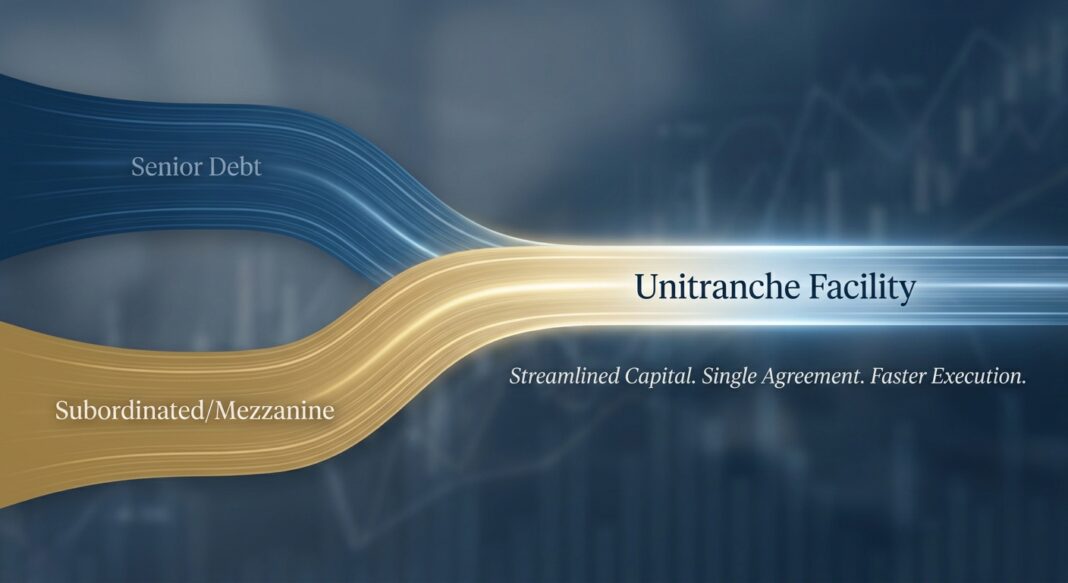
One Loan to Rule Them All
Imagine closing an acquisition in 45 days instead of 120. No senior lender in a standoff with a mezzanine provider. No inter-creditor agreement battles. No syndication risk that blows up your deal at the finish line. That is the core promise of unitranche debt — and it has become the dominant financing structure for middle-market acquisitions in 2026.
For business owners evaluating how to finance a buyout, recapitalization, or growth initiative — and for investors trying to understand where private credit actually sits in the capital structure — unitranche is a concept that demands a clear-eyed explanation. It is not just a product. It is a structural innovation that fundamentally changed how private credit competes with banks, and why private credit won.
According to CT Acquisitions (July 2026), roughly 80% of lower-middle-market leveraged buyouts closed in 2025 used a private credit unitranche rather than a syndicated bank loan. Understanding how that structure works — and what it costs — is no longer optional knowledge for anyone operating in the capital markets.
What Is a Unitranche Loan?
Unitranche debt is a hybrid loan structure that merges senior and subordinated debt into a single, consolidated credit facility. Instead of a borrower negotiating separately with a senior bank lender and a mezzanine provider — each with their own credit agreements, covenants, and intercreditor arrangements — the borrower signs one loan document, with one set of terms, at one blended interest rate.
As Mayer Brown (July 2026) explains, a unitranche structure involves a single secured credit facility in which two or more groups of lenders share the same security interest on the borrower’s collateral, but agree among themselves — privately — to a payment priority. The borrower sees one loan. Behind the scenes, the lenders split into a first-out position (lower risk, lower return) and a last-out position (higher risk, higher return).
This internal split, governed by an Agreement Among Lenders (AAL), is a document the borrower typically never sees. Regions Bank notes that the AAL governs repayment priority and creditor rights, while the borrower simply benefits from a single credit agreement with streamlined terms. The blended interest rate reflects a balance between senior debt’s lower cost and subordinated debt’s higher yield requirement.
How It Works: A Concrete Example
Consider a private equity firm acquiring a manufacturing business for $50 million — financed with $30 million in unitranche debt and $20 million in equity.
In a traditional two-tranche structure, that $30 million would be split into approximately $20 million of senior bank debt at, say, 7.5% and $10 million of mezzanine debt at 13–15%. The borrower would manage two lenders, two sets of covenants, and an intercreditor agreement that defines who gets paid first in a restructuring — a document that alone can take weeks to negotiate.
In a unitranche structure, a single private credit manager provides the full $30 million at a blended rate — currently ranging from approximately 9.00% to 9.75% all-in yield, according to Valuation Research Corporation (July 2026). The borrower pays one rate, negotiates one covenant package, and closes significantly faster.
Internally, the lender may split the $30 million between a $10 million first-out revolver priced tighter (reflecting lower risk) and a $20 million last-out term loan priced wider to compensate for absorbing losses first. That internal economics arrangement never surfaces in the borrower’s documentation. The net result: the operator gets speed and simplicity; the lender earns a blended yield that compensates for holding both layers of risk.
Private Credit Hub (September 2026) notes that this single-lender approach can also reduce legal and administrative expenses, partially offsetting the all-in rate premium over a pure senior bank facility. For time-sensitive M&A transactions, that speed premium is frequently worth the economics.
Current Market Relevance
Unitranche is not a niche instrument — it is the workhorse of private credit in 2026. The data makes this clear:
| Metric | Data Point | Source |
|---|---|---|
| Unitranche all-in yield (Q2 2026) | ~9.00%–9.75% | VRC, July 2026 |
| Unitranche coupon spreads over SOFR | 4.75%–5.50% | VRC, July 2026 |
| LBO share using unitranche (lower MM, 2025) | ~80% | CT Acquisitions / S&P GMI, July 2026 |
| Global private credit AUM (start of 2026) | ~$1.7 trillion | Preqin 2026 Global Alternatives Report |
| Typical gross private credit spreads (2026) | 4%–5% (down ~100 bps from 2025) | Credit Benchmark, Sept. 2026 |
The backdrop for these numbers matters. The Federal Reserve’s July 2026 SLOOS confirmed that bank lending standards for C&I loans were essentially unchanged in Q2 2026, following a period of tightening in Q1 2026 reported in the April 2026 SLOOS. Crucially, the April survey also documented tighter bank standards for non-depository financial institutions, with higher risk premiums, stricter covenants, and shorter maturities — conditions that push sponsor-backed borrowers toward private credit alternatives.
Meanwhile, Lord Abbett (June 2026) noted that spreads have widened by roughly 50 to 100 basis points since late 2025, with improved documentation and more selective capital deployment — a setup they describe as a “lender-friendly reset.” For investors deploying into unitranche today, entry conditions are more favorable than at any point in the last two years.
Northleaf Capital (May 2026) reinforces this, noting that direct lending continues to generate high single-digit unlevered asset returns — a meaningful premium over public credit markets on a risk-adjusted basis.
Decision Framework
For Investors Evaluating Unitranche Exposure
Investors assessing a private credit fund or BDC with significant unitranche exposure consider several structural factors beyond the headline yield:
- Blended yield vs. attachment point: Unitranche lenders earn a premium over pure first-lien positions, but they also absorb subordinated risk. Investors evaluate what percentage of enterprise value sits above their loan — the equity cushion — as the primary loss-absorption buffer.
- First-out vs. last-out composition: A fund holding predominantly last-out positions carries meaningfully higher risk than one concentrated in first-out. According to Credit Benchmark (2026), typical default risk across private credit fund holdings ranges from 4.5% to 6.5%, compared to less than 0.5% for BDC-level default risk — a gap that reflects portfolio composition and how losses are allocated within unitranche structures.
- Covenant quality: Unitranche agreements typically include maintenance covenants tied to leverage and interest coverage ratios. Tighter covenant packages — an emerging feature of the 2026 lender-friendly reset — provide earlier warning signals and restructuring leverage before a borrower deteriorates.
- Manager underwriting discipline: With demand for new loans exceeding available supply through Q2 2026, per Capstone Partners (Q2 2026), manager selectivity — not just market conditions — drives realized outcomes across unitranche portfolios.
For Operators and Business Owners
Business owners considering a unitranche facility weigh the following against traditional bank financing:
- Speed and certainty: Unitranche deals can close in 30–60 days versus 90–120+ days for syndicated or multi-lender structures. For time-sensitive acquisitions or competitive auction processes, this execution advantage is often decisive.
- Single relationship: One lender means one covenant negotiation, one amendment process, and one contact when business conditions shift. This simplicity has real operational value.
- Cost vs. a bank line: All-in unitranche yields of 9%–9.75% are higher than a traditional bank revolver, but the unitranche typically provides more leverage capacity and no syndication risk. Regions Bank notes unitranche is most commonly used by businesses with annual EBITDA below $50 million and sales under $500 million — the segment where bank appetite is most constrained.
- Flexibility in structure: Unitranche facilities can include delayed-draw term loans, revolving credit components, and PIK toggle options — features that pure senior bank debt rarely accommodates for mid-market borrowers.
Key Takeaways
- Unitranche is the dominant structure: Roughly 80% of lower-middle-market LBOs in 2025 used unitranche financing rather than a syndicated bank loan, per S&P Global Market Intelligence data cited by CT Acquisitions.
- One loan, two economic layers: Behind a single borrower credit agreement sits a first-out/last-out split between lenders — a structure the borrower never directly negotiates, but that materially affects how losses are absorbed in a stress scenario.
- Pricing has reset favorably for lenders: All-in unitranche yields of 9.00%–9.75% and wider spreads versus late 2025 reflect improved entry conditions for investors deploying new capital in 2026.
- Bank tightening is structural, not cyclical: Federal Reserve SLOOS data confirms that bank standards remain elevated and banks have tightened terms on loans to non-bank financial intermediaries — conditions that systematically redirect middle-market borrowers toward private credit.
- Speed and simplicity are real economic advantages: For operators, the unitranche premium over bank financing is partially offset by lower transaction costs, faster execution, and access to leverage levels that bank syndicates rarely provide to sub-$50M EBITDA businesses.


