
The Growth-Stage Financing Gap: Where Banks Stop and Dilution Begins
You have built a profitable, cash-flowing business. Revenue is climbing, EBITDA is compounding, and the opportunity in front of you — an acquisition, a new geography, a capacity build-out — requires capital that your existing cash flow cannot self-fund fast enough to matter. You go to your bank. They offer senior debt at 3–4x EBITDA. You do the math and come up roughly $15M–$30M short of what the strategy actually requires.
The reflex answer for many operators at this stage is to raise equity — a minority sale, a private equity recap, or a growth round. But equity at a pre-inflection valuation carries a permanent, compounding dilution cost that most owners only calculate after the fact. A growth equity investor taking 30% at today’s valuation owns 30% of everything you build from here.
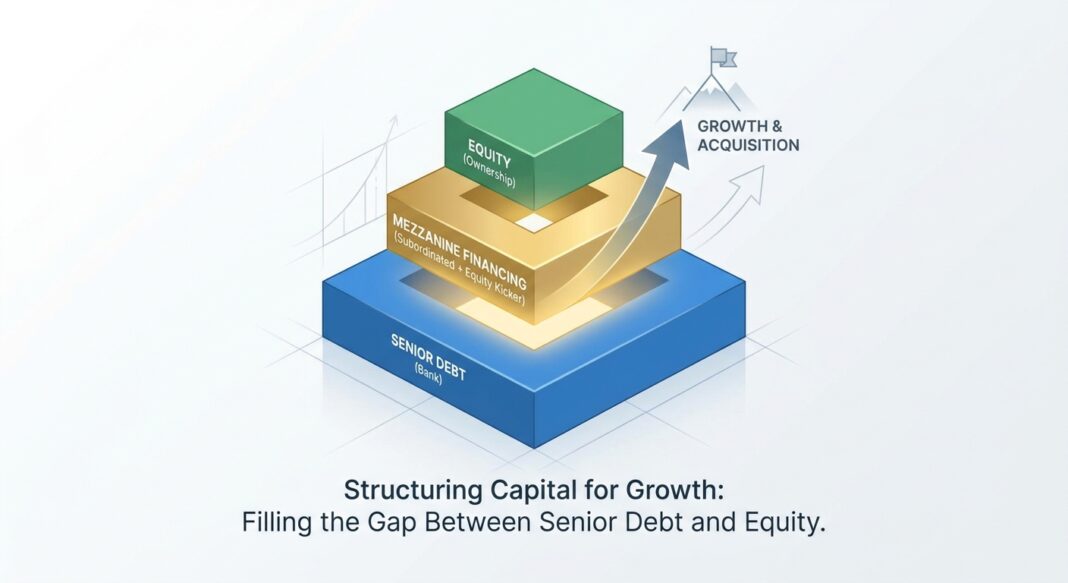
The structure that sits between those two endpoints — and that remains one of the most underutilized tools in the middle market — is mezzanine financing. Mezzanine is subordinated capital that fills the gap between what senior lenders will provide and what the strategy actually requires, without forcing ownership transfer. For growth-stage companies with $3M–$25M in EBITDA and a clearly articulated use of proceeds, it is often the most capital-efficient structure available. This article explains how it is built, what it costs in 2026, when it wins against alternatives, and how to run a process to secure the best available terms.
Anatomy of a Mezzanine Structure: Components, Mechanics, and Term Sheet Elements
Mezzanine financing is a hybrid instrument. It has three defining structural features that distinguish it from senior debt: its subordinated and unsecured position, its option for Payment-in-Kind (PIK) interest, and its equity kicker — almost always in the form of stock warrants. Understanding each component is the prerequisite to negotiating any of them effectively.
1. Subordination and Position in the Capital Stack
Mezzanine debt is a hybrid financing solution positioned between senior debt and equity, offering growth capital with flexible terms and equity kickers. In a liquidation waterfall, mezzanine lenders are paid after all senior creditors but before equity holders. This subordinated position — combined with typically minimal collateral — is the primary reason mezzanine prices at a meaningful premium to senior debt. The instrument can take the form of subordinated unsecured debt, second lien debt, or in some structures, preferred stock.
2. Interest: Cash-Pay and PIK
Mezzanine loans often include two types of interest payments, giving the borrower some flexibility in how they manage cash flow: current cash interest (a standard periodic payment) and Payment-in-Kind (PIK) interest, where the interest amount is added to the total loan balance rather than paid in cash. The PIK feature is critical for growth-stage borrowers deploying capital into operations rather than returning it to lenders. However, operators must model PIK carefully: when borrowers elect PIK interest, the outstanding balance compounds, increasing the total debt burden. If the anticipated liquidity event is delayed, the growing PIK balance creates a larger refinancing burden at bullet maturity.
3. The Equity Kicker: Warrants and Conversion Rights
In mezzanine financing, warrants act as an equity kicker, letting lenders share in the company’s upside value if it grows. A warrant is a right — not an obligation — to purchase equity at a fixed strike price, often at or near the company’s current implied valuation at the time of deal close. Every warrant granted to a mezzanine lender dilutes existing common equity. In a successful exit, the mezzanine lender’s equity kicker reduces the return available to the PE sponsor or management team — a cost that must be weighed against the benefit of reduced upfront equity contribution. Warrant coverage typically runs 2–5% of fully diluted equity for middle market deals.
Illustrative Term Sheet: $20M Mezzanine for a $60M EV Software Services Company
Consider a B2B software services company with $6M EBITDA and a $60M enterprise value. The operator is acquiring a bolt-on competitor for $18M. Senior bank debt maxes out at 3.5x ($21M). The equity gap is $18M minus what the balance sheet can absorb. A $15M–$20M mezzanine tranche fills the structure cleanly.
- Instrument: Subordinated note, unsecured, bullet maturity
- Size: $18M
- Maturity: 5 years (bullet)
- Cash-pay coupon: 9–11% per annum, paid quarterly
- PIK component: 2–3% per annum, accrued and capitalized to principal
- All-in cost (2026 market): 12–14% cash + PIK; 16–20% total IRR including warrant value
- Equity kicker: Warrants covering 3–4% of fully diluted equity, $0.01 strike or at current FMV
- Amortization: Minimal to none during the term; full bullet repayment at maturity
- Prepayment protection: Typically a call premium of 2–3% in year one, stepping down to par by year three
- Covenant package: Maintenance leverage covenant (net debt/EBITDA), tested quarterly, with 25–35% headroom cushion
Mezzanine vs. the Alternatives: When Each Layer Wins
Structuring the right capital layer is a cost-of-capital optimization problem. The decision tree runs from the cheapest source (bank senior debt) to the most expensive (equity), with mezzanine occupying the critical middle ground. Mezzanine is cheaper than equity and tax-deductible, and it wins when the deal’s unlevered return beats the mezzanine cost.
Mezzanine vs. Senior Bank Debt
Senior bank debt is the cheapest capital available — typically floating at SOFR + 200–400 bps with amortization requirements and personal guarantee triggers for non-sponsored companies. Its ceiling, however, is structurally limited. Banks underwrite to cash flow coverage and collateral value, topping out at 3–3.5x EBITDA for most middle market borrowers without a PE sponsor. For growth-stage operators requiring 5–6x total leverage to complete an acquisition or fund organic expansion, senior debt alone is insufficient. Mezzanine does not replace senior — it extends the total leverage quantum the business can access.
Mezzanine vs. Unitranche
Current middle-market unitranche spreads run approximately SOFR + 4.75% to SOFR + 5.50% for mid-sized deals, per Lincoln International’s Q1 2026 data. The unitranche collapses the senior and subordinated tranches into a single facility, offering speed and simplicity — a 45–90 day unitranche close versus 90–150 days for traditional senior plus mezzanine syndication. However, the blended rate in a unitranche is typically higher than a well-structured senior + mezz split when senior leverage is maximized first. Traditional mezzanine remains relevant in situations where the borrower wants to minimize total cost by maximizing cheap senior debt separately, and in deals where the sponsor or management team wants equity kickers to align lender incentives.
Mezzanine vs. Growth Equity
Growth-stage companies face a tough choice: raise cash for expansion or keep control. Mezzanine financing fits well here because it provides sizable funding without forcing owners to give up significant equity. Unlike equity investors who may demand board seats and governance rights, mezzanine lenders typically do not take board representation or voting rights, allowing business owners to maintain control over strategic decisions. The trade-off is structured repayment obligation and fixed charges; equity is permanent capital with no maturity wall. The right choice depends on whether the operator’s projected returns exceed the all-in cost of mezz — if the acquisition target will generate an incremental return above 14–18%, mezzanine creates equity value that an equity round would have shared away.
When Mezzanine Is the Wrong Tool
Mezzanine financing is less appropriate for companies with volatile or seasonal cash flows, businesses in early stages without consistent profitability, or situations where the higher cost of debt would create meaningful financial stress. Lenders will require demonstrated EBITDA — most providers set a floor of $3M–$5M — and a clear path to servicing fixed charges without impairing operations.
Current Market Terms: What the 2026 Mezzanine Market Looks Like
The private credit market has reached a pivotal stage in its growth, with direct lending now matching the broadly syndicated loan market at $1.5–2 trillion in size and forecast to reach $3 trillion by 2028. Within that market, mezzanine occupies a specialized but active tier. Here are the key structural benchmarks for 2026:
Pricing
Total all-in cost for middle market mezzanine runs 12–15% for cash + PIK combined, with lender IRR of 16–22% inclusive of warrant value. In 2025–2026, mezzanine funds have seen renewed interest as investors seek strategies with built-in cash yields in a higher-rate environment. J.P. Morgan data as of February 2026 puts annualized mezzanine returns at 11.4%, compared to 9.0% for direct senior lending and 5.5% for leveraged loans — confirming the yield premium that makes mezzanine attractive to providers and expensive to borrowers.
Leverage Quantum
The mezzanine lender provides total leverage that can reach 5–6x EBITDA in a single facility, compared to 3–4x that a senior-only lender would typically provide. The incremental leverage — the portion funded by mezz — is the component priced at subordinated risk levels.
Covenant Structures
Covenant negotiation is a significant area of differentiation. A typical leverage covenant in a direct lending transaction may be set with a 25–35% cushion to the EBITDA projected in a sponsor or borrower model prepared and delivered to the lender prior to closing. The broader market has seen a meaningful shift toward looser covenant packages: in the upper middle market, around 30% of recent deals are now covenant-lite, up from just 5% a decade ago, and leverage-linked maintenance tests often come with cushions that allow earnings to fall 30–40% before triggering a breach. For middle market mezzanine specifically, maintenance covenants remain the standard — but cushion size and EBITDA definition negotiation are live deal points.
Warrant Coverage
Warrant coverage in the 2–5% range remains market-standard for non-sponsored middle market deals. For sponsor-backed transactions, equity kickers are often replaced by higher cash coupons and exit fees, as sponsors are reluctant to grant warrants that dilute the equity waterfall. The all-in IRR target for mezzanine providers — regardless of the cash vs. warrant split — runs 15–22% for the lower middle market.
Amortization and Maturity
Unitranche and mezzanine facilities typically feature minimal amortization during the loan term, with principal repayment concentrated at maturity. This bullet repayment structure aligns with private equity hold periods and exit strategies. Five-year terms are the current norm for lower middle market mezzanine, with prepayment premiums of 2–3% in year one stepping to par by year three or four.
The Gap Capital Playbook: Quantifying, Preparing, and Running the Mezzanine Process
For most operators, mezzanine is not a product they have accessed before. The process is distinct from a bank credit facility and requires deliberate preparation. The following is a stage-by-stage framework.
Step 1: Quantify the Gap with Precision
Before approaching any lender, build a detailed sources and uses table that maps the total capital requirement for the specific use of proceeds — acquisition price, transaction costs, working capital buffer, integration costs — against available sources: cash on hand, senior debt capacity (at realistic leverage multiples), and seller notes if applicable. The residual is the mezzanine need. Operators who present a sloppy capital need will receive expensive terms; those who arrive with a precise, modeled gap command better pricing and structure.
Step 2: Prepare Lender Materials
Mezzanine lenders underwrite to free cash flow coverage, not asset value. The materials that move a process forward are: three years of audited or reviewed financials, trailing twelve months management accounts, a detailed EBITDA reconciliation with add-back support, a 36-month integrated financial model (P&L, balance sheet, cash flow), and a clear narrative on the acquisition or growth thesis. A capital advisory firm helps you prepare your financial story in the way mezzanine lenders evaluate it, identify the right lenders for your industry and situation, structure the transaction to minimize equity dilution, and negotiate terms that protect your long-term interests.
Step 3: Run a Competitive Process
The mezzanine market is populated by BDCs (Ares, Blue Owl, Prospect Capital), specialty mezz funds (Audax Mezzanine, NewSpring Capital, Crescent Capital), and direct lending platforms with subordinated debt mandates. Running three to five parallel processes is standard and materially influences pricing. Lenders who know they are competing tighten spreads, reduce warrant coverage, and increase cushion thresholds. Operators who approach a single provider on an exclusive basis consistently leave 100–200 basis points and 1–2% of warrant coverage on the table. Evaluating a fund’s flexibility in customizing terms around PIK interest, warrants, and covenants is important, as this flexibility can determine how well the financing aligns with your business requirements.
Step 4: Model the True Cost of Capital
The stated coupon is not the cost of mezzanine. The true cost must aggregate cash-pay coupon, PIK accrual, warrant dilution at modeled exit multiples, exit fees, and prepayment premiums. Principal funded, cash interest received, principal repaid, exit fees, prepayment premiums, and equity-kicker value all appear on the same timeline; from those cash flows, MOIC and IRR are calculated directly. Model three exit scenarios — base, upside, and stress — and evaluate the mezzanine structure against dilutive equity in each. The answer is not always mezzanine.
Negotiation Guidance: Where to Push and Where to Yield
Mezzanine term sheets are highly negotiated documents. Key terms include maturity, interest rates with payment-in-kind options, ranking, collateral, and covenants, with a central focus on equity participation or the equity kicker, such as warrants or co-investment rights, used to enhance investor returns. The following are the highest-leverage negotiation points for borrowers:
- Warrant coverage percentage: This is the most economically significant variable for dilution-sensitive operators. Push for 2–3% rather than 5%; the lender’s IRR should be achievable on coupon alone if the business profile is strong.
- Cash vs. PIK split: Borrowers with strong free cash flow should push to convert more PIK to cash-pay in exchange for lower total coupon — reducing the compounding burden and final bullet. Conversely, early-stage growth investments benefit from maximizing PIK in early years while returns ramp.
- EBITDA definition and add-backs: The covenant is only as protective as the EBITDA it tests. Negotiate the broadest permissible add-back basket consistent with your actual run-rate economics. Adjustments for one-time costs, management fees, and equity compensation are standard.
- Covenant cushion and cure rights: A 25–30% cushion to projected EBITDA is market-standard. Push for equity cure rights as a safety valve — the right to inject equity to cure a covenant breach before the lender can accelerate. Note that many current credit agreements limit cures to two per rolling four quarters.
- PIK toggle mechanics: For deals with near-term uncertainty, negotiate a PIK toggle — the right to elect PIK interest for defined periods rather than being locked into cash-pay — in exchange for a modest step-up spread during PIK periods. In the toggle context, include notice timing, conditions precedent to cash-pay resumption, and any step-up margin for PIK periods.
- Prepayment premiums: Mezzanine providers build expected hold periods into their return models. A 2% call premium in year one, 1% in year two, par thereafter is negotiable for strong credits. Avoid make-whole provisions that lock in three to five years of interest regardless of repayment date.
For investors evaluating a company’s capital structure, mezzanine in the stack signals a management team that understood cost of capital tradeoffs and chose to preserve ownership — a constructive signal when the use of proceeds is offensive (acquisition, expansion) rather than defensive (liquidity, balance sheet repair). Scrutinize the warrant coverage, PIK balance trajectory, and covenant headroom to assess how much stress the structure can absorb before fixed charges become a governance issue.
Key Takeaways
- Mezzanine fills a structural gap banks cannot. Senior debt tops out at 3–4x EBITDA for most middle market borrowers. Mezzanine extends total leverage to 5–7x, enabling transactions that would otherwise require full equity financing or simply not happen at all.
- The true cost is not the coupon. All-in mezzanine IRR in 2026 runs 16–22% inclusive of warrant value. Operators must model the warrant dilution impact at multiple exit scenarios to make an apples-to-apples comparison against growth equity alternatives.
- PIK compounds — model it accordingly. PIK interest is not a deferral; it is compounding leverage. A five-year PIK balance at 2–3% per annum on a $20M note adds approximately $2–3M to the bullet repayment. Model this explicitly and ensure the business will have the liquidity or refinancing path to address it at maturity.
- Competitive process is the single most powerful cost-reduction lever. Running three to five simultaneous lender processes consistently compresses spreads by 100–200 basis points and reduces warrant coverage by 1–2%. Operators who approach the market unilaterally overpay.
- Covenant structure is the risk management layer — negotiate it precisely. A maintenance covenant with a 30% cushion is a functional safety valve. A cov-lite structure offers short-term flexibility but removes the early-warning mechanism that allows constructive restructuring before a crisis. For operators who want lender alignment, a tightly defined but well-cushioned maintenance covenant is the smarter long-term choice.


