
Why One Loan Can Hide Two Very Different Risk Profiles
Walk into a middle-market leveraged buyout today and the odds are strong that a single instrument is financing the deal: the unitranche loan. According to CT Acquisitions (July 2026), roughly 80% of lower-middle-market leveraged buyouts closed in 2025 used a private credit unitranche rather than a syndicated bank loan. Yet for all its dominance in deal flow, the unitranche remains one of the most misunderstood structures in private credit — misunderstood by borrowers who think simplicity means safety, and by investors who assume a single coupon means a single risk.
This article unpacks what a unitranche actually is, how the First-Out/Last-Out (FOLO) mechanism works beneath the surface, what the current pricing environment looks like, and what both operators seeking capital and investors evaluating private credit funds need to ask before signing on to one.
What Is a Unitranche Loan?
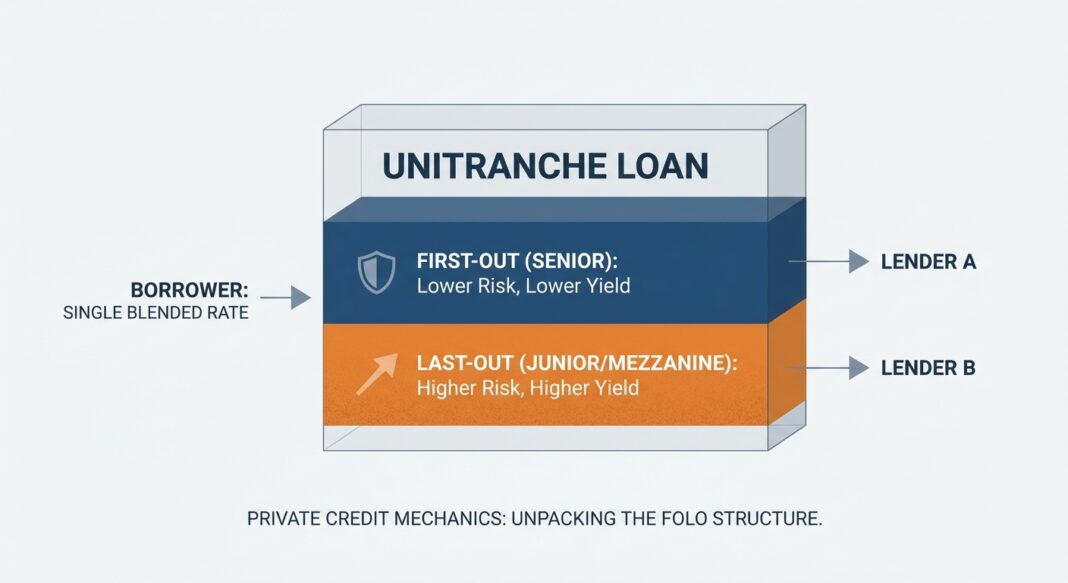
A unitranche is a single secured credit facility that collapses what would traditionally be two separate debt layers — a senior term loan and a junior or mezzanine loan — into one instrument, with one credit agreement, one agent, one collateral package, and one blended interest rate paid by the borrower.
As Mayer Brown (August 2026) explains, the structure involves a single secured credit facility in which two or more groups of lenders share the same security interest on the borrower’s collateral, but agree among themselves on payment priority and other arrangements. That borrower-facing simplicity is what makes it attractive. One closing process, one documentation set, one payment schedule.
But simplicity on the surface does not mean simplicity underneath. As Stirling Capital Group (July 2026) notes, the unitranche rate is a weighted average that falls between the lower senior debt rate and the higher subordinated rate — and critically, a unitranche is not cheaper than traditional bank debt. The blended rate is higher than a pure senior loan. The borrower pays a spread premium for the speed, flexibility, and certainty of execution that a bank syndicate typically cannot match.
The Hidden Architecture: First-Out / Last-Out
Here is what most borrowers — and many investors — never fully examine. Behind the single blended rate the borrower sees, the lenders themselves may be operating in entirely different risk-and-return positions. This is the FOLO structure, governed by a private contract called an Agreement Among Lenders (AAL).
According to Deal Academy (July 2026), the first-out lender takes a lower yield and ranks ahead in the payment and recovery waterfall, while the last-out lender takes a higher yield and stands behind, absorbing the first loss if the credit fails. The borrower may owe a single blended rate, even though the lenders allocate interest and recovery proceeds very differently among themselves.
The AAL — a document the borrower is typically not a party to — governs payment waterfalls, enforcement control, voting rights, and what happens in a workout or default scenario. As Mayer Brown (August 2026) notes, the structure is intended to provide the first-out lender with reduced risk and return, and the last-out lender with increased risk and return, while giving the borrower a single, streamlined credit facility.
Think of it this way: the borrower experiences one loan. But inside that loan, Lender A is holding a position economically similar to a senior bank loan, while Lender B is holding a position economically similar to mezzanine debt — with all the subordination risk that entails.
A Concrete Example: The Numbers Behind the Structure
Consider a hypothetical middle-market acquisition. The target company generates $20 million in annual EBITDA. The buyer needs $100 million in debt financing. Rather than stacking a $60 million senior term loan at SOFR + 300 bps on top of a $40 million mezzanine tranche at 13%, the sponsor closes a single $100 million unitranche at a blended rate of approximately SOFR + 525 bps.
Behind the scenes, the lenders divide the facility via an AAL:
- First-Out Tranche: $60 million — priced at approximately SOFR + 350 bps. This lender is paid first from cash flows and first from collateral in a liquidation.
- Last-Out Tranche: $40 million — priced at approximately SOFR + 775 bps. This lender absorbs first loss, compensated by a materially higher yield.
- Blended rate to the borrower: ~SOFR + 525 bps — one payment, one document, one relationship.
The borrower closes faster and deals with one agent rather than two competing lender groups. The first-out lender gets senior-like protection. The last-out lender gets mezzanine-like returns. The economics are divided; the documentation is unified. This is not a discount structure — it is a convenience structure that prices the time-and-certainty premium into the blended coupon.
Current Market Reality: Pricing, Volume, and the Lender-Friendly Shift
The unitranche market has experienced meaningful spread compression since its post-2022 peaks, though conditions have recently begun shifting back in lenders’ favor.
| Metric | Current Data | Source |
|---|---|---|
| New-issue unitranche spreads (Q1 2026) | ~SOFR + 525 bps (avg.) | CT Acquisitions / PitchBook LCD, July 2026 |
| Unitranche all-in yield range (Q2 2026) | ~9.00% – 9.75% | Valuation Research Corp., Q2 2026 |
| Spread widening since late 2025 | ~50–100 bps wider | Lord Abbett / PitchBook, June 2026 |
| Peak unitranche all-in yield (mid-2023) | ~11.5% – 12.5% | Valuation Research Corp., Q2 2026 |
| CDLI 20-year avg. annual return | 9.5% (one negative year in 20) | Cliffwater / Yahoo Finance, March 2026 |
| Proskauer private credit default rate (Q2 2026) | 2.51% across 716 loans / $195.6B | Investing.com / Proskauer Index, August 2026 |
According to Lord Abbett (June 2026), the market has reset in a more lender-friendly direction in 2026, with new loans increasingly coming with better credit structures: less leverage, more covenants, fewer payment-in-kind (PIK) requests, and tighter documentation. This matters significantly for unitranche structures, where the last-out tranche’s protection depends heavily on covenant discipline.
The Federal Reserve’s July 2026 SLOOS reported basically unchanged standards for C&I loans, but the April 2026 survey noted that banks reported tighter standards for nonbank financial institution (NDFI) loans over the prior year — including stricter loan covenants and higher premiums on riskier loans. This selective tightening reinforces why borrowers continue migrating to private credit unitranche structures rather than bank-syndicated markets.
Decision Framework
For Investors Evaluating Private Credit Funds
Not all unitranche exposure is equal. Investors considering private credit funds backed by unitranche portfolios should evaluate:
- First-Out vs. Last-Out concentration: A fund holding predominantly last-out positions carries materially different risk than one holding first-out positions, even if both quote “senior secured” in marketing materials. As Alternative Fortune (July 2026) notes, the critical questions are how much of the underlying book is last-out, and at what spread new loans are being written now.
- Covenant quality: A unitranche without financial maintenance covenants (a “covenant-lite” structure) removes early warning signals. In a FOLO structure, the last-out lender’s enforcement rights under the AAL may be constrained even after a covenant breach. Investors should ask specifically about maintenance covenant coverage.
- Blended yield vs. underlying tranche yield: Quoted fund yields typically reflect the blended coupon. The last-out tranche may price at SOFR + 850 bps or more — indicating real subordination risk embedded within that attractive headline number.
- Spread trajectory: Valuation Research (Q2 2026) notes unitranche coupon spreads generally ranging from 4.75% to 5.50%, nearly 25 basis points above year-end 2025 levels — a modestly improved entry point for new investors relative to prior quarters.
For Operators and Business Owners Seeking Capital
The unitranche can be an excellent financing tool for the right situation. Operators typically consider it when:
- Speed matters: A unitranche can close in four to six weeks versus 10 to 14 weeks for a syndicated bank process. For acquisition financing with tight timelines, this is a structural advantage.
- Certainty of execution is critical: Unlike syndicated deals, unitranche commitments are held by a small group of lenders who won’t re-trade pricing. No syndication risk.
- Higher leverage is needed: A typical direct lending transaction, per Investing.com (August 2026), carries maximum leverage covenants around 4x EBITDA and minimum interest coverage near 2.5x — structures bank syndicates may resist for middle-market companies.
- Legal counsel should review the AAL: Even though the borrower is not a party to the AAL, its terms — particularly enforcement control provisions — can significantly affect how a workout unfolds. Operators should understand which lender group controls remedy enforcement before signing.
Key Takeaways
- One loan, two risk profiles: The borrower sees a single blended rate and one credit agreement. Behind it, lenders may be divided into first-out (lower risk, lower return) and last-out (higher risk, higher return) positions via an Agreement Among Lenders (AAL) — a private document the borrower typically never sees.
- Unitranche is a convenience premium, not a discount: Borrowers pay a spread above pure senior bank debt for speed, certainty, and simplicity. Investors earn a blended yield that prices in both senior and subordinated risk within one coupon.
- 2026 is a lender-friendly reset: Spreads have widened 50–100 bps since late 2025, leverage requirements have tightened, and covenant quality has improved — making new unitranche originations structurally more protective than loans written during the 2023–2024 spread-compression cycle.
- Default metrics diverge by methodology: Proskauer’s Q2 2026 index reported a 2.51% default rate across $195.6 billion in senior secured and unitranche loans. Fitch’s broader definition reached 6.0% in April. Investors should ask which methodology a fund uses before comparing performance claims.
- The AAL is the real document: Investors evaluating unitranche-heavy funds and operators closing unitranche deals should both insist on understanding AAL mechanics — specifically enforcement control, payment waterfalls, and last-out amendment rights — before the deal closes, not after a covenant breach forces the issue.


