
Bond Capital | Market & Sector Intelligence | September 5, 2026
Private Credit’s Lender-Friendly Reset: Spreads Widen, Sectors Bifurcate, and Underwriting Discipline Returns
A confluence of geopolitical shocks, AI-driven sector disruption, and BDC redemption pressure has triggered the most consequential repricing in private credit since 2020 — creating asymmetric opportunity for disciplined lenders and meaningful risk for over-levered borrowers.
I. Market Headline: The Lender-Friendly Reset Is Here
Private credit has entered what analysts at Lord Abbett are calling a “lender-friendly reset” — a meaningful shift in market dynamics driven by three converging forces: (1) a U.S.-Iran military conflict that rattled global macro confidence in Q1 2026, (2) an accelerating AI-driven reassessment of software sector credit quality, and (3) a wave of BDC redemption requests that exposed structural vulnerability in retail-oriented private credit vehicles.
The cumulative effect has been a decisive repricing. Spreads in private credit are back in the S+500 context — up from the mid-400 bps level seen in late 2025 — as documented by Hamilton Lane. The broadly syndicated loan (BSL) market has repriced in parallel, while the lower middle market — long overlooked by the flood of institutional capital — was never fully penetrated by the compression cycle and now offers an even wider premium.
Critically, this is not a systemic credit crisis. The Federal Reserve’s July 2026 SLOOS confirmed that bank lending standards for C&I loans were broadly unchanged in Q2, with standards for large and middle-market firms currently easier than the historical midpoint of the range since 2005. The stress is concentrated, structural, and sector-specific — making this an environment that rewards manager discipline and penalizes undifferentiated exposure.
For borrowers with strong fixed charge coverage ratios (FCCR), clean balance sheets, and non-software business models, capital remains available and competitive. For operators sitting inside older vintage capital structures with elevated leverage and AI-exposed revenue streams, the market is resetting terms — and the maturity wall clock is ticking.
II. Quantitative Market Snapshot
The following data box synthesizes the most current available market metrics as of the publication date. All figures carry source attribution and should be interpreted in the context of continued price discovery across private and public credit markets.
| Metric | Current Value | Prior Period | Change | Source |
|---|---|---|---|---|
| Overnight SOFR Rate | 3.66% | 3.68% (3-mo Term SOFR, June 2026) | −2 bps | NY Fed / SOFRrate.com, Sep 3, 2026 |
| 5-Year U.S. Treasury Yield | ~4.23% | 3.92% (March 2026) | +31 bps | Valuation Research Corp., Q2 2026 |
| Middle Market Private Credit Spreads | S+500 bps (context) | S+mid-400 bps (late 2025) | +50–100 bps | Hamilton Lane / PitchBook, 2026 |
| B-Minus (Lower-Rated) Loan Spreads | S+409 bps | S+354 bps (Q1 2026) | +55 bps | Sikich / PitchBook LCD, Q2 2026 |
| Software Sector Secondary Spreads (vs. B-Rated Index) | ~+229 bps premium | At index (year-end 2025) | +245 bps vs. year-end | PitchBook LCD / VRC, June 19, 2026 |
| Direct Lending Origination Volume (Q2 2026) | $33.6B | $74.7B (Q1 2026) | −55% | PitchBook / LCD via Angel Investors Network, Q2 2026 |
| Direct Lending Deal Count (Q2 2026) | 154 transactions | 217 (Q1 2026) | −29% QoQ; lowest since Q2 2023 | PitchBook / LCD via Angel Investors Network, Q2 2026 |
| BDC Non-Accrual Rate (Median, Top 20 BDCs) | 2.8% (Q2 2026) | 1.3–1.4% (year-end 2023) | +0.8 ppts QoQ; highest since 2017 | Solve / Financial Times via Angel Investors Network, Q2 2026 |
| Private Credit vs. High Yield Spread Premium | ~150–200 bps | ~350 bps (2019) | Compressed ~150–200 bps vs. 2019 | Owners.pe, April 2026 |
| LBO Share of Direct Lending Volume (Q1 2026) | 40.3% | 36.2% (Q4 2025) | +4.1 ppts QoQ | Valuation Research Corp. / PitchBook, Q2 2026 |
Rate Environment & KPI Context
With overnight SOFR at 3.66% as of September 3, 2026 and the 5-year Treasury at approximately 4.23%, the all-in yield environment for middle market borrowers carrying S+500 bps paper now exceeds 8.5% — a materially different cost-of-capital backdrop than the 2021–2022 vintage originations that now compose the stress concentration in today’s BDC portfolios.
From a KPI perspective, borrower interest coverage ratios (EBITDA/interest expense) have shown modest improvement year-over-year due to some EBITDA growth and slightly lower reference rates, according to Heron Finance’s Q2 2026 benchmark report covering 69 established private credit funds. Critically, loan-to-value (LTV) ratios have remained stable across segments, suggesting lenders have not materially loosened underwriting standards over the past three years — a meaningful buffer against further deterioration. However, the share of loans performing below fund managers’ expectations increased in Q1 2026, and non-accrual debt across the broader BDC universe rose to 1.9% of total debt at cost in Q1, up 52 basis points from the prior quarter, per PitchBook LCD data.
Moody’s estimates the 2025 private credit default rate in the range of 1.6%–4.7%, with PIK income as a share of investment income continuing to rise. As of March 2026, average probability-of-default-implied risk for public BDCs exceeded that of Baa-rated public corporates by the widest margin since post-pandemic normalization. Markets have significantly reduced expectations for Fed rate cuts in 2026, reinforcing a higher-for-longer environment that disproportionately burdens floating-rate borrowers — the dominant structure in private credit portfolios.
III. Sector Analysis: Capital Rotation in Real Time
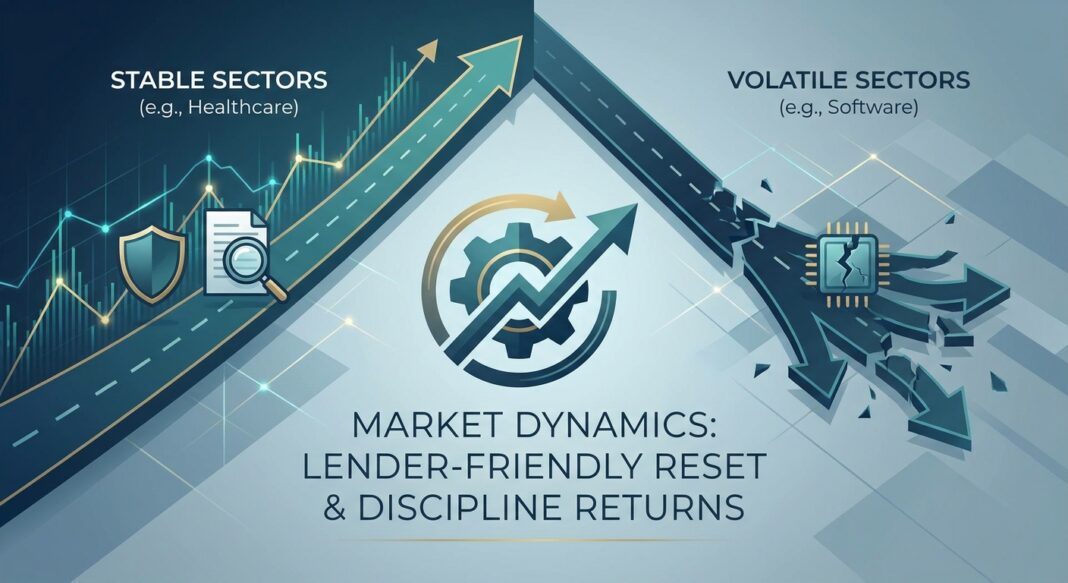
🔴 Software & Technology — Structural Repricing, Not Cyclical Dislocation
The most consequential sector story of 2026 is the structural repricing of software credit. Per PitchBook LCD data as of June 19, 2026, secondary spreads for software credits are approximately 245 basis points wider than year-end levels and roughly 229 basis points above the broader B-rated loan index — a dramatic divergence that reflects market concern about AI-driven disruption to recurring revenue models. Software’s share of broadly syndicated loan issuance fell to just 8.8% year-to-date through Q2, down from 17.6% in 2025 and its lowest level since 2013.
Octus data identified information technology as the sector driving the most significant non-accrual deterioration in Q1 2026, with total BDC non-accrual debt jumping 40% sequentially from $7.12 billion in Q4 2025 to $9.98 billion. Lender appetite for new software originations remains cautious: many managers are already overexposed and limiting incremental additions. The critical underwriting distinction, per Lord Abbett’s midyear analysis, is between profitable, cash-generative software businesses and pre-profitability ARR borrowers whose products face direct AI substitution risk — a distinction now embedded in pricing.
🟢 Healthcare — The New Anchor Sector
Healthcare has become the defining reallocation story in U.S. leveraged credit. Healthcare captured a record 12.4% of institutional loan issuance in Q2 2026, making it the largest sector for institutional loans for the first time since 2015 — directly displacing software. According to Octus data, healthcare led all private credit in 2025 with 19% of direct lending deals, and was the only sector that did not see meaningful year-over-year spread tightening, with spreads holding at approximately SOFR+500 bps in Q4 2025 — offering a durable yield floor. Demographic tailwinds, non-cyclical service models, and predictable cash flows continue to underpin strong lender appetite. The key watchpoint, per Morgan Stanley Investment Management, is that healthcare has also led all sectors in loans placed on non-accrual status over the past year — suggesting selectivity within the sector remains essential.
🟡 Industrials & Energy-Intensive Sectors — Geopolitical Risk Premium
The U.S.-Iran military conflict introduced a new risk variable for energy-intensive industrials. Capstone Partners’ Q1 2026 Middle Market Leveraged Finance Report documented that lenders have responded by tightening underwriting standards specifically for energy-intensive industries and businesses whose leverage assumptions were predicated on stable energy costs. Volatility in oil and oil-based products has increased upside risks to the inflation outlook and complicated the Federal Reserve’s policy path. Lenders active in manufacturing, logistics, and distribution are now applying AI risk evaluation as a standard analytical component of new underwriting, in addition to traditional energy cost sensitivity analysis.
🟢 Lower Middle Market — The Compression Gap Opportunity
The most underreported structural opportunity in today’s market exists at the lower end of the middle market (companies with $5M–$25M EBITDA). According to Avante Capital Partners, the spread premium of lower middle market credits over large-cap had already widened to 232 basis points before the current repricing cycle — a divergence driven by the concentration of institutional capital deployment at the top of the market. For allocators focused on this segment, wider spreads, real covenants, and building deal flow from boomer-generation business succession represent a structurally favorable setup that has been amplified, not diminished, by 2026’s volatility.
IV. Implications for Institutional Investors and Business Operators
For Institutional Investors & Lenders
The current environment structurally favors managers who combine patience with selectivity. Lord Abbett’s midyear analysis is direct: wider spreads and improving documentation are constructive, but durable advantage will come from more conservative leverage, stronger covenant packages, and stress testing before capital is deployed. With origination volume falling to $33.6 billion in Q2 — roughly 55% below Q1 — while fundraising continues, GPs with dry powder face a genuine decision point: defend discipline and accept lower deployment velocity, or chase yield and accept deteriorating credit quality. The Q2 data suggests most chose the former. That may not last if the deployment gap widens further into year-end.
For allocators evaluating manager selection, non-accruals, PIK usage, sector concentration, and 2021–2022 vintage exposure are the four most critical portfolio differentiation signals in the second half of 2026. The compression of the private credit premium over public high yield — from approximately 350 bps in 2019 to ~150–200 bps today — also requires revisiting the illiquidity premium calculus for semi-liquid structures, particularly given the redemption dynamics that have constrained certain vehicle operators.
For Business Operators & Borrowers
Operators in higher-quality sectors with strong FCCRs, stable or growing EBITDA, and defensible competitive positions will continue to find capital available and — in the upper middle market — still competitive. Sponsors that have used the slower deal environment to strengthen financial reporting, improve operating performance, and present credible long-term growth strategies continue to find capital available.
However, operators with elevated leverage ratios, PIK interest in the capital stack, or meaningful software-sector revenue exposure should assume underwriting standards will remain tighter and pricing will reflect a risk premium through at least Q1 2027. The rescission of the 2013 Interagency Guidance on Leveraged Lending — documented by Chambers and Partners’ 2026 Private Credit Guide — gives banks and private lenders greater flexibility to define their own leveraged lending thresholds, potentially broadening the range of structures available to operators, but also removing a floor on how aggressively leverage can be extended to riskier credits.
Critically, for middle market businesses facing upcoming refinancings: just 15% of BDC-held debt investments are due in 2026–2027 — down from 27% as of Q2 2024 — reflecting meaningful progress in addressing the maturity wall. But all-in yields above 8.5% for new originations represent a step-change in interest burden for companies refinancing 2021-era paper at SOFR+400 bps. FCCRs must be stress-tested against this scenario explicitly.
V. Forward-Looking View: H2 2026 and Into 2027
The second half of 2026 is likely to be defined by dispersion — between managers, between sectors, and between vintages. Four dynamics will determine the trajectory:
- Redemption trajectory at non-traded BDCs: Per BofA’s framework cited by Trading Market Signals, requests are expected to remain elevated through Q3, then potentially decline in Q4 as the proration reflex exhausts itself. If Q3 requests exceed Q2 levels, the narrative shifts from mechanical to convictional — a significantly more bearish signal for the structure of semi-liquid private credit vehicles.
- Fed rate path: Markets have sharply reduced rate-cut expectations for 2026, per Moody’s, with Moody’s baseline GDP forecast at ~1.5% — just above the historical stall-speed below which defaults accelerate. Any further deterioration in growth would compress ICR across leveraged credit simultaneously.
- European private credit acceleration: As With Intelligence reports, Basel IV implementation in Europe is expected to drive a major shift away from bank lending — currently ~70% of total European lending — toward private debt funds. Apollo and Ares have both cited substantial origination opportunity on the continent. This represents a medium-term structural tailwind for global private credit AUM growth, even as U.S. deployment slows.
- M&A recovery as the unlock valve: North American sponsor-backed M&A volumes are 52.3% below January 2026 levels as of June, but corporate M&A transaction value has risen 71% year-to-date to $1.53 trillion in the Americas, per LSEG. A broadening of private equity exit activity — which requires public market stability and tighter credit spreads — remains the single most important catalyst for direct lending volume recovery into 2027.
VI. Key Market Insights — Bond Capital Takeaways
- Spreads have reset, not collapsed: Middle market private credit spreads are back at S+500 bps — up 50–100 bps since late 2025 — representing a genuine lender-friendly repricing that rewards disciplined managers with dry powder and punishes those constrained by redemption queues.
- Non-accruals demand attention, not panic: The median BDC non-accrual rate hit 2.8% in Q2 2026 — its highest level since 2017 — driven by IT and software concentration in 2021–2022 vintages. This is a manageable number in isolation but represents a doubling from 2023 baselines, and the direction and velocity of change are the operative risk signals.
- Healthcare has structurally displaced software as the anchor sector: Healthcare captured a record 12.4% of institutional loan issuance in Q2 at spreads of ~SOFR+500 bps — making it the yield-plus-quality sweet spot for direct lenders. Non-accrual exposure within the sector requires sub-sector selectivity; not all healthcare credits are equivalent.
- The lower middle market premium is real and growing: With a 232 bps spread premium over large-cap and structural covenant protection, the $5M–$25M EBITDA segment offers the clearest risk-adjusted value proposition in the current environment — particularly for lenders who can accept lower liquidity in exchange for genuine credit differentiation.
- Regulatory deregulation is a double-edged sword: The rescission of the 2013 Interagency Leveraged Lending Guidance expands structural flexibility for private credit lenders — but the elimination of a regulatory floor on leverage definitions also removes a systemic guardrail. Operators should expect greater lender-by-lender variation in underwriting tolerance; proactive relationship management with lenders before refinancing windows open is now a material operational imperative.


