
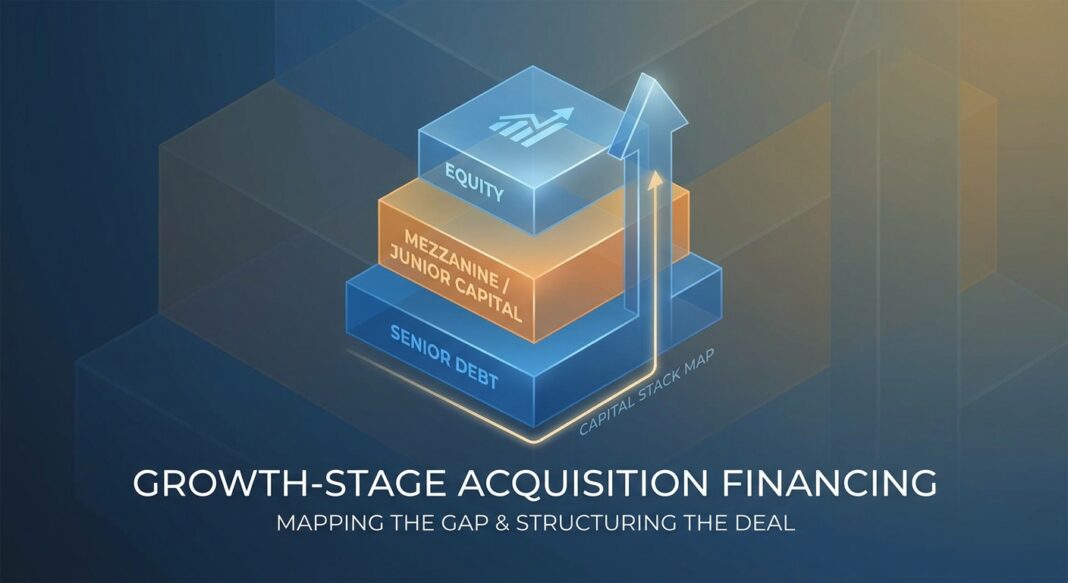
The Growth-Stage Financing Problem: $30M Deal, $12M Capital Gap
Picture the scenario: a growth-stage business services operator with $5M in trailing EBITDA identifies a $30M acquisition target — a complementary platform with defensible contracts and stable cash flow. The purchase price is executable. The strategic logic is sound. The problem is structural. The company’s bank will underwrite 3.5x EBITDA — roughly $17.5M in senior secured debt. The operator can mobilise $5M in equity. That leaves a capital gap of $7.5M sitting between the first-lien ceiling and the equity floor.
This scenario is not unusual. It is, in fact, the dominant financing challenge at the lower middle market in 2026. The gap between what banks will lend and what operators need to fund growth events — acquisitions, recapitalisations, management buyouts — is precisely where capital structure decisions compound into competitive advantages or post-close distress.
Filling that gap intelligently requires a practitioner-level command of every layer of the capital stack: its cost, its covenants, its access conditions, and its interaction with the layers above and below it. This article maps those layers, illustrates the structure with a worked example, and provides a tactical playbook for running the process from identification of need through to term sheet negotiation.
The Cost-of-Capital Spectrum: Banks to Equity
Every acquisition financing decision starts with understanding where each source sits on the cost-of-capital spectrum and what it demands in return for that cost. In the lower middle market, the stack has five recognisable layers:
Layer 1 — Senior Bank Debt (Cheapest, Most Constrained)
Commercial banks remain the lowest-cost source in the stack, with bank commercial and industrial lending rates undercutting direct lending pricing by 100–200 basis points. The constraint is leverage: bank underwriting for cash-flow lending typically caps at 3.0x–4.5x EBITDA, with covenant packages that include quarterly maintenance tests on leverage, interest coverage, and fixed-charge coverage ratios. For acquisitions that require total leverage above 4.5x, the bank layer alone will not close the deal.
Layer 2 — Unitranche (The Growth-Stage Default)
For deals in the $50M–$200M enterprise value range, unitranche has become the dominant structure. Unitranche debt is a single-tranche term loan that combines what would otherwise be a senior secured loan and a subordinated or mezzanine loan into one instrument — one loan document, one lender or lender-led syndicate, one set of covenants, one interest rate, and one prepayment schedule. The structural simplicity has measurable execution value: unitranche closes in 45–90 days versus 90–150 days for traditional senior plus mezzanine syndication, an advantage that matters most for buyers running roll-up platforms with frequent add-ons.
On pricing, a unitranche blends senior and junior debt, so it prices above a standalone senior loan — roughly SOFR + 450 to 650 bps against SOFR + 250 to 350 bps for a plain first-lien term loan in 2025. That premium is the cost of speed, certainty, and the absence of intercreditor friction. By the third quarter of 2025, 56% of direct loans priced below SOFR + 500 bps as the syndicated market competed spreads tighter, compressing economics further for lenders and improving terms for borrowers in quality credits.
Average total leverage in sponsored middle-market unitranche deals hovered around 5.0x EBITDA in mid-2024 as lenders focused on free cash flow and covenant headroom. Combined with a revolving credit facility, a unitranche structure can therefore address the capital gap where banks reach their ceiling, at meaningful scale and without intercreditor complexity.
Layer 3 — Mezzanine (Subordinated Capital with Equity Features)
When total leverage requirements exceed what a single unitranche can support — or when the borrower wants to layer capital sources to optimise blended cost — mezzanine enters the stack. Mezzanine debt has three defining structural features that distinguish it from senior debt: its subordinated and unsecured position, its option for Payment-in-Kind (PIK) interest, and its equity kicker — almost always in the form of stock warrants.
In terms of current market pricing, the cost structure for mezzanine in acquisition financing runs 8%–12% cash interest plus 2%–4% PIK (accruing to principal) plus warrants or equity co-investment of 1%–5%, creating a 16%–22% all-in IRR for the provider. In the lower middle market specifically, mezzanine and junior-capital providers fill the gap between senior debt and equity, typically pricing at 11.5%–14% cash coupon plus 1%–3% PIK plus 1%–3% warrants. Deals typically range from $3M to $25M in mezzanine commitment.
Mezzanine capital solves two problems in the lower middle market stack. First, it fills the gap when senior lenders will only underwrite 3.0x–4.5x EBITDA but the deal supports 5.0x–6.0x total leverage. Second, it reduces the equity cheque required from the operator, preserving ownership concentration and return-on-equity potential.
Layer 4 — Preferred Equity (Hybrid Positioning)
Preferred equity sits above common equity in the payment waterfall but below all debt layers. It is most commonly used in growth-stage companies where debt capacity is constrained by asset-light balance sheets or where institutional minority investors want downside protection without taking on operating control. Preferred equity typically carries a fixed dividend (often 8%–12%), liquidation preference, and anti-dilution protections, but does not create the mandatory debt service burden of mezzanine.
Layer 5 — Common Equity (Most Expensive, Maximum Flexibility)
The fully-loaded dilution cost of a single growth-stage priced round, measured at exit, typically runs 30%–35% of the pre-money founder position, versus an 8%–10% after-tax cost of senior secured debt. Late-stage valuations remain roughly 40% below their 2021 peaks, making equity more expensive in dilution terms than it was during the last boom. Common equity therefore remains the capital of last resort for acquisition financing — appropriate as a top-up layer but rarely optimal as the primary funding instrument when debt capacity exists.
Structure Breakdown: A $30M Acquisition for a $5M EBITDA Operator
Consider a lower middle market industrial services company with $5M in trailing twelve-month EBITDA acquiring a $30M purchase-price target. Merger and acquisition financing is the layered capital stack — typically a mix of senior debt, mezzanine or unitranche, sponsor equity, and rollover equity — that funds the purchase of an operating business at the LMM level of $1M to $25M EBITDA. Here is how a representative stack might be assembled for this transaction:
| Layer | Amount | % of Deal | Pricing (Indicative) | Leverage Multiple | Key Terms |
|---|---|---|---|---|---|
| Senior Secured (Unitranche) | $17.5M | 58% | SOFR + 500–550 bps (~10.5–11.0% all-in) | 3.5x EBITDA | 5-year bullet; 1% p.a. amortisation; single financial maintenance covenant (max leverage 4.75x); 1% OID |
| Mezzanine / Junior Capital | $7.5M | 25% | 12% cash coupon + 2% PIK + 2% warrant coverage | 1.5x incremental (5.0x total) | 6-year maturity; interest-only; equity warrants at entry valuation; 2% origination fee; springing intercreditor |
| Operator Equity | $5.0M | 17% | N/A (cost = dilution at exit) | N/A | Common equity; management retain majority ownership; board seat retained |
| Total | $30M | 100% | Blended ~11.5–12.5% | 5.0x EBITDA |
Note: Figures are illustrative of representative 2026 lower middle market deal structure. Actual terms vary materially by credit quality, sector, lender relationships, and market conditions at time of execution.
The PIK Mechanic and Equity Kicker — Understanding the True Cost
When borrowers elect PIK interest, the outstanding balance compounds, increasing the total debt burden. If the anticipated liquidity event is delayed, the growing PIK balance creates a larger refinancing burden at bullet maturity — a risk that can become severe in deteriorating markets. In the example above, the $7.5M mezzanine tranche accruing 2% PIK annually grows to approximately $8.26M at year three and $9.1M at year five before any cash coupon payments are factored in. Operators must model the full PIK terminal balance against projected exit valuation, not the face amount at origination.
On warrants: typically structured as warrants or options, equity kickers grant the lender the right to purchase equity in the company at a predetermined price, which can be particularly lucrative if the company’s value increases significantly over time. Every warrant granted to a mezzanine lender dilutes existing common equity. In a successful exit, the mezzanine lender’s equity kicker reduces the return available to the sponsor and management team — a cost that must be weighed against the benefit of reduced upfront equity contribution.
Covenant Design: Maintenance vs. Incurrence in Growth Acquisition Deals
The covenant package is one of the most consequential — and most negotiated — elements of any growth acquisition financing. Understanding the structural difference between maintenance and incurrence covenants is not semantic; it determines lender intervention rights and sponsor operational flexibility.
A maintenance covenant is a recurring financial test, usually quarterly, that a borrower must pass whether or not it has taken any new action. An incurrence covenant is a permissioning test triggered only when a borrower proposes a specified transaction, such as raising additional debt, paying a dividend, or moving assets. The distinction determines when creditors can intervene, how much flexibility equity sponsors keep between transactions, and where value can leak in a weakening credit.
In practical terms for growth-stage acquisitive businesses: covenant use shifts with borrower size — maintenance covenants are more prevalent with smaller borrowers, while incurrence covenants are the primary guardrails as companies grow. For the unitranche layer described above, a borrower should expect at minimum one springing maintenance covenant tied to a revolving credit facility utilisation threshold, plus incurrence tests gating additional debt, acquisitions, and restricted payments.
Covenant-lite institutional leveraged loans now carry recovery rates running at 65–67 cents on the dollar versus 75 cents or more for covenanted loans — a data point that explains why direct lenders in the middle market have retained tighter covenant packages than their broadly syndicated counterparts. Private credit managers with lower-middle-market books remain covenant-rich, and borrowers in the $5M–$25M EBITDA band should expect maintenance covenants on leverage and fixed-charge coverage as standard, not negotiable.
From the borrower’s perspective, the negotiation is about headroom, not elimination. A maximum leverage covenant set at 4.75x with a 5.0x deal leverage at close leaves 25 basis points of buffer — insufficient to absorb even one quarter of EBITDA underperformance. Negotiating 30%–35% headroom above the closing leverage multiple, plus a cure mechanism (equity contributions to cure a covenant breach), are standard asks that well-prepared borrowers should bring to term sheet negotiations.
The Gap Capital Playbook: Quantify, Prepare, Run the Process
Identifying that a capital gap exists is the easy part. Closing it efficiently — with the right lender, on the right terms, without derailing deal timing — requires a structured process.
Step 1: Quantify the Need with Precision
Before approaching any capital provider, an operator must produce a fully integrated three-statement model covering the combined entity post-acquisition, with at minimum three scenarios: base, downside (20% EBITDA haircut), and severe downside (35% EBITDA haircut). The capital stack must finance the total project cost, not just the headline price. That total includes purchase price, transaction fees, working capital normalisation, integration costs, and any immediate capex commitments. Understating the total project cost at origination is one of the most common — and most damaging — errors in lower middle market acquisition financing.
Key metrics to quantify before approaching lenders:
- Pro forma combined EBITDA (with conservative synergy assumptions — lenders will haircut them)
- Debt service coverage ratio at base case (target >1.5x on total debt service)
- Free cash flow after debt service (the true test of leverage sustainability)
- Working capital requirement in the first 12 months post-close
- Maximum leverage multiple that the combined entity’s cash flows can service across all scenarios
Step 2: Prepare the Materials Package
A credible materials package for a growth acquisition financing includes: a Confidential Information Memorandum (CIM) with detailed financial history and pro forma projections; a quality of earnings analysis (sell-side QoE if available, or sponsor-commissioned buy-side QoE for larger deals); a management presentation covering the acquisition thesis, integration plan, and leverage reduction roadmap; and a sources-and-uses table with clearly articulated equity contribution. Misreading covenant design at underwriting typically manifests in amendments, liability management, and recovery outcomes rather than in the original term sheet — the same logic applies to materials quality: gaps surfaced during lender due diligence after term sheet execution lead to re-trades, not clean closes.
Step 3: Run a Staged, Competitive Process
For a $30M deal of the type described above, the lender universe is well-defined. Direct lenders aggressively compete for deals in the $50M–$200M EV band. Top participants include Ares Capital, Blue Owl Capital, Antares Capital, Twin Brook Capital Partners, Apollo Global Management direct lending, Carlyle Direct Lending, KKR Capital Markets, Golub Capital, and Monroe Capital. For the mezzanine layer, named 2026 lower middle market mezzanine providers include NewSpring Mezzanine, Star Mountain Capital, Peninsula Capital Partners, Prudential Capital Group, Northstar Capital, Brookside Mezzanine, and SBIC-licensed funds such as Argosy Capital and Plexus Capital.
Run senior and mezzanine processes in parallel, not sequentially. Mezzanine lenders will require sight of the senior term sheet before finalising their own economics, but initiating both conversations simultaneously compresses overall execution time by 3–6 weeks.
The mezzanine underwriting process typically runs 60–90 days from term sheet to close. For the unitranche, a unitranche close takes 45–90 days versus 90–150 days for traditional senior plus mezzanine syndication. Factoring these timelines into the acquisition process — specifically into the M&A exclusivity period — is critical to avoiding lapse of exclusivity before financing is secured.
Negotiation Guidance: Term Sheet to Close
With term sheets in hand, operators face a condensed set of high-leverage negotiation points. These are the items where movement is achievable and where leaving basis points or contractual flexibility on the table compounds across the life of the facility:
For the Senior / Unitranche Layer
- Covenant headroom: Push for at minimum 30% cushion on maintenance covenant levels above the day-one leverage ratio. A 5.0x deal leverage should carry a 6.0x–6.5x covenant ceiling, not 5.25x.
- EBITDA definition: Covenant erosion through aggressive EBITDA add-backs, large grower baskets, and ratio-based exceptions can weaken protections. In 2024, market caps on pro forma cost savings add-backs clustered around 25%–35% of EBITDA. Borrowers should seek add-back capacity for integration costs, non-recurring items, and run-rate synergies within these market norms.
- Prepayment flexibility: Negotiate a soft call structure (101 in year one, par thereafter) rather than make-whole premiums. For acquisition platforms expecting refinancing or add-on transactions within 24 months, prepayment economics are material.
- Accordion / incremental facility: Secure a pre-negotiated incremental commitment (typically 0.5x–1.0x EBITDA) to fund bolt-on acquisitions without re-opening the full credit agreement. This is standard in sponsored deals but often absent in sponsor-less lower middle market transactions.
For the Mezzanine Layer
- Warrant strike price: Negotiate warrant exercise price at the higher of current equity valuation or a specified floor. Avoid $0.01 strike warrants — they are economically equivalent to a direct equity grant and maximally dilutive at exit.
- PIK toggle terms: Effective PIK structures include carefully tailored triggers that constrain or condition PIK elections. Performance-based triggers might require a minimum liquidity threshold, a maximum leverage ratio, or positive free cash flow before permitting cash-pay toggling. Alternatively, time-based triggers may allow PIK for an initial period, with a step-down to partial cash-pay thereafter. Borrowers should push for the right to elect PIK unilaterally in years one through two, then step down to mandatory cash pay by year three — preserving early-period cash flow without compounding the terminal PIK balance into an unmanageable exit event.
- Intercreditor terms: Ensure the senior lender’s cure rights on mezzanine defaults include an adequate cure period (typically 60–90 days), and that the mezzanine lender’s standstill on enforcement during a senior workout is clearly defined. These terms are non-negotiable for most senior lenders but should be reviewed carefully by mezzanine providers before signing.
Key Takeaways
- The debt-first calculus has shifted decisively in 2026. Debt-inclusive capital events in the growth-stage band increased 47% year-over-year in H1 2026, while pure equity rounds declined 12%. The cost-of-capital maths now favours deploying available debt capacity before repricing equity at lower valuations.
- Unitranche dominates the $50M–$200M EV band because of structure, not just price. Traditional senior plus mezzanine can achieve a lower weighted cost of capital if mezz carries equity kickers, but intercreditor complexity slows execution and reduces flexibility. Unitranche wins on speed, confidentiality, and single-document control.
- Mezzanine fills leverage gaps banks cannot address — but its true cost is higher than the headline rate. The 16%–22% all-in IRR target for mezzanine providers, combining cash coupon, PIK compounding, and warrant dilution, must be fully modelled at exit — not just at origination.
- Covenant design is a control rights question, not just a compliance question. Maintenance covenants require borrowers to report key financial metrics regularly, providing lenders with early warning signals of potential distress — and serve as functional levers to force engagement where lenders can prompt corrective action if signs of stress begin to appear. Borrowers who understand this negotiate headroom; those who do not accept trip-wire levels that hand over control at the first sign of underperformance.
- Process sequencing determines deal economics. Running senior and mezzanine lender processes in parallel, initiating materials preparation before exclusivity, and building adequate financing contingency into M&A timelines are execution disciplines that separate deals that close on schedule from those that re-trade or collapse in the final stretch.


