
The Acquisition Financing Dilemma at the Growth Stage
A growth-stage operator sitting on $6M–$12M of EBITDA and eyeing a platform or bolt-on acquisition faces a structural decision that will define the next three to five years of the business: how do you finance a transaction at a 6x–8x purchase multiple when your bank will only lend to 3.0x–3.5x EBITDA, and you have no appetite to hand control to a private equity sponsor?
That gap — between what senior debt will support and what the deal actually costs — is the defining challenge of growth-stage acquisition financing. Filling it correctly determines whether the business emerges stronger, or whether debt service consumes the operating leverage the acquisition was supposed to create.
The answer lies in navigating the capital stack with precision: matching each layer of capital to a specific use-of-proceeds, understanding the real cost of every instrument in a higher-rate environment, and running a disciplined process to negotiate structure. This is the Gap Capital Playbook.
Step 1 — Map the Full Capital Stack
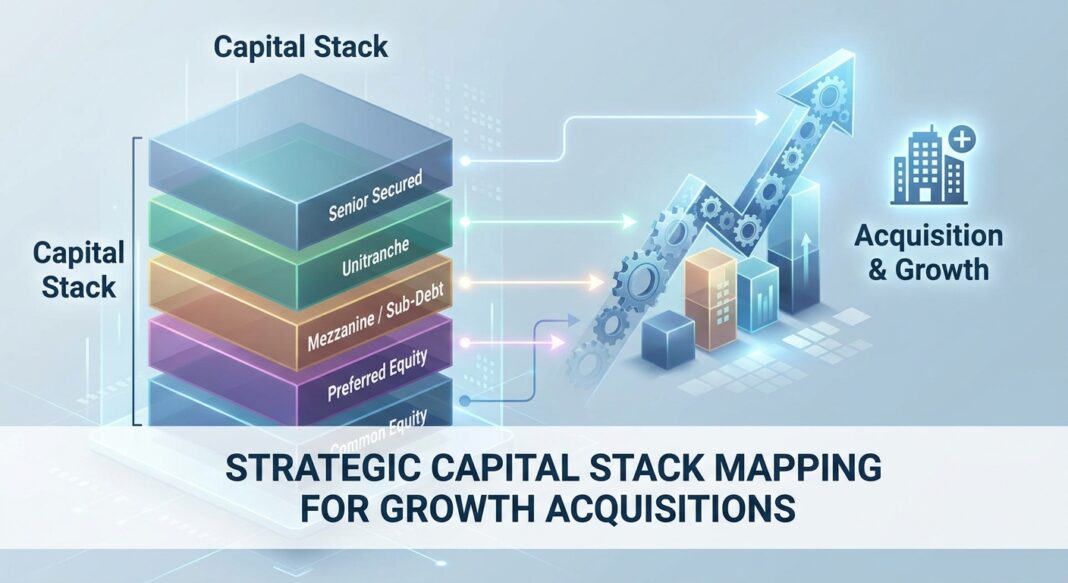
Before evaluating any individual instrument, operators need a clear map of the full stack from cheapest to most expensive. Every layer has a different seniority, pricing, and covenant posture.
The 2026 Capital Stack, Layer by Layer
| Layer | Instrument | 2026 Pricing (All-In) | Typical Leverage | Key Feature |
|---|---|---|---|---|
| 1 — Senior Secured | Bank Term Loan / ABL | 9%–10% | 3.0x–3.5x EBITDA | Quarterly maintenance covenants; lowest cost |
| 2 — Unitranche | Direct Lending (single tranche) | 9.5%–11% (SOFR +500–700bps) | 4.0x–6.0x EBITDA | One lender, one agreement, single covenant package |
| 3 — Mezzanine / Sub-Debt | Subordinated Note + Warrants | 13%–17% all-in (cash + PIK + warrant) | Layered above senior to 5.0x–5.5x | PIK toggle preserves cash; equity kicker dilutes cap table |
| 4 — Preferred Equity | Structured Preferred / Convertible | 12%–18% dividend + conversion | Fills gap to total deal value | Non-debt structure; no fixed payment trigger |
| 5 — Common Equity | Sponsor / Growth Equity / Rollover | 20%+ IRR hurdle | Residual (30%–50% of deal) | Most expensive; most dilutive; no fixed repayment |
Sources: S&P Global LCD via CT Acquisitions Q2 2026; GF Data Q1 2026; Lincoln International Q1 2026 Senior Debt Facility pricing. See sources section.
The principle is straightforward: each layer is more expensive because it assumes more risk and sits lower in the repayment waterfall. Senior secured debt is cheapest because it is paid first and secured by assets. As of Q2 2026, senior secured lending for lower middle market businesses runs at all-in coupons in the 9%–10% range, per S&P Global LCD data cited by CT Acquisitions. Common equity is the most expensive because it is the residual claimant — it only gets paid after everyone else.
The operator’s job is to minimize the average cost of capital across the stack while preserving enough operating flexibility to execute the acquisition thesis.
Step 2 — Understand the Two Core Gap-Filling Instruments
For a growth-stage operator financing a $40M–$120M enterprise value acquisition, the gap between senior debt capacity and total deal cost is typically filled by one of two instruments: a unitranche facility or a senior + mezzanine split. Each has distinct mechanics, pricing, and structural trade-offs.
Option A: The Unitranche — One Stop, One Lender
A unitranche facility combines what would otherwise be separate senior and subordinated tranches into a single instrument with one lender and one credit agreement. The borrower sees a single blended interest rate; the lender manages internal risk allocation via an Agreement Among Lenders (AAL) that allocates first-out and last-out exposure privately.
Worked Example — $80M Enterprise Value Software Business:
- Purchase price: $80M (8.0x $10M EBITDA)
- Unitranche facility: $50M (5.0x EBITDA) at SOFR + 575bps (approx. 10.1% all-in, Q3 2026)
- Equity contributed: $30M (37.5% of deal value)
- OID: 2.0% upfront; 18-month prepayment protection
- Covenants: Single maximum leverage test (5.75x EBITDA); quarterly reporting
- Maturity: 5 years, bullet at maturity
- Lender: Typical providers include Ares Capital, Blue Owl, Antares, Twin Brook, Apollo Direct Lending
The structural advantage is simplicity. With one lender, there is one negotiation, one closing, and one relationship to manage post-close — including covenant modifications, add-on acquisitions, and any waiver requests. That speed premium is real: unitranche financing can close 30–45 days faster than a syndicated alternative, which is often the difference between winning and losing a competitive process.
Option B: Senior + Mezzanine — The Traditional Split
A senior-plus-mezz structure layers two separate instruments from two separate lenders. A commercial bank or BDC provides senior debt to 3.0x–3.5x EBITDA; a mezzanine fund fills the gap to 4.5x–5.5x.
Worked Example — Same $80M Deal, Split Stack:
- Senior Term Loan: $35M (3.5x EBITDA) at SOFR + 400bps (~8.7% all-in)
- Mezzanine Note: $15M (1.5x EBITDA) at 11% cash + 2% PIK + 3% warrant coverage = ~16%–17% all-in IRR to lender
- Equity contributed: $30M
- Total blended debt cost: Approximately 10.5%–11.5% (weighted)
- Intercreditor agreement required between senior and mezzanine lender
- Warrant dilution: 3% equity stake granted to mezz lender at closing
Mezzanine financing is structured as subordinated debt that sits below all senior creditors in the payment waterfall. It typically includes a combination of cash interest, PIK (payment-in-kind) interest that accrues onto the principal balance rather than being paid in cash, and equity warrants. PIK interest compounds the debt balance over time: if a liquidity event is delayed, the growing PIK balance can create a larger refinancing burden at bullet maturity. Every warrant granted to a mezzanine lender also dilutes existing common equity — a cost that must be explicitly modeled against the benefit of reduced upfront equity contribution.
Step 3 — Unitranche vs. Mezzanine: When Each Wins
| Consideration | Unitranche | Senior + Mezzanine |
|---|---|---|
| Speed to close | Faster (single underwrite; 30–45 days quicker) | Slower (two parallel processes; intercreditor negotiation) |
| Blended cost | 9.5%–11% all-in (typically 25–75bps cheaper than split) | 10.5%–12% blended (but maximizes cheap senior) |
| Equity dilution | None (pure debt instrument) | 1%–5% warrant coverage to mezz lender |
| Cash flow preservation | Lower — full cash coupon from day one | Higher — PIK toggle option preserves cash in early years |
| Covenant complexity | Single package; one lender to negotiate with | Two separate packages; intercreditor agreement adds friction |
| Best fit | Competitive processes; time-sensitive closings; software/services businesses with predictable FCF | Larger deals exceeding single-lender capacity; when PIK toggle is essential; add-ons with existing senior facilities |
Traditional mezzanine remains relevant in specific contexts: very large transactions where unitranche lenders cannot provide the full quantum of debt, situations where the borrower wants to minimize total blended cost by maximizing cheaper senior debt, and portfolio company add-on financings where existing credit agreements restrict additional senior debt. In 2025–2026, mezzanine funds have also seen renewed interest as investors seek strategies with built-in cash yields in a higher-rate environment.
Step 4 — Covenant Design: What You Are Actually Agreeing To
The covenant package is not a boilerplate formality — it is a real-time operating constraint that determines how much management flexibility the business retains and how quickly lenders can intervene if performance deteriorates.
There are two fundamentally different covenant architectures in the current market:
- Maintenance Covenants: A recurring quarterly financial test — typically a maximum leverage ratio or minimum fixed charge coverage ratio — that the borrower must pass regardless of any action taken. Missing a threshold, even by a fraction, can trigger technical default and expensive waiver negotiations. Maintenance covenants are early-warning tools: they give lenders an intervention right before a payment default occurs, which produces materially better recovery outcomes.
- Incurrence Covenants: Only triggered when the borrower takes a specific affirmative action — issuing new debt, making an acquisition, paying a dividend. A borrower can sit on deteriorating financials for quarters without triggering lender intervention rights. This creates a surveillance gap that only surfaces at payment default, by which point enterprise value may have eroded significantly.
What the 2026 Market Actually Looks Like
The covenant landscape has bifurcated sharply between public and private markets. In the broadly syndicated loan (BSL) market, approximately 90% of new loans in 2024 remained covenant-lite, continuing borrower-friendly documentation trends. In contrast, private credit lenders have maintained firmer positions on covenant inclusion, particularly for mid-market transactions — though covenant-lite structures did reach 21% of direct lending transactions in 2025, up from just 4% in 2023.
For growth-stage borrowers in the $5M–$20M EBITDA range, the practical covenant posture in 2026 is: expect maintenance covenants from private credit unitranche lenders, and negotiate for maximum headroom rather than covenant removal. A well-structured covenant with a 30%+ cushion to the test level is far less constraining than a tight covenant at 10% headroom. Headroom design — not covenant type — is the real negotiation.
Banks lean toward strict quarterly maintenance tests; direct lenders increasingly favor incurrence-based or single-covenant structures at the upper end of the market. Operators running add-on acquisition strategies need to map out how each bolt-on will impact the leverage covenant pro-forma — before the deal is signed, not after.
Step 5 — The Gap Capital Playbook
The Gap Capital Playbook is a four-stage process: Quantify → Prepare → Process → Negotiate.
Phase 1: Quantify the Gap
Start with the deal math, not the lender. Define the total acquisition cost (purchase price + fees + working capital adjustments). Then calculate what the cheapest available debt layer will support — typically 3.0x–3.5x EBITDA in senior secured. The difference between total deal cost and senior debt capacity is your financing gap. That gap is what you are taking to market, and it should be expressed in dollar terms, leverage multiples, and as a percentage of total capitalization before you call a single lender.
Example: $80M deal at 8.0x EBITDA. Senior debt supports $35M (3.5x). Total gap: $45M. Filled by $15M mezzanine + $30M equity, or $50M unitranche + $30M equity. Model both stacks with all-in cost, post-close DSCR, covenant headroom, and breakeven EBITDA.
Phase 2: Prepare the Materials
Lenders evaluate three things: quality of EBITDA, predictability of free cash flow, and management credibility. A borrower-ready credit package for a growth-stage acquisition should include: trailing twelve-month and projected P&L with clean EBITDA build; customer concentration and revenue quality analysis; management team background; acquisition thesis with integration assumptions; and a debt capacity model showing post-close leverage, DSCR, and covenant cushion under base and stress scenarios. The quality of this package determines both which lenders engage and how aggressively they price.
Phase 3: Run the Process
Target lenders by deal size and sector fit — not by brand name. For a $25M–$150M EV transaction, the active 2026 unitranche market is dominated by Ares Capital, Blue Owl Capital, Antares Capital, Twin Brook Capital Partners, Apollo Direct Lending, Golub Capital, and Monroe Capital. For mezzanine, BDCs (Ares, Blue Owl, Main Street), specialty funds (Audax Mezzanine, Madison Capital, Maranon), and family office mezz pools are all active. Run a competitive process with three to five lenders simultaneously. The goal is not to take the first term sheet — it is to create enough competition to leverage terms on pricing, covenant headroom, and prepayment flexibility.
Phase 4: Negotiate the Structure
The five highest-value negotiation points for growth-stage borrowers in the current market are:
- Covenant cushion: Push for 30%–35% headroom above the leverage test level on a pro-forma basis for planned add-ons. A 5.5x covenant on a 4.0x draw at close is not tight — a 5.5x covenant on a 5.0x draw is.
- PIK toggle flexibility: In mezzanine structures, negotiate the right to toggle interest from cash to PIK during the first 24 months. This preserves cash during the integration period when EBITDA may be temporarily compressed.
- Prepayment economics: Current market standard is 2%–3% prepayment fee declining over 24 months. Push for a 12-month call protection window rather than 24 months if refinancing risk is a concern.
- Acquisition basket: Negotiate a permitted acquisition basket that allows bolt-on deals below a threshold (e.g., $10M–$15M EV) without lender consent, subject to pro-forma leverage compliance. This is essential for roll-up operators.
- Equity cure rights: Secure the right to inject equity to cure a covenant breach before a technical default is declared — typically limited to two times per year with a cap on total cure injections. This is standard in private credit but must be explicitly documented.
Current Market Benchmarks (August 2026)
- Direct lending volume: Full-year 2025 direct lending reached $247 billion — the second-busiest year on record, per PitchBook LCD data cited in DLA Piper’s Private Credit Pulse Q1 2026.
- Global private credit AUM: The market reached $3.5 trillion in AUM as of Q1 2026, per DLA Piper Private Credit Pulse, with KBRA projecting continued rapid growth through 2026.
- Unitranche pricing: SOFR + 500–700bps for core LMM transactions in 2026, producing all-in costs of 9.5%–11% at current SOFR levels, per CT Acquisitions 2026 pricing data.
- Total leverage: Senior leverage multiples on middle market deals averaged 3.7x in Q1 2026, with total leverage at 4.6x on average across the LMM, per GF Data.
- Mezzanine all-in cost: 13%–17% all-in (11%–14% cash coupon + 2%–4% PIK + 1%–5% warrant coverage), per CT Acquisitions 2026 pricing data.
- Covenant-lite penetration: 21% of direct lending transactions in 2025 used covenant-lite structures, up from 4% in 2023, per market reporting cited in Aspirations Group/ACG Strategic Insights (2026). The core mid-market still runs largely on maintenance covenants.
- Direct lending spreads: Widened by roughly 50–100 basis points since late 2025, alongside a return to stronger lender protections, per Lord Abbett’s 2026 Midyear Investment Outlook: Private Credit’s Lender-Friendly Reset, cited in ACG Strategic Insights.
Key Takeaways
- Map the gap first, not the instrument. Quantify the financing gap in dollar and leverage terms before approaching any lender. The structure follows the gap, not the other way around.
- Unitranche wins on speed and simplicity; mezzanine wins on cash flow preservation. If the acquisition thesis requires a fast close or clean post-close operations, unitranche is typically the right call. If the integration period will temporarily compress EBITDA and cash preservation matters, PIK optionality in a mezz structure has real value.
- Covenant headroom is the real negotiation — not covenant type. A maintenance covenant with 35% headroom is operationally benign. A tight incurrence covenant with narrow baskets can be more constraining. Model every covenant against your post-close operating plan, including planned bolt-ons.
- The acquisition basket is as important as the interest rate. For operators running a roll-up strategy, a well-structured permitted acquisition basket — allowing sub-threshold bolt-ons without lender consent — is worth more than 25 basis points of spread savings.
- Run a competitive process, always. The 2026 private credit market has $3.5 trillion in AUM competing for deals. Operators who run structured, competitive lender processes with quality materials consistently achieve better pricing, wider covenant headroom, and more flexible prepayment terms than those who accept the first term sheet presented.


