
Why One Loan Is Doing the Work of Two
When a private equity sponsor or a growing middle-market business needs to finance an acquisition or expansion, the traditional answer involved assembling multiple layers of debt — senior secured from a bank, mezzanine from a specialist fund, and sometimes subordinated notes from elsewhere. Each tranche carried its own legal agreements, its own lenders, its own covenants, and its own closing timeline. The process was slow, expensive, and structurally complex.
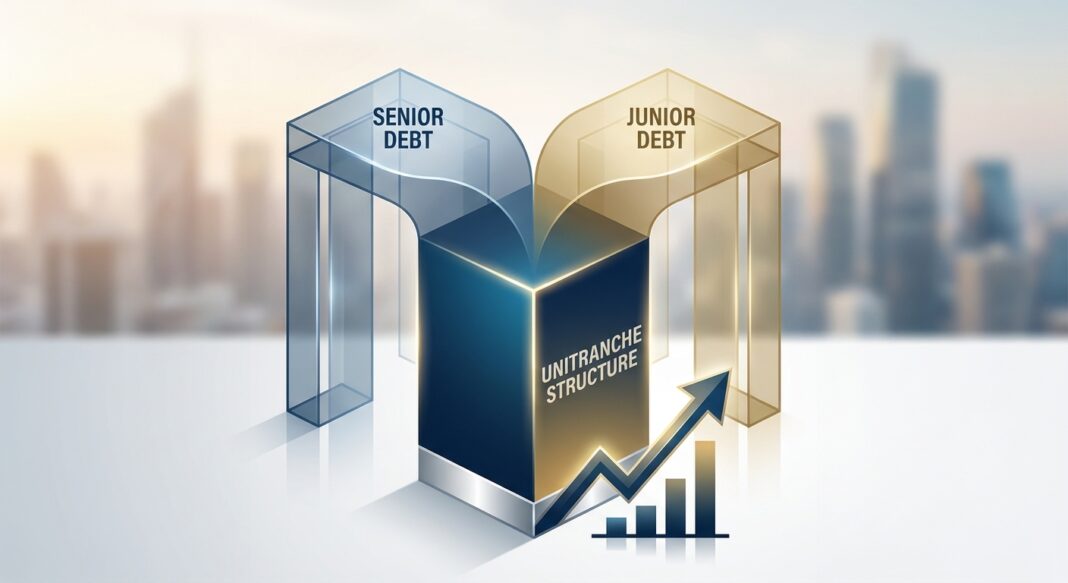
The unitranche loan changed that calculus. Born out of the direct lending revolution and now the dominant instrument in private credit deal-making, the unitranche is a single loan facility that blends what would traditionally be senior and subordinated debt into one clean package — one interest rate, one set of documents, one closing process. PitchBook (2026) confirms that direct lending — the primary vehicle for unitranche issuance — accounts for roughly 60% of all private debt capital raised, underscoring just how thoroughly this structure has come to define the market.
For investors evaluating private credit allocations, and for operators deciding how to finance their businesses, understanding exactly how unitranche lending works — including the hidden architecture inside the loan — is essential groundwork.
The Concept: One Loan, Two Risk Profiles
On the surface, a unitranche facility is elegantly simple. Wall Street Prep describes it as a hybrid structure in which the borrower pays a single blended interest rate and executes a single credit agreement. There are no separate tranches, no inter-creditor fights visible to the borrower, and no multi-lender waterfall to navigate at closing.
Beneath that surface, however, lenders govern their own internal risk allocation through a document the borrower never signs: the Agreement Among Lenders (AAL). Mayer Brown (July 2026) explains that in a unitranche arrangement, there is only one lien, and the priority of payment is governed by the AAL rather than by competing security interests. The AAL splits the loan into two internal positions:
- First-Out (FO): The senior position within the facility. First-out lenders receive lower interest but get paid back first if the borrower defaults or is liquidated. This is typically a revolving credit or term loan held by a bank or risk-averse lender.
- Last-Out (LO): The subordinated internal position. Last-out lenders hold the larger share of the loan and accept a higher yield in exchange for absorbing losses first. Private credit funds predominantly occupy this position.
As Jones Day notes, first-out lenders typically receive a lower proportion of the blended unitranche margin but are first to receive both interest and principal repayments. The borrower, crucially, sees none of this — to them, there is a single loan and a single lender relationship.
How It Works: A Concrete Example
Consider a private equity firm acquiring a software business for $50 million (6.25x EBITDA of $8M). The deal is financed as follows:
- Equity: $15M (30% of enterprise value)
- Unitranche Debt: $35M (70% LTV, or 4.375x EBITDA leverage)
The unitranche lender prices the facility at SOFR + 500 basis points — a single rate the borrower pays on the full $35M. With 3-month Term SOFR at approximately 3.69% as of June 2026 (per Valuation Research Corp., Q2 2026), the all-in rate is roughly 8.69%, well within the current market range of 9.00%–9.75% for unitranche yields on a spot basis, according to the same report.
Internally, the lender group has executed an AAL dividing that $35M:
- First-Out tranche: $10M (revolving credit, priced at SOFR + 275 bps)
- Last-Out tranche: $25M (term loan, priced at SOFR + 600 bps — compensating for subordinated risk)
The borrower never sees this split. They pay a single blended rate on $35M. The lenders, however, have precisely allocated who bears loss risk and who receives priority repayment. Mayer Brown (2023) observes that where last-out lenders hold a substantial majority of total debt, they typically argue for meaningful control over amendments and enforcement decisions — giving them influence over restructuring outcomes despite sitting in the junior seat.
The key trade-off for the borrower: they pay a modest premium over a plain senior loan in exchange for dramatically simplified execution, fewer counterparties, and greater structural flexibility. Mayer Brown confirms that the structure typically offers quicker execution and, in some cases, a lower blended cost of capital than a separately structured senior-plus-mezzanine deal.
Current Market Relevance
The unitranche is not merely a structural novelty — it is now the engine of the private credit market, and understanding current pricing and conditions is essential context for both lenders and borrowers evaluating deals today.
| Metric | Current Data Point | Source |
|---|---|---|
| Unitranche all-in yield range (spot) | ~9.00%–9.75% | VRC Q2 2026 |
| Unitranche coupon spread range | SOFR + 475 to 550 bps | VRC Q2 2026 |
| Lower-middle-market direct lending spread premium vs. syndicated | +100 to 150 bps (SOFR + 450–475 bps) | Alternative Fortune / PitchBook LCD, Jul 2026 |
| Global private credit AUM | ~$3.2 trillion | PIMCO, Jun 2026 |
| Direct lending share of private debt fundraising | ~60% | Creative Planning / PitchBook, 2026 |
| Bank C&I lending standards (Q2 2026) | Basically unchanged; C&I standards easier than historic midpoint | Federal Reserve SLOOS, Jul 2026 |
Three structural forces are shaping the unitranche market right now:
1. Bank standards are stabilizing, but private credit’s structural advantages persist. According to the Federal Reserve’s July 2026 SLOOS, bank lending standards for C&I loans are now reported as easier than the midpoint of their historic ranges — a meaningful shift from the tight conditions of 2022–2024. Yet banks remain constrained in offering the speed, flexibility, and hold sizes that private credit provides. Creative Planning (2026) notes that service- and technology-oriented businesses lacking hard collateral often find banks structurally unable to serve them, driving continued demand for unitranche solutions.
2. Yields have compressed from peak but remain above historical norms. VRC’s Q2 2026 report shows unitranche yields ranging between 9.00% and 9.75% — down roughly 250 basis points from the 2023 peak of 11.5%–12.5%, but still approximately 150–200 basis points above the pre-2022 historical range of 7%–8%. Lenders entering the market today are locking in meaningfully lower economics than 2022–2023 vintage deals.
3. The market is resetting in a more lender-friendly direction. Lord Abbett’s 2026 Midyear Outlook observes that spreads are wider, covenants and documentation are improving, and managers with dry powder can now afford to be more selective about the credits they choose to finance — a meaningful improvement from the borrower-favored environment of 2021–2022.
Decision Framework
For Investors Evaluating Private Credit
Before allocating to a fund or BDC with significant unitranche exposure, investors consider the following questions:
- What position does the fund hold — first-out or last-out? The AAL determines who absorbs losses first. Last-out exposure carries materially different risk than first-out, even within the same stated loan.
- At what spread are new loans being written? As Alternative Fortune (Jul 2026) emphasizes, current vintage loans written at SOFR + 450–475 bps represent thinner economics than past performance suggests — the historical index reflects a market that no longer prices the way it once did.
- How are covenants structured? Lord Abbett (2026) notes that documentation quality is improving — investors evaluate whether managers are capturing these structural improvements or still underwriting to 2021-era loose terms.
- What does the borrower’s free cash flow look like? Hamilton Lane (2026) identifies durable cash flows and lower leverage as the key variables for downside protection in today’s environment.
For Operators Evaluating Unitranche Financing
Business owners and CFOs consider unitranche financing when:
- Speed and certainty matter more than rate. Unitranche closes faster than a multi-lender syndicated deal. Wall Street Prep confirms that the structure’s appeal to borrowers lies in simplified negotiations and reduced documentation burden, not in achieving the lowest possible coupon.
- The business lacks traditional collateral. Asset-light companies — software, services, healthcare — often find banks structurally incapable of underwriting their cash-flow profiles. Unitranche lenders underwrite to EBITDA and free cash flow rather than hard assets.
- Flexibility in capital structure is needed. Unitranche facilities rarely require mandatory amortization and offer relatively low prepayment penalties, giving operators room to refinance or restructure as conditions evolve.
- The cost of complexity exceeds the cost of the premium. If assembling a two-tranche structure requires separate legal, advisory, and administrative costs across multiple lender groups, the blended cost of a unitranche — even at a higher spread — may be lower in total economic terms.
Key Takeaways
- The unitranche is one loan with two internal risk profiles. The borrower sees a single facility; the Agreement Among Lenders (AAL) governs how first-out and last-out lenders share repayment priority and loss exposure invisibly behind the scenes.
- Spreads have compressed but remain above historical norms. All-in unitranche yields of 9.00%–9.75% (Q2 2026) are ~250 bps below 2023 peaks but still represent a meaningful premium over the pre-2022 baseline of 7%–8%.
- Direct lending now commands ~60% of private debt fundraising, cementing the unitranche as the market’s structural default — not a niche instrument.
- For investors, the AAL position matters as much as the headline yield. Last-out exposure carries subordinated risk that first-out pricing does not reflect. Investors evaluate the internal split, not just the blended rate.
- For operators, the premium buys execution, not just capital. The unitranche’s value is speed, certainty, and access — particularly for asset-light businesses that traditional bank lending standards cannot accommodate.


