
The Financing Challenge: When Senior Debt Runs Out of Road
Picture a growth-stage operator with $4M in EBITDA under management, executing a bolt-on acquisition at a $24M enterprise value — roughly a 6x multiple. The company’s bank will underwrite senior debt to roughly 3.5x EBITDA, producing a $14M facility. Equity is expensive, dilutive, and structurally incompatible with a founder who wants to retain majority control through the transition. That leaves a $4–6M gap between senior capacity and the total purchase price — a gap that does not disappear by wishing it away.
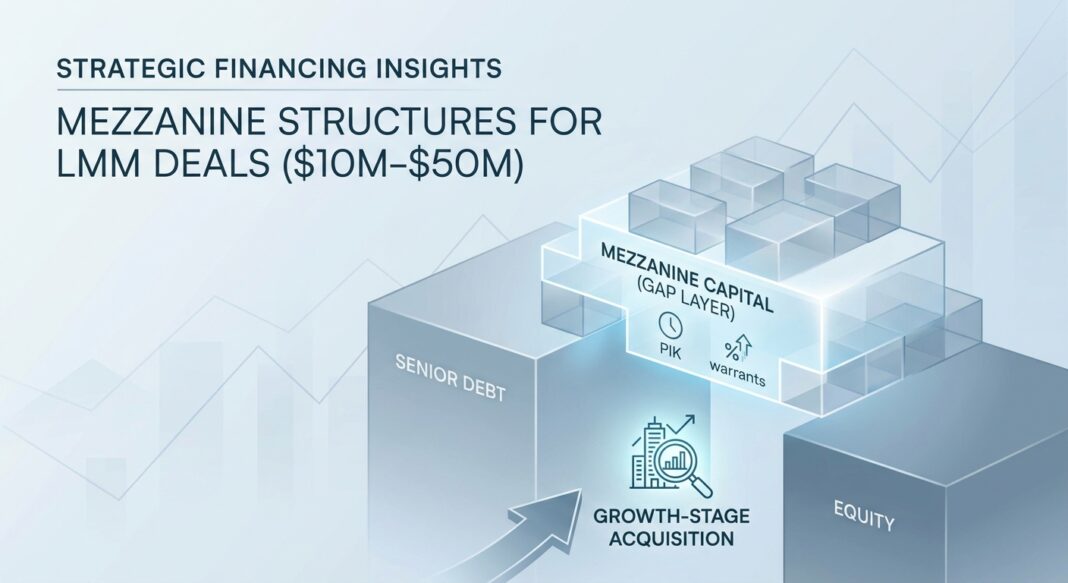
This is precisely where mezzanine capital earns its keep. Mezzanine financing bridges the gap between what senior lenders provide and your total capital needs. It is the middle layer of the capital stack — subordinated to senior debt, sitting above common equity — and it carries a pricing structure designed to compensate for that junior position: a blended combination of current cash interest, payment-in-kind (PIK) accrual, and an equity participation feature, almost always in the form of warrants.
In 2026, mezzanine has re-emerged as a deal-critical instrument for lower-middle-market (LMM) operators who have outgrown SBA structures but are not yet large enough to access the deepest unitranche or broadly syndicated pools. Understanding how to structure it, price it, and negotiate it is no longer optional — it is core capital strategy.
Structure Breakdown: The Three Layers of a Mezzanine Package
Mezzanine debt has three defining structural features that distinguish it from senior debt: its subordinated and unsecured position, its option for Payment-in-Kind (PIK) interest, and its equity kicker — almost always in the form of stock warrants. Each component serves a distinct economic function for both the borrower and the lender.
1. The Subordinated Position
Mezzanine debt sits between senior debt and equity in a company’s capital stack. If things go south, senior lenders get paid first, equity gets paid last — and mezzanine waits patiently in the middle. This structural subordination is governed by an intercreditor agreement (ICA) between the senior lender and the mezzanine provider. The ICA defines standstill periods, payment blockage rights, and the mezzanine lender’s remedies — all critical negotiation battlegrounds before a term sheet is signed.
2. Cash Interest + PIK Toggle
The cash coupon is the base rate a borrower pays quarterly or semi-annually. The PIK component is the portion that accretes to the outstanding principal balance rather than being paid in cash. PIK instruments allow borrowers to defer interest payments by issuing additional debt instead of cash payments. These instruments have been particularly attractive in leveraged buyouts and acquisitions, providing breathing room for companies to channel cash flow into business growth rather than debt servicing.
Importantly, PIK compounds leverage over time. When borrowers elect PIK interest, the outstanding balance compounds, increasing total debt burden. If the anticipated liquidity event is delayed, the growing PIK balance creates a larger refinancing burden at bullet maturity — a risk that can become severe in deteriorating markets. Operators should model the PIK compounding trajectory explicitly before accepting toggle provisions.
3. Equity Kickers and Warrant Coverage
Equity warrants or kickers add 2–8% additional IRR from ownership participation. Warrant coverage typically grants mezzanine lenders the right to purchase 1–20% of the borrower’s equity. The interest rates are usually higher than senior debt, reflecting the increased risk, and can be paid in cash or accrue to the principal. Equity kickers add another layer of complexity and negotiation to the terms, as they need to align with both the lender’s return expectations and the borrower’s future plans for the company.
For borrowers, warrants represent a deferred dilution cost. Warrants are not an immediate grant of stock, but like other convertible securities, they add a new and complex security type to a company’s ownership structure. This feature is what makes mezzanine financing a hybrid instrument and adds significant complexity to the cap table.
Worked Term Sheet Example: A $6M Mezz Tranche in a $24M LMM Deal
Consider a professional services company with $4M EBITDA being acquired at 6x ($24M enterprise value). The capital stack is constructed as follows:
- Senior Cash Flow Term Loan: $14M at SOFR + 350bps (all-in ~8.5%), 5-year term, 1% annual amortization, first lien on all assets
- Mezzanine Tranche: $6M, structured as follows:
- Cash coupon: 10% per annum, paid quarterly
- PIK component: 2.5% per annum, accretes to principal
- Warrants: covering 4% of fully diluted equity, exercisable at a pre-agreed valuation cap
- Maturity: 6 years, bullet repayment
- All-in IRR target for the mezz lender: approximately 16–18%
- Equity Contribution: $4M (operator + rollover equity), representing ~17% of deal value
This structure closes the acquisition without diluting the operator below majority ownership, while the mezz lender’s total return is driven by a blended current/PIK yield plus the warrant participation in any exit uplift. A representative mezzanine tranche carries, for example, a 13% cash coupon plus 2% PIK plus warrants for 5% equity, targeting a 17% all-in IRR.
How Mezzanine Compares: Unitranche, Senior + Mezz, and Growth Equity
Mezzanine vs. Unitranche
Unitranche debt is a single-tranche term loan that combines what would otherwise be a senior secured loan and a subordinated/mezzanine loan into one instrument. From the borrower’s perspective, there is one loan document, one lender or lender-led syndicate, one set of covenants, one interest rate, and one prepayment schedule. Unitranche eliminates the intercreditor complexity inherent in a senior-plus-mezz split and closes faster — 45–90 days for a unitranche close vs. 90–150 days for traditional senior plus mezz syndication.
However, unitranche dominates specifically in the $50M–$200M enterprise value band. The sweet spot is $25M–$200M EV; below that range, SBA plus senior bank wins on cost, and above $300M, the broadly syndicated loan market wins on cost. For the $10M–$30M EV segment, traditional mezz layered beneath a conventional bank line frequently remains the more accessible and cost-effective solution, particularly for operators without a private equity sponsor.
Traditional senior plus mezzanine can achieve a lower weighted cost of capital if mezz carries equity kickers, but intercreditor complexity slows execution and reduces flexibility. The operator must decide: is the modest cost savings worth the added documentation burden and timeline risk?
Mezzanine vs. Growth Equity
While venture capital targets early-stage startups with higher risk, growth capital focuses on companies with proven revenues ready for the next phase. Private equity often involves full buyouts, but growth capital partners typically take minority stakes, allowing founders to retain significant control. Growth equity avoids the fixed-charge obligations of debt but is substantially more dilutive over a 5–7 year hold when warrant uplift is modeled at exit. Sponsors use mezzanine to reduce equity contribution because even at 15–20% yields, mezzanine is cheaper than the 20%+ returns expected on equity.
When Mezzanine Wins
Mezz wins when the deal is too large for SBA, equity capacity is limited, and the target generates predictable free cash flow. Despite the unitranche’s rise, traditional mezzanine debt has not disappeared. It remains relevant in several contexts: very large transactions where unitranche lenders cannot provide the full quantum of debt needed, situations where the borrower wants to minimize total cost by maximizing cheap senior debt separately, deals where the sponsor or management team wants equity kickers to align lender incentives, and portfolio company add-on financings where existing credit agreements restrict additional senior debt.
Current Market Terms: What the 2026 Mezzanine Market Is Pricing
The mezzanine market in 2026 reflects both the higher-rate legacy environment and intensifying lender competition for quality credits. Here are five data-anchored market benchmarks:
- All-In Cost (LMM): In 2026, all-in cost for mezzanine is approximately 10–14% (cash coupon 8–11% + PIK 2–4% + warrants), producing a 16–22% all-in IRR for the mezz lender.
- Standard Cost Structure: The cost structure for mezzanine is typically 8–12% cash interest + 2–4% PIK + warrants or equity co-investment of 1–5% equity, creating a 16–22% all-in IRR.
- LMM Deal Size: Mezzanine deals in the lower middle market typically range from $3M to $25M in mezz commitment. Mezzanine capital fills the gap when senior lenders will only underwrite 3.0x to 4.5x EBITDA but the deal supports 5.0x to 6.0x total leverage.
- Leverage Environment: Leverage ratios on new-issue transactions averaged 4.9x EBITDA in 2025, compared with 5.0x EBITDA in 2024 and 5.2x EBITDA in 2023. Leverage is modestly compressing, reinforcing the role of mezz as a gap-fill tool rather than an aggressive leverage extender.
- Covenant Shift: The portion of U.S. private credit respondents that will not do deals without financial maintenance covenants grew dramatically to 46%, climbing 11 percentage points from 2025. Lenders are reclaiming structural protections after years of borrower-friendly covenant erosion — a dynamic that directly affects mezz negotiation leverage.
In 2025–2026, mezzanine funds have seen renewed interest as investors seek strategies with built-in cash yields in a higher-rate environment. For borrowers, this is a double-edged dynamic: more capital available means more competition and potentially tighter pricing, but lenders are simultaneously demanding stronger covenant packages in light of recent stress signals. Cracks are emerging in corporate credit. A series of high-profile leveraged loan defaults in late 2025 and the rising use of payment-in-kind toggles in direct lending point to mounting stress.
The Gap Capital Playbook: Quantify, Prepare, Run the Process
Step 1 — Quantify the Gap
Begin with a clean EBITDA figure, stress-tested for add-backs and normalizations. Apply your senior lender’s maximum leverage multiple (typically 3.0x–4.5x for conventional banks in the LMM). The difference between your total purchase price plus transaction costs and the maximum senior debt capacity is your gap. Model three scenarios — base, downside, and stress — to establish how much mezz PIK compounding you can absorb if the exit timeline extends by 12–24 months.
Step 2 — Prepare Your Financing Package
Mezzanine lenders underwrite to cash flow sustainability and exit optionality, not collateral. Mezzanine debt providers evaluate your historical and projected cash flow, growth potential, and ability to service both existing senior debt and the new mezzanine layer. Your package must include: three years of audited financials, a detailed LTM EBITDA bridge with add-back justification, a five-year integrated financial model (P&L, balance sheet, cash flow), capital structure overview showing the proposed stack, and a clear articulation of the exit path — whether strategic sale, sponsor recap, or IPO.
Step 3 — Run a Competitive Process
Do not approach a single mezz lender. Run a parallel process across at least three to five providers. Top mezzanine providers in the middle market include BDCs such as Ares Capital and Owl Rock, specialty mezz funds such as Audax Mezzanine and NewSpring, and family offices doing direct deals. Named 2026 LMM mezz providers include NewSpring Mezzanine, Star Mountain Capital, Peninsula Capital Partners, Prudential Capital Group, Northstar Capital, Brookside Mezzanine, and SBIC-licensed funds like Argosy Capital and Plexus Capital. Competition is the only reliable mechanism for improving pricing and loosening structural terms.
Step 4 — Coordinate with Senior Lender Early
The intercreditor negotiation between your senior lender and your mezz provider is the most underestimated timeline risk in the process. Engage both parties simultaneously. Align on standstill periods (typically 90–180 days for the senior lender’s enforcement stay), payment blockage triggers, and the mezz lender’s cure rights before either term sheet is signed. Surprises in the ICA negotiation are the most common cause of deal slippage in sub-$25M mezz financings.
Negotiation Guidance: Key Deal Points for Borrowers
For Operators
- Cash vs. PIK Split: Negotiate for maximum PIK optionality — the ability to toggle to full PIK if cash flow contracts. The PIK toggle is a liquidity insurance policy. Pay for it structurally by accepting slightly wider warrant coverage, not by accepting a higher cash coupon you cannot sustain in a downside scenario.
- Warrant Strike Price and Coverage: Every warrant granted to a mezzanine lender dilutes existing common equity. In a successful exit, the mezzanine lender’s equity kicker reduces the return available to the PE sponsor and management team — a cost that must be weighed against the benefit of reduced upfront equity contribution. Push for warrant strike prices tied to your current EBITDA multiple at closing, not a discounted entry price. Negotiate hard on the coverage percentage; even 1–2 points of equity matter at a 7–8x exit multiple.
- Covenant Design: In private credit, covenants serve as functional tools for risk management. Maintenance covenants provide early warning signals, and incurrence covenants prevent actions that increase lender risk. Covenant use shifts with borrower size — maintenance covenants are more prevalent with smaller borrowers, while incurrence covenants are the primary guardrails as companies grow. Negotiate for maintenance covenants set with adequate headroom (typically 20–25% cushion to projected EBITDA), and push for equity cure rights that allow a capital injection to remedy a covenant breach before triggering a default.
- Prepayment Premiums: Standard mezz prepayment schedules run with a call protection of 2–3% in year one, stepping down to par by year three or four. If your plan calls for a near-term refinancing or strategic exit, negotiate a make-whole cap or accelerated call-protection step-down schedule.
For Investors Evaluating Mezz Structures
- Verify that the PIK component is modeled correctly in cash flow projections — PIK does not provide current cash income; it accrues as additional principal and is received only at bullet maturity or exit. Conflating PIK yield with current cash income overstates near-term serviceability.
- Confirm warrant dilution is fully reflected in exit return calculations. A mezz lender’s 4% warrant coverage on a company exiting at 7x EBITDA represents real capital that reduces sponsor and management distributions at close.
- The market for debt financing remains highly competitive, so borrowers will continue to enjoy negotiating leverage to set terms, particularly in the large-cap segment of the market. At the LMM level, that dynamic is more balanced — quality operators with clean cash flow documentation and a credible exit thesis retain meaningful negotiating leverage even in a lender-tightening cycle.
Key Takeaways
- Mezzanine fills a structural gap senior debt cannot close. In deals where senior lenders cap leverage at 3.0x–4.5x EBITDA but the transaction supports 5.0x–6.0x total leverage, mezzanine is frequently the only non-dilutive path to closing without surrendering majority equity.
- The three-component cost structure demands scenario modeling. Cash coupon, PIK accrual, and warrant dilution each carry distinct timing and economic impacts. The all-in mezz cost in 2026 runs 10–14% in explicit coupon terms, but the warrant kicker can add 2–8% IRR to the lender’s total return — a cost that becomes fully visible only at exit.
- PIK toggles are a liquidity feature, not a sign of distress. Structuring PIK optionality into the facility from day one is prudent cash flow management, not a distress signal. Operators who negotiate full PIK toggle rights preserve more free cash flow for working capital and growth capex during the hold period.
- Covenant design in 2026 is tightening. Nearly half of U.S. private credit lenders now require financial maintenance covenants — a marked reversal from the covenant-lite trend of 2021–2023. Borrowers should expect more robust financial covenant packages and should negotiate headroom and equity cure rights into every LMM mezz facility.
- Run the process competitively and synchronize lenders early. The intercreditor negotiation is the deal’s hidden critical path. Engaging senior and mezzanine lenders in parallel — rather than sequentially — is the single highest-impact process change an operator can make to compress timeline and protect deal certainty.


